Theoderic the Great
King of Ostrogoths
Years: 454 - 526
Theoderic the Great (454 – August 30, 526), often referred to as Theodoric, is king of the Germanic Ostrogoths (471–526), ruler of Italy (493–526), regent of the Visigoths (511–526), and a viceroy of the Eastern Roman Empire.
His Gothic name translates into "people-king" or "ruler of the people".
Theoderic was born in Pannonia in 454, after his people had defeated the Huns at the Battle of Nedao.
His father is King Theodemir, a Germanic Amali nobleman, and his mother is Ereleuva.
Theoderic grows up as a hostage in Constantinople, receiving a privileged education, and he succeeds his father as leader of the Pannonian Ostrogoths in 471.
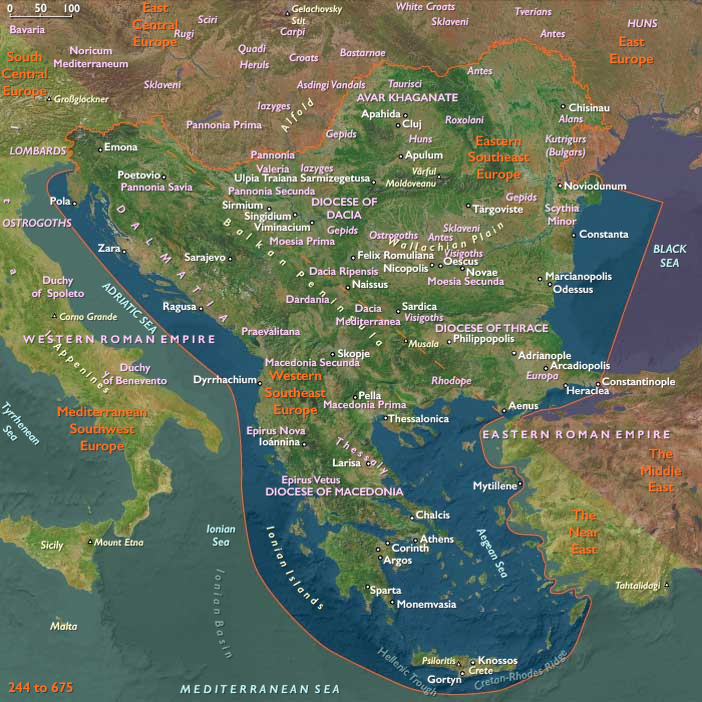
Settling his people in lower Moesia, Theoderic comes in conflict with Thracian Ostrogoths led by Theodoric Strabo, whom he eventually supplans, uniting the peoples in 484.
Byzantine Emperor Zeno subsequently gives him the title of Patrician and the office of Magister militum (master of the soldiers), and even appoints him as Roman Consul.
Seeking further gains, Theoderic frequently ravages the provinces of the Eastern Roman Empire, eventually threatening Constantinople itself.
In 488, Emperor Zeno orders Theoderic to overthrow the German Foederatus Odoacer, who had likewise been made patrician and even King of Italy, but who had since betrayed Zeno, supporting the rebellious Leontius.
After a victorious three-year war, Theoderic kills Odoacer with his own hands, settles his 100,000 to 200,000 people in Italy, and founds an Ostrogothic Kingdom based in Ravenna.
He promotes separation between the Arian Ostrogoths and the Roman population; intermarriage is outlawed.
Seeking to restore the glory of Ancient Rome, he rules Italy in its most peaceful and prosperous period since Valentinian, until his death in 526.
Memories of his reign make him a hero of German legend as Dietrich von Bern.

Related Events
Filter results
Showing 10 events out of 87 total
East Central Europe (388–531 CE): Hunnic Empire, Germanic Kingdoms, Sarmatian Legacy, and Early Slavic Expansion
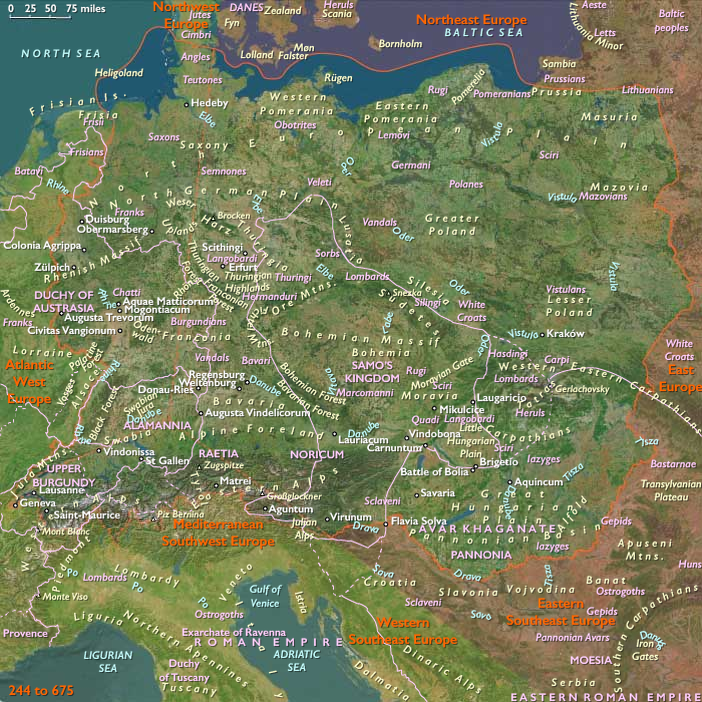
Between 388 and 531 CE, East Central Europe—including modern-day Poland, Czechia, Slovakia, Hungary, and those parts of Germany and Austria east of 10°E and north of the boundary line stretching southeastward from approximately 48.2°N, 10°E to the Austro-Slovenian border near 46.7°N, 15.4°E—underwent significant transformations driven by the powerful Hunnic invasions, extensive Germanic migrations, the collapse of Roman provincial administration, and the continuing influence of Sarmatian populations. These dynamics fundamentally reshaped regional demographics, political alliances, economic patterns, and cultural landscapes, laying foundations for early medieval Europe.
Political and Military Developments
Arrival and Dominance of the Huns
From the late 380s, the Huns, nomadic warriors originally from Central Asia, rapidly dominated East Central Europe. Motivated by environmental pressures, demographic growth, and the pursuit of tribute and conquest, the Huns under Rua, Bleda, and particularly Attila (r. 434–453) established a powerful empire centered on the Carpathian Basin (modern Hungary). Their expansion displaced numerous tribes, destabilized Roman frontier provinces, and profoundly altered regional geopolitics.
Collapse of Roman Provincial Structures
Roman provincial governance, previously divided into Pannonia Prima, Secunda, Savia, and Valeria, crumbled under sustained Hunnic and Germanic pressures. Provinces such as Pannonia Savia and Secunda ceased to exist by the late 5th century, with Roman control of Pannonia Valeria finally dissolving in 496 CE, symbolizing Rome's definitive withdrawal from the region.
Germanic Kingdoms: Ostrogoths, Gepids, Lombards, Thuringians, and Rugii
Following Attila’s death in 453 CE, Germanic tribes filled the ensuing power vacuum, establishing influential kingdoms:
-
Ostrogoths: Initially displaced by Huns, migrated through the region under Theodoric the Great (r. 493–526), ultimately moving into Italy by 488 CE at the invitation of the Eastern Roman Empire, attracted by opportunities for stable governance.
-
Gepids: Originating from Gothic confederations and displaced by Huns, established a strong kingdom in eastern Hungary, Slovakia, and Transylvania after Attila's fall, seizing strategic opportunities in the Carpathian Basin.
-
Lombards (Langobardi): Migrating from northern Germany due to environmental stress and tribal conflicts, controlled areas of modern Austria, western Hungary, Czechia, and later northern Italy.
-
Thuringians: Consolidated power in eastern Germany, forming a stable kingdom and fostering regional stability.
-
Rugii: Originally from the Baltic (Pomerania), migrated southward to escape other migrating tribes and Hunnic pressures, settling around the upper Tisza. They maintained relative autonomy until conflicts around 500 CE with the Ostrogoths and Odoacer led to their collapse.
Sarmatian Continuity and Influence: Iazyges and Alans
Throughout this era, the region experienced continued Sarmatian influence, primarily from the Iazyges and Alans—Iranian-speaking nomadic peoples renowned for their cavalry tactics. Despite Hunnic pressure, significant populations of Sarmatians remained in the plains of modern-day Hungary and adjacent areas, exerting sustained military, political, and cultural influence. Their elite cavalry skills were widely adopted by successor Germanic kingdoms, leaving a lasting imprint on military traditions and noble cultures.
Migration Patterns of Vandals and Alans
Driven westward by Hunnic incursions, the Vandals, accompanied closely by Alans, migrated from regions around modern Poland and Czechia through Gaul and Iberia, eventually establishing a lasting kingdom in North Africa by 429 CE. These movements were emblematic of the broader disruptions and realignments triggered by the Hunnic invasions.
Early Slavic Expansion and Stability
Proto-Slavic and early Slavic populations, initially based in modern-day Poland, western Ukraine, and Czechia, gradually expanded into territories depopulated by earlier Germanic and Hunnic migrations. Demonstrating remarkable cultural stability, these communities laid durable foundations for future Slavic states, gradually shaping the region’s demographic identity.
Economic and Technological Developments
Economic Disruption and Adaptation
Hunnic invasions and Roman administrative collapse severely disrupted established economic networks, prompting decentralized economies focused on local agriculture, animal husbandry, and village-based trade. Subsequent Germanic kingdoms gradually restored economic stability, revitalizing trade along reestablished regional routes.
Technological Resilience
Despite upheaval, ironworking, agricultural technologies, and traditional crafts persisted, blending Roman techniques with Germanic, Slavic, and Sarmatian influences, maintaining productivity and technological continuity amid political turbulence.
Cultural and Artistic Developments
Cultural Hybridization
Extensive interactions among diverse groups—including the Huns, Germanic tribes, Sarmatian Iazyges and Alans, Romans, and early Slavic populations—resulted in rich cultural exchanges and hybridization, evident in artistic motifs, burial customs, pottery styles, and linguistic exchanges.
Germanic and Hunnic Artistic Contributions
Germanic kingdoms and Hunnic artisans produced sophisticated jewelry, metalwork, and weaponry, blending steppe-nomadic, Roman, and traditional Germanic artistic styles, contributing significantly to the region’s material culture.
Sarmatian Artistic Legacy
The continuing Sarmatian presence was strongly reflected in sophisticated metalwork adorned with animal motifs, intricate harness fittings, and rich burial assemblages. Sarmatian cultural and artistic traditions thus influenced the visual and material culture of the broader region, enduring as symbols of noble status and equestrian prowess.
Settlement and Urban Development
Decline of Roman Urban Centers
Roman settlements and military fortifications such as Carnuntum, Vindobona (Vienna), and Aquincum (Budapest)declined significantly, becoming smaller fortified outposts or rural settlements controlled by Germanic and other tribal groups.
Continued Importance of Augusta Vindelicorum (Augsburg)
The city of Augusta Vindelicorum (Augsburg), initially established as a Roman provincial capital, retained regional significance and economic vitality, sustaining continuous settlement and cultural continuity despite regional transformations.
Emergence of Germanic and Slavic Rural Settlements
Germanic and early Slavic populations increasingly favored dispersed agricultural village communities with communal social structures, reshaping settlement patterns into predominantly rural landscapes.
Social and Religious Developments
Tribal Social Hierarchies and Leadership
Germanic kingdoms maintained strong hierarchical structures, centered around warrior aristocracies and kinship-based alliances. The nomadic Hunnic and Sarmatian aristocracies likewise significantly influenced social structures, particularly through equestrian traditions and military prowess.
Religious Continuity and Syncretism
Local Germanic, Slavic, and Sarmatian populations largely retained traditional religious practices—including ancestral worship, nature-based rituals, and communal ceremonies—while Christianity persisted within urban remnants and certain Germanic communities, creating a diverse religious landscape.
Long-Term Consequences and Historical Significance
The period from 388 to 531 CE profoundly reshaped East Central Europe's historical trajectory. Driven by the migrations and conquests of the Huns, Vandals, Ostrogoths, Gepids, Lombards, Rugii, and influential Sarmatian tribes, the political and cultural landscape underwent transformative realignments. The enduring Sarmatian legacy influenced regional military practices, noble identities, and cultural symbolism, especially later adopted by medieval Polish nobility. Economic decentralization, technological resilience, cultural hybridization, and the foundations laid by expanding Slavic populations established essential precursors for the development of medieval kingdoms and societies, decisively shaping the region's subsequent history.
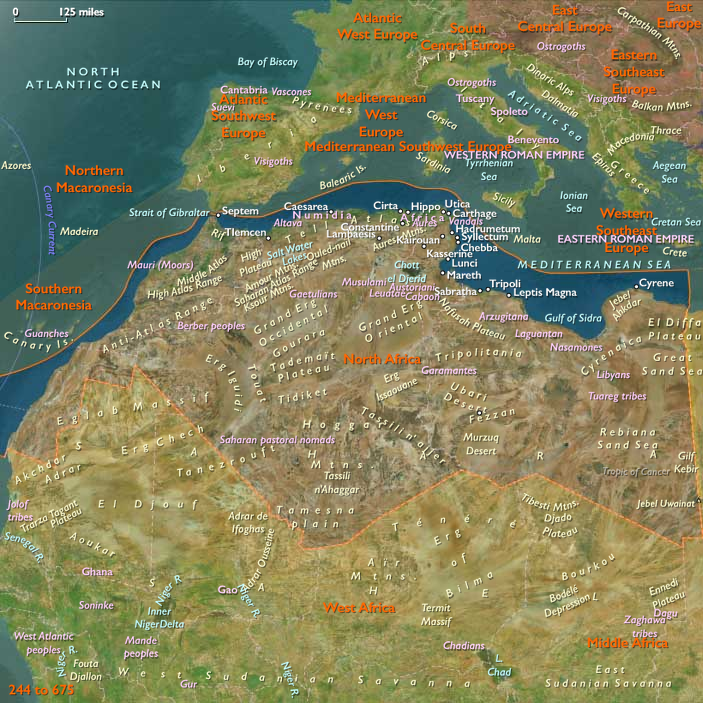
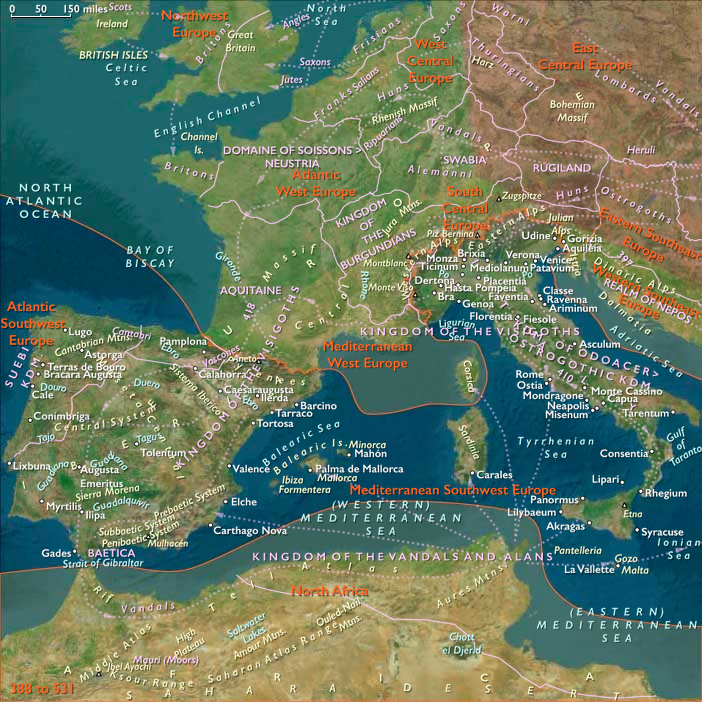
Mediterranean Southwest Europe (388–531 CE): Imperial Decline, Barbarian Ascendancy, and Cultural Transformation
The age 388–531 CE in Mediterranean Southwest Europe encompasses profound shifts, including the final decline of Western Roman imperial authority, the rise of Germanic kingdoms, and significant religious and cultural transformations. These events deeply influence the historical trajectory of the region, laying the foundations of medieval Europe.
Division and Decline of the Roman Empire (388–411 CE)
In 395 CE, the Roman Empire definitively splits into Western and Eastern halves, marking a turning point. The Western Empire, weakened by internal strife and external invasions, progressively dissolves. Emperor Honorius (r. 395–423 CE) struggles against invasions, commissioning his sister, Galla Placidia, and her husband, the Visigothic king Ataulf, to stabilize Iberia. Their efforts partially restore order, with the Visigoths settling permanently in Spain, subduing the Suevi, and pushing the Vandals into North Africa.
Visigothic Kingdom and Ecclesiastical Authority (412–447 CE)
The Visigoths, highly Romanized, establish their capital at Toledo by 484 CE, governing in the emperor's name as imperial patricians. Despite their relatively small numbers—approximately 300,000 among four million Hispano-Romans—their elite status significantly shapes regional politics.
Ecclesiastical institutions, especially the Council of Bishops, emerge as stabilizing forces amid declining civil governance. Bishops, possessing both civil and religious authority, effectively maintain order, reinforcing Christianity’s growing influence as a social and political force.
Ostrogothic Ascendancy and Cultural Flourishing (448–459 CE)
In Italy, Ostrogothic king Theodoric the Great emerges as a dominant figure, leading his Goths against Odoacer in 489 CE and establishing the Ostrogothic Kingdom by 493 CE. Theodoric's rule blends Roman administrative practices with Gothic leadership, ushering in stability and cultural revival, exemplified by artistic masterpieces like the mosaics in Ravenna’s mausoleum of Galla Placidia.
Late Imperial Decline, Visigothic Expansion, and Vandal Incursions (460–471 CE)
Between 456 and 460 CE, Vandals under Genseric briefly occupy coastal cities in Corsica and Sardinia, an occupation formalized by Emperor Majorian. Roman authority, weakened under emperors Majorian and Anthemius, struggles to maintain territorial integrity, but General Marcellinus, possibly supported by Pope Hilarius, regains control of these territories by 466 CE.
Simultaneously, Visigoths under King Euric consolidate power in southern Gaul and Iberia, gradually dismantling Roman administrative structures and paving the way toward medieval feudalism. Amid political upheaval, Christianity remains a powerful stabilizing and cultural force.
The Fall of Western Rome and Renewed Vandal Expansion (472–483 CE)
In 476 CE, the Western Roman Empire formally collapses with the deposition of Emperor Romulus Augustulus by the Germanic chieftain Odoacer. Concurrently, Visigothic King Euric expands his dominion, firmly establishing the Visigothic Kingdom across southern Gaul and Iberia.
Between 474 and 482 CE, Sardinia again falls under Vandal rule, possibly led by Huneric. Their control secures maritime trade routes between North Africa and the Mediterranean. Sardinian cities, notably Olbia, suffer destructive raids, reflecting the island’s strategic importance.
Theodoric’s Conquest, Ostrogothic Kingdom, and Vandal Administration (484–495 CE)
From 489 CE, Theodoric leads the Ostrogoths into Italy, defeating Odoacer by 493 CE and establishing the Ostrogothic Kingdom centered at Ravenna. Concurrently, Vandals maintain a structured administrative system in Sardinia, overseen by a praeses from Caralis, supported by procurators and tax officials. The territory is divided among crown lands and Vandal warriors, though local Sardinian-Roman landowners retain estates through payments, and Barbagia maintains semi-autonomous status.
Visigothic Consolidation and Frankish Rivalry (496–507 CE)
Under Alaric II, the Visigoths enact the Breviary of Alaric (506 CE), codifying Roman law for their subjects. However, rising tensions with the Franks culminate in Alaric’s defeat and death at the Battle of Vouillé (507 CE), forcing Visigoths into a defensive position within Iberia.
Stabilization and Reorganization (508–531 CE)
After Vouillé, the Visigothic Kingdom under Amalaric stabilizes, solidifying power in Iberia. In Italy, Theodoric’s Ostrogothic Kingdom experiences continued stability, economic prosperity, and cultural vitality, reflected in architectural achievements like the Basilica of Sant’Apollinare Nuovo and Theodoric’s Mausoleum.
Cultural and Economic Continuity
Despite fragmentation, local economies adapt successfully, with robust agricultural production and active regional trade. Christianity shapes cultural norms, education, and artistic expression, preserving Roman traditions within evolving medieval contexts.
Germanic Influence and Legacy
The Suevi maintain a modest kingdom in northwestern Iberia, while the Vandals, despite limited numbers, imprint their legacy on southern Spain (Andalusia) and Sardinia, influencing regional names and historical memory.
Legacy of the Age
The era 388–531 CE signifies a critical transformation from classical Roman civilization to early medieval Europe. Visigothic and Ostrogothic kingdoms, empowered ecclesiastical structures, and cultural adaptations profoundly shape the region’s future identity. This period's enduring legacies include Roman-derived legal systems, ecclesiastical dominance, linguistic shifts (Romance languages), and foundational medieval political structures.
Emperor Leo signs a peace treaty with the Ostrogoths; King Theodemir, in compliance with the terms, sends his five-year-old son Theodoric as a child hostage to Constantinople.
East Central Europe (460–471 CE): Post-Hunnic Realignments, Ostrogothic and Gepid Dominance, and Tribal Adaptations
Between 460 and 471 CE, East Central Europe—including Poland, Czechia, Slovakia, Hungary, and those portions of Germany and Austria lying east of 10°E and north of a line stretching from roughly 48.2°N at 10°E southeastward to the Austro-Slovenian border near 46.7°N, 15.4°E—experienced a dynamic period of tribal realignment and regional restructuring following the collapse of the Hunnic Empire. The vacuum of power created after Attila’s death allowed prominent Germanic tribes, especially the Ostrogoths under leaders like Theodemir, and the Gepids under King Ardaric, to assert dominance, profoundly reshaping regional politics. Roman provincial administration in territories such as Pannonia Savia and Pannonia Secunda dissolved entirely, marking a definitive end to coherent Roman control in these areas. Amid these shifting conditions, the Rugii retained diplomatic autonomy along the upper Tisza, while the proto-Slavic communities continued their steady adaptation and cultural resilience.
Political and Military Developments
Ostrogothic and Gepid Ascendancy
-
Following the collapse of the Hunnic Empire, regional power coalesced around two primary Germanic tribal groups: the Ostrogoths (under chieftains including Theodemir and his son, Theodoric the Great) and the Gepids, led by King Ardaric, who established significant control over much of modern Hungary and surrounding territories.
-
These tribes became dominant political forces, reshaping the balance of power across former Roman frontier provinces and initiating new alliances and rivalries.
Final Dissolution of Roman Provincial Administration
-
By this period, Roman administrative structures along the Danube frontier, particularly in the provinces of Pannonia Savia and Pannonia Secunda, had completely collapsed. Former provincial territories came definitively under the control of Germanic tribes, notably the Gepids and Ostrogoths, fundamentally altering the region's governance.
Rugian Diplomatic Stability
-
The Rugii skillfully maintained diplomatic neutrality and autonomy along the upper Tisza, securing their position by carefully managing relations with Ostrogothic, Gepid, and residual Roman factions.
Economic and Technological Developments
Localized Economic Networks
-
Economic life further decentralized, with local communities relying increasingly on agriculture, livestock raising, and localized trade. Ostrogothic and Gepid dominance brought stability to certain regional markets, enabling gradual economic recovery in areas of sustained tribal control.
Diminished Infrastructure Maintenance
-
Roman-era infrastructure continued its steady decline, although existing fortified settlements and roads remained functional, minimally maintained by new tribal authorities to support governance and security needs.
Cultural and Artistic Developments
New Cultural Blending under Ostrogothic and Gepid Influence
-
Material culture, including jewelry, pottery, and metalwork, began reflecting Ostrogothic and Gepid cultural identities. Artistic styles demonstrated a distinctive fusion, combining previous Hunnic influences with renewed Germanic traditions and residual Roman aesthetics.
Proto-Slavic Cultural Stability
-
Proto-Slavic populations sustained traditional social practices and cultural traditions, cautiously incorporating external influences without losing core elements of their communal identities.
Settlement and Urban Development
Partial Stabilization and Revival of Settlements
-
Former Roman settlements such as Carnuntum, Vindobona, and Aquincum persisted as diminished yet functional military and administrative outposts, now under Ostrogothic and Gepid influence, providing limited regional stability.
Continued Importance of Augusta Vindelicorum (Augsburg)
-
Augusta Vindelicorum (modern Augsburg), originally the Roman-founded capital of the Celtic Vindelici in southwestern Bavaria, remained a strategically significant settlement. Its location on key communication and trade routes connecting former Roman provinces like Raetia and Noricum to the broader East Central European region sustained its importance during this transitional era.
Rugian Communities as Regional Anchors
-
Rugian settlements along the upper Tisza continued thriving, becoming dependable centers of local economic and political stability through their careful diplomatic policies.
Social and Religious Developments
Ostrogothic and Gepid Tribal Structures
-
Ostrogothic and Gepid leadership solidified hierarchical structures built around powerful warrior elites. These tribes reasserted traditional Germanic practices and rituals, strengthening internal cohesion and legitimacy.
Rugian Diplomatic Adaptation
-
Rugian leadership maintained stability by skillfully negotiating alliances and neutrality with powerful neighbors, preserving their autonomy and cultural traditions.
Proto-Slavic Social Cohesion
-
Proto-Slavic communities retained cohesive social hierarchies, community structures, and traditional religious practices, enabling cultural resilience amid ongoing geopolitical shifts.
Long-Term Consequences and Historical Significance
The era 460–471 CE marked a critical transitional phase in East Central Europe’s historical trajectory. The collapse of Hunnic authority facilitated the rise of powerful tribes like the Ostrogoths and Gepids, who decisively reshaped regional politics and culture. The complete dissolution of Roman provincial governance in Pannonia Savia and Pannonia Secunda underscored the finality of Rome's retreat from the region. At the same time, urban centers such as Augusta Vindelicorum maintained regional importance through strategic trade and connectivity. The diplomatic adaptability of groups like the Rugii and the resilience of proto-Slavic communities provided essential stability and continuity. These transformations laid important foundations for subsequent political and cultural developments, significantly influencing the region’s transition from late antiquity toward early medieval Europe.
Atlantic Southwest Europe (460–471 CE): Visigothic Dominance, Suebic Decline, and Regional Realignment
Between 460 and 471 CE, Atlantic Southwest Europe—covering northern and central Portugal, Galicia, Asturias, Cantabria, and northern Spain south of the Franco-Spanish border (43.05548° N, 1.22924° W)—underwent significant political realignment as Visigothic power displaced Suebic dominance. The defeat and weakening of the Suebic kingdom following the decisive intervention of the Visigothic king Theodoric II in 456 CE dramatically altered regional dynamics. Despite political turbulence, local economic resilience, the deepening institutional strength of Christianity, and enduring regional identities allowed Atlantic Southwest Europe to successfully adapt to these substantial shifts.
Political and Military Developments
Visigothic Ascendancy and Suebic Fragmentation
-
The Suebic kingdom entered a rapid decline following King Rechiar’s defeat by the Visigothic king Theodoric II in 456 CE at the Battle of Órbigo, near Astorga. After this decisive battle, the Suebi lost significant territories, retreating primarily to their original base in Gallaecia and northern Portugal, and fragmenting politically into smaller, competing factions.
-
Between 460 and 471 CE, the Visigoths extended their influence significantly into Atlantic Southwest Europe, exerting overlordship over Lusitania and parts of central Hispania, though direct Visigothic administrative control remained limited. Instead, their regional presence was characterized by alliances and client relationships with local elites and Romanized urban centers.
Local Autonomy and Regional Resilience
-
Amid these larger shifts, local elites, influential bishops, and tribal chiefs increasingly assumed direct governance responsibilities. In regions less directly impacted by Visigothic influence—such as Asturias, Cantabria, and Vasconia—autonomous structures persisted with little interference.
-
The Vascones, in particular, continued successfully preserving their independence, internal stability, and diplomatic neutrality, maintaining a distinct regional identity largely unaffected by Visigothic or Suebic conflicts.
Economic and Technological Developments
Continued Economic Stability Amid Political Transition
-
Despite political disruptions, the regional economy displayed resilience and adaptability. Economic activity continued in mining sectors (particularly gold and silver from Galicia and Asturias), agriculture (grain, olives, vineyards), livestock farming, pottery, textiles, and local metalwork.
-
Coastal settlements, notably Olissipo (Lisbon) and Bracara Augusta (Braga), maintained modest trade networks with Mediterranean, Gallic, and North African markets, though commerce continued shifting toward increasingly localized, regional exchanges.
Fortified Villas and Proto-Feudal Economics
-
The economic landscape remained dominated by fortified rural estates, which served as autonomous centers of agricultural production, local governance, and defense. Managed by local elites or ecclesiastical leaders, these estates clearly prefigured medieval feudal arrangements.
-
Urban centers such as Emerita Augusta, Bracara Augusta, and Asturica Augusta persisted as administrative and religious hubs, albeit with diminished populations and less extensive economic influence than in earlier periods.
Cultural and Religious Developments
Deepening Institutional Christianity
-
Around 466 CE, King Remismund unified the fractured Suebic Kingdom, significantly strengthening diplomatic ties with the Visigothic kingdom. A Visigothic cleric named Ajax, sent by Visigothic king Theodoric II, successfully converted the predominantly pagan Suebi to Arian Christianity, establishing lasting Arian ecclesiastical structures. This conversion marked a major religious shift and deepened the region's diplomatic and cultural integration with the Visigoths.
-
Christianity continued its decisive institutional expansion and influence throughout the region. Bishoprics, notably at Braga, Emerita Augusta, and Asturica Augusta, further consolidated their roles as key spiritual, civic, and administrative institutions, mediating between local populations and shifting political authorities.
-
The prominence of monastic communities expanded, providing social services, education, and cultural preservation. This monastic influence increasingly shaped the region's social and cultural character, embedding Christianity deeply into daily life.
Syncretism and Germanic Integration
-
The weakened Suebi, many of whom increasingly embraced Christianity in the latter half of the 5th century, became progressively integrated into broader Romanized Iberian society. This cultural integration, facilitated by religious conversion, reinforced the distinctive regional identity marked by Iberian, Celtic, Roman, and Germanic traditions.
-
Rural and tribal populations continued practicing distinctive local forms of Christianity mixed with older pagan rituals, particularly evident in Galicia, Asturias, and northern Portugal, solidifying the region’s enduring syncretic traditions.
Civic Identity and Local Governance
-
Civic identity continued evolving toward strongly localized affiliations and community-based governance structures. The weakening of centralized authority and the rise of Visigothic power encouraged communities to rely heavily on local leaders, bishops, and tribal alliances, deepening regional identities and administrative autonomy.
Notable Tribal Groups and Settlements
-
Suebi: Significantly weakened by Visigothic intervention, fragmented into smaller political units in Galicia and northern Portugal but maintained some degree of localized influence.
-
Lusitanians, Vettones, Vaccaei: Effectively managed political transitions by maintaining autonomy through strategic alliances with Visigothic rulers or strengthened local governance.
-
Gallaeci, Astures, Cantabri: Continued resilient indigenous traditions and local governance, pragmatically adapting to political shifts and the decline of Suebic power.
-
Vascones: Successfully preserved their autonomy, neutrality, and cultural distinctiveness, unaffected directly by Visigothic expansion or Suebic decline.
Long-Term Significance and Legacy
Between 460 and 471 CE, Atlantic Southwest Europe:
-
Experienced a critical shift from Suebic to Visigothic dominance, marking a significant step toward the broader integration of Iberia into the Visigothic kingdom.
-
Demonstrated robust economic resilience and adaptability, laying foundations for medieval feudal economies rooted in localized agricultural estates.
-
Solidified Christianity’s dominant social and cultural role, creating institutional structures essential to medieval regional identities and governance.
This period significantly advanced the region’s transformation from a fragmented late Roman society to one defined by Germanic political authority, strong local governance, and deeply embedded Christian institutions—core elements of its enduring medieval character.
Theodomir had two "brothers"—actually, brothers-in-law—named Valamir and Videmir, with whom he had ruled jointly as a vassal of the late Attila the Hun.
Theodemir is Arian, while his wife Erelieva is Catholic and had taken the Roman Christian name Eusabic upon her baptism.
Erelieva has borne him two children: Theoderic (454–526) and Amalafrida.
Theodomir takes over the three Pannonian Goth reigns after the death of Videmir in 470, having earlier inherited the heirless Valamir's part of the kingdom on the latter’s death in 465.
East Central Europe (472–483 CE): Theodoric the Great, Ostrogothic Consolidation, and Regional Stability
Between 472 and 483 CE, East Central Europe—including Poland, Czechia, Slovakia, Hungary, and those portions of Germany and Austria lying east of 10°E and north of a line stretching from roughly 48.2°N at 10°E southeastward to the Austro-Slovenian border near 46.7°N, 15.4°E—experienced the consolidation of Ostrogothic and Gepid power. This era was particularly marked by the rise and expanding influence of Theodoric the Great, who increasingly dominated Ostrogothic politics and asserted authority over broad territories formerly controlled by Rome and the Huns. Amid these developments, the Rugii retained their independence through skillful diplomacy, while proto-Slavic communities continued their enduring cultural resilience and steady adaptation.
Political and Military Developments
Rise of Theodoric the Great
-
Theodoric the Great emerged prominently during this period as the leading figure of the Ostrogoths following the death of his father, Theodemir (474 CE). His strong leadership swiftly strengthened Ostrogothic authority, notably in territories corresponding to modern-day Austria, eastern Germany, Czechia, and western Hungary.
-
Theodoric secured dominance by successfully negotiating alliances, confronting rival groups, and initiating military actions, thus significantly stabilizing Ostrogothic influence across the region.
Gepid Territorial Consolidation
-
Concurrently, the Gepids under their king continued to solidify their presence in the eastern parts of former Roman Pannonia, extending their control over central Hungary and adjacent territories, frequently interacting diplomatically and militarily with the Ostrogoths and Rugii.
Rugian Diplomatic Neutrality
-
The Rugii maintained their stable autonomy along the upper Tisza, carefully balancing diplomatic relationships with Theodoric’s Ostrogoths, the Gepids, and surrounding tribal factions, thereby ensuring their continued independence and regional significance.
Economic and Technological Developments
Stabilization of Localized Economies
-
Ostrogothic and Gepid dominance contributed to a measure of regional economic stability, allowing limited revival of trade networks, particularly along strategic routes connecting settlements such as Augusta Vindelicorum (Augsburg) and former Roman provincial centers.
-
Local economies remained primarily agricultural and pastoral but benefited from increased security and trade facilitated by stable tribal governance.
Infrastructure Adaptation
-
Although large-scale infrastructure improvements ceased, existing roads and fortifications were maintained to support regional governance and security, reflecting stable Ostrogothic and Gepid control.
Cultural and Artistic Developments
Ostrogothic and Gepid Cultural Expression
-
The period saw further refinement of Ostrogothic and Gepid material culture, with distinctive artistic styles emerging clearly in jewelry, weaponry, and decorative metalwork, blending Germanic traditions, residual Roman influences, and elements inherited from Hunnic styles.
Proto-Slavic Cultural Stability
-
Proto-Slavic populations maintained traditional customs and community cohesion, demonstrating cultural resilience and cautious integration of external influences within a context of regional stability under dominant Ostrogothic and Gepid influence.
Settlement and Urban Development
Strengthened Importance of Regional Urban Centers
-
Settlements such as Augusta Vindelicorum (Augsburg) continued as significant regional hubs, benefiting from increased political stability and revived regional trade.
-
Former Roman towns (Carnuntum, Vindobona, Aquincum) maintained their strategic significance, albeit in reduced forms, serving as military and administrative outposts for the ruling tribes.
Rugian Settlements as Anchors of Stability
-
Rugian communities along the upper Tisza continued thriving economically and politically, reinforcing their role as stable centers amidst broader regional realignments.
Social and Religious Developments
Ostrogothic and Gepid Leadership Structures
-
Tribal structures among Ostrogoths and Gepids further solidified around powerful warrior elites, emphasizing traditional Germanic cultural practices and reinforcing internal unity.
Rugian Diplomatic Adaptation
-
Rugian leaders continued their skilled diplomacy, adeptly managing alliances and neutrality with dominant regional powers, ensuring autonomy and preserving traditional cultural identities.
Proto-Slavic Social Cohesion
-
Proto-Slavic communities maintained their internal social structures, traditional religious practices, and communal resilience, facilitating continuity in cultural and social traditions despite ongoing geopolitical changes.
Long-Term Consequences and Historical Significance
The era 472–483 CE represented a key transitional phase in East Central Europe, characterized by the decisive consolidation of Ostrogothic power under Theodoric the Great and strengthened Gepid territorial control. The continued stability of Rugian autonomy, alongside the cultural resilience of proto-Slavic communities, provided a framework of enduring local continuity. These developments significantly shaped subsequent regional dynamics, laying essential foundations for the transition from late antiquity into the medieval societies that would define East Central Europe’s historical trajectory.
Theodoric called Strabo, son of Triarius, is a chieftain of the Thracian Goths; he has two brothers.
The wife of the Alan general Aspar is his sister.
Strabo has a wife, Sigilda, and a son called Recitach.
He is a contemporary of the more famous Theodoric the Amal, a Moesian Goth of the royal Amal family, who will become known as Theodoric the Great.
Around 459, he is attested as in friendly relationship with the Empire, possibly one of the foederati, and receiving an annual subsidy from Constantinople.
The Alan commander Aspar, at the time magister militum of Emperor Leo I, had been murdered in 471 by order of the emperor himself.
Strabo, who was at the command of his people in Thrace, had revolted to avenge his relative, but had been defeated by the Roman generals Zeno and Basiliscus (both will later become emperors).
However, Strabo had been able to set three conditions to end his unrest: receiving the properties left as legacy by Aspar, being allowed to settle his Goths in Thrace, and being raised to the rank of magister militum.
Since Leo has rejected the requests, offering the rank of magister militum only in exchange of an oath of loyalty, Strabo starts a military campaign against the cities of Thrace.
Part of the Gothic army attacks Philippi (or Philippopolis), while …
…Theodoric Strabo leads the remaining men to attack and occupy Arcadiopolis.
Theodoric signs a peace with Leo in 473 when the Goths run out of supplies; according to its terms, Constantinople is to pay an annual tribute of two thousand pounds of gold to the Goths, whose independence is recognized, and Strabo is to obtain the rank of magister militum.