Theodoros I Laskaris
Emperor of Nicaea (Emperor of the Eastern Roman [Byzantine] Empire in exile)
Years: 1174 - 1222
Theodoros I Komnenos Laskaris (c. 1174/1175–1221/August, 1222) is Emperor of Nicaea (1204–1221 or 1205–1222).
Related Events
Filter results
Showing 10 events out of 34 total
The origins of Alexios Palaiologos are obscure.
His family is wealthy and mostly known as civil and military officials under the Komnenian emperors.
Alexios's father was probably the sebastos and megas hetaireiarches George Palaiologos, the son or grandson of Alexios I Komnenos's staunchest supporter George Palaiologos.
Through his grandmother, Alexios shares in the blood of the Komnenian house.
In circa 1198, Alexios had been chosen by Emperor Alexios III, who was without male offspring, to wed his eldest daughter, Irene.
She was a widow of Andronikos Kontostephanos, and Alexios Palaiologos was forced to divorce his own beautiful first wife (whose name is unknown) to marry her.
The wedding, accompanied by lavish celebrations, had taken place in spring 1199.
Alexios had thus become the imperial heir apparent, and is elevated to the rank of despot.
At the same time, the emperor's second daughter Anna, also a widow, had been wed to Theodore Laskaris, the future founder of the Empire of Nicaea.
Shortly afterwards, both imperial sons-in-law are sent alongside general Manuel Kamytzes against the rebel Ivanko in Thrace.
During this campaign, in the siege of Kritzimos, Alexios's father George is killed.
The campaign fails when the imperial force is trapped in an ambush and Kamytzes is captured.
This success emboldens Ivanko, who now claims the imperial title.
In spring 1200, Alexios III pretends to be willing to begin negotiations, and sends Alexios Palaiologos to meet the rebel.
Alexios gives solemn promises of safety, but when Ivanko appears in the imperial camp, he is arrested and executed.
In February of the same year, Alexios had been called upon to help with the riots that broke out in Constantinople in protest against the embezzlement of charitable donations by the prison warden John Lagos.
A large mob had taken control of the capital's prisons and opened them, and battled the guards of the emperor, who was away at Chrysopolis.
Alexios Palaiologos had led troops into the city and suppressed the revolt after inflicting heavy casualties on the populace.
Alexios Palaiologos is instrumental in the suppression of the attempted coup by John Komnenos the Fat in July 1201.
After the rebels had seized control of most of the Great Palace, Alexios is sent by the emperor with troops and boats from the Blachernae to the eastern shore of the city.
Here they meet up with the Great Palace's guard, and clear the palace and the Hippodrome of the supporters of the usurper, who is caught and beheaded.
Alexios Mourtzouphlos is likely put in prison for his role in this affair (he is known to have been in prison in 1203), and the two Komnenos brothers, Alexios and David, seem to have fled the capital immediately after the coup's failure.
Alexios is injured in February 1201 or 1202 when the imperial tent collapses during an earthquake, but in the same summer he leads the campaign that subdues the rebellion of governor John Spyridonakes in eastern Macedonia, forcing the latter to flee to Bulgaria.
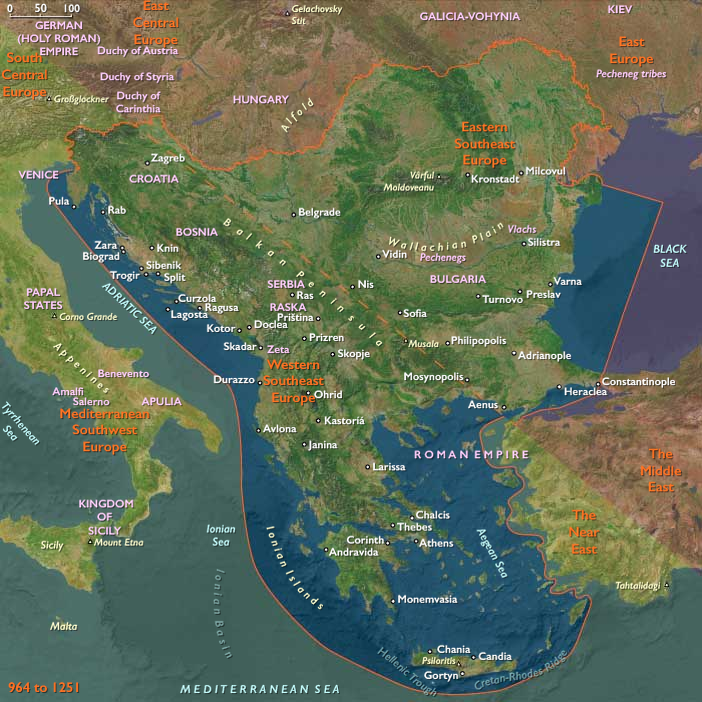
The Latin crusaders consolidate their new empire of Constantinople, which they call Romania, while Theodore Lascaris consolidates the remnants of Greek imperial power and erects a new empire centered upon Nicaea in Asia Minor, with Ionian and Balkan holdings.
Pope Innocent III, a primary organizer of the Venetian-backed Fourth Crusade—composed largely of Frenchmen, Venetians, and other Italians, collectively called Franks or Latins—has been unable to prevent its diversion, by the Venetians, to capture Constantinople.
Constantinople’s new coemperors, Isaac II Angelos and his son Alexios IV are unable to pay their debts to the West or to unite the two churches.
They have inspired little confidence among the people of Constantinople in their efforts to defend the city from the Latins and Venetians, who are restless and riot when the money and aid promised by Alexios IV is not forthcoming.
The courtier Alexios Doukas Mourtzouphlos, related to the imperial Doukas family, emerges as a leader of the anti-Latin movement and personally leads some skirmishes against the crusaders.
Heavy taxation, as well as wanton behavior on the part of the crusaders in Constantinople, causes a national revolt at the end of January 1204, when the populace of Constantinople rebels and tries to proclaim a rival emperor in Hagia Sophia.
The emperors barricade themselves in the palace and entrust Doukas with a mission to seek help from the crusaders.
Instead, Doukas uses his access to the palace to arrest the emperors, imprisoning both Alexios IV and his father on the night of January 27-28, 1204.
Alexios V Doukas, crowned in early February 1204, has Alexios IV strangled on February 8.
Isaac II dies soon afterwards, his death variously attributed to fright, sorrow, or foul play.
Alexios V had begun after his coronation to strengthen the defenses of Constantinople and ended negotiations with the Latins, disavowing Alexios IV's debt to the crusaders.
It is too late, however, for the new Emperor to make much of a difference.
An attempted surprise attack against the crusader camp fails despite the emperor's personal leadership.
During the ensuing fight, he defends the city with courage and tenacity, beating back the crusader assault of April 9.
On April 12, 1204, a strong northern wind aids the Venetian ships to come close to the wall.
After a short battle, approximately seventy crusaders manage to enter the city.
Some Crusaders are eventually able to knock holes in the walls, small enough for a few knights at a time to crawl through; the Venetians are also successful at scaling the walls from the sea, though there is extremely bloody fighting with the Varangians, at this time composed of English and Danes.
The crusaders capture the Blachernae section of the city in the northwest and use it as a base to attack the rest of the city, but while attempting to defend themselves with a wall of fire, they end up burning down even more of the city, leaving fifteen thousand people homeless.
The crusaders' second attack proves too strong to repel, and Alexios V flees into Thrace on the night of April 12, 1204, accompanied by Eudokia Angelina and her mother Euphrosyne Doukaina Kamatera.
Constantinople is under Latin control by the next day, the great city having for the first time in its long history; it is subjected by the foot soldiers to pillage and massacre for three days.
During the horrible and savage sacking inflicted on Constantinople by the crusaders, many ancient and medieval Roman and Greek works are either stolen or destroyed.
The magnificent Library of Constantinople is destroyed.
Despite their oaths and the threat of excommunication, the Crusaders ruthlessly and systematically violate the city's holy sanctuaries, destroying, defiling, or stealing all they can lay hands on; nothing is spared.
It is said that the total amount looted from Constantinople was about nine hundred thousand silver marks.
The Venetians receive one hundred and fifty thousand silver marks that is their due, while the Crusaders receive fifty thousand silver marks.
A further one hundred thousand silver marks are divided evenly up between the Crusaders and Venetians.
The remaining half-million silver marks are secretly kept back by many Crusader knights.
Many priceless icons, relics, and other objects will later turn up in western Europe, a large number in Venice.
The huge tenth-century altarpiece later known as the Pala d'Oro, as well as magnificent reliquaries, book covers, and four bronze horses (later to grace the entrance of Saint Mark's Basilica), are among the rich booty taken to Venice from Constantinople.
The Venetians and crusaders themselves take over the city and the government of the empire.
It is decided that twelve electors—six Venetians and six crusaders—should choose an emperor who will have one-quarter of the imperial domain.
The other three-quarters are to be divided.
The clergy of the party not belonging to the emperor elect are to have Hagia Sophia and choose a patriarch.
A small amount of property is specifically designated to support the clergy.
The rest is to be considered booty and divided.
Constantine Laskaris, one of the city's leading defenders, had meanwhile been proclaimed emperor in the Cathedral of St. Sophia as Constantine XI; he and other refugees now flee to Bursa.
The crusaders and the Venetians proceed to implement their agreement when order is restored.
The imperial crown is at first offered to, and refused by, Enrico Dandolo, Doge of Venice.
The choice then lies between Baldwin IX, Count of Flanders (and, as Count of Hainaut, Baldwin VI) and the nominal leader of the crusade, Boniface of Montferrat.
While Boniface is considered by both the Crusaders and the citizens of Constantinople the most probable choice, due to his connections with the imperial court—his brother Conrad had married into the royal family—Baldwin, the most popular leader in the host, is young, gallant, pious, and virtuous, one of the few who interprets and observes his crusading vows strictly.
The Venetians want an emperor whom they could control more easily, and with their influence, Baldwin, elected emperor of the Latin Empire of Constantinople, called Romania, on May 9, is crowned on May 16 in the church of the Hagia Sophia.
Dandolo takes for himself and the doges of Venice the title “lord of the fourth part and a half of the whole empire of Romania.” The title corresponds exactly to that part of the territories of the Empire apportioned to the Venetians in the division of spoils among the crusaders.
Since he has been one of the most powerful leaders of the expedition, Dandolo remains in Constantinople to direct all the operations there and to look out for the interests of Venice.
The Venetian Thomas Morosini is chosen patriarch, but the lands parceled out among the leaders do not include all the former imperial possessions.
Constitutional restrictions hamper the new Latin emperor from the outset.
The Venetians enjoy self-government in Constantinople, as well as total control over the former imperial lands they have taken: Crete and the Aegean islands, Corfu, and other Ionian islands.
The emperor cannot act without the consent of the council of Frankish barons and Venetians.
The Latin Empire is organized on feudal principles; the emperor is feudal superior of the princes who receive portions of the conquered territory.
His own special portion consists of the city of Constantinople, the adjacent regions both on the European and the Asiatic side, along with some outlying districts, and several islands including Lemnos, Lesbos, Chios and Tenos.
The territories still have to be conquered; and first of all it is necessary to break the resistance of the Greeks in Thrace and secure Thessalonica, the second-largest imperial city after Constantinople.
In this enterprise in the summer of 1204, Baldwin comes into collision with Boniface of Montferrat, the rival candidate for the empire, who is to receive a large territory in Macedonia with the title of King of Thessalonica.
Boniface, having reluctantly accepted Baldwin’s installation as emperor, hopes to make himself quite independent of the empire, to do no homage for his kingdom, and he opposes Baldwin's proposal to march to Thessalonica.
The antagonism between Flemings and Lombards aggravates the quarrel.
Baldwin insists on going to Thessalonica; Boniface lays siege to Adrianople, where Baldwin has established a governor; civil war seems inevitable.
An agreement is effected by the efforts of Dandolo and the count of Blois.
Boniface wins this dispute by handing over his assigned territory on Crete to the Venetians and receives Thessalonica as a fief from the emperor, and is appointed commander of the forces which are to march to the conquest of Greece.
Baldwin's wife Marie, unaware of the events in Constantinople, had sailed to Acre, where she had learned of her husband's election as emperor, but dies in August 1204 before she can join him.
In October, Baldwin enfeoffs six hundred knights with lands formerly held by Greek nobles.