
The plate could not be loaded.
North Polynesia Collapse Brief Hawaiian Volcanoes, Lowstand Shores, and Seabird Islands Brief ‹ Polynesia Hawaiian Volcanoes, Lowstand Shores, and Seabird Islands Explore events
Late Pleistocene I
Hawaiian Volcanoes, Lowstand Shores, and Seabird Islands
North Polynesia · Polynesia · Northern Oceania
Read the brief
Geographic and Environmental Context
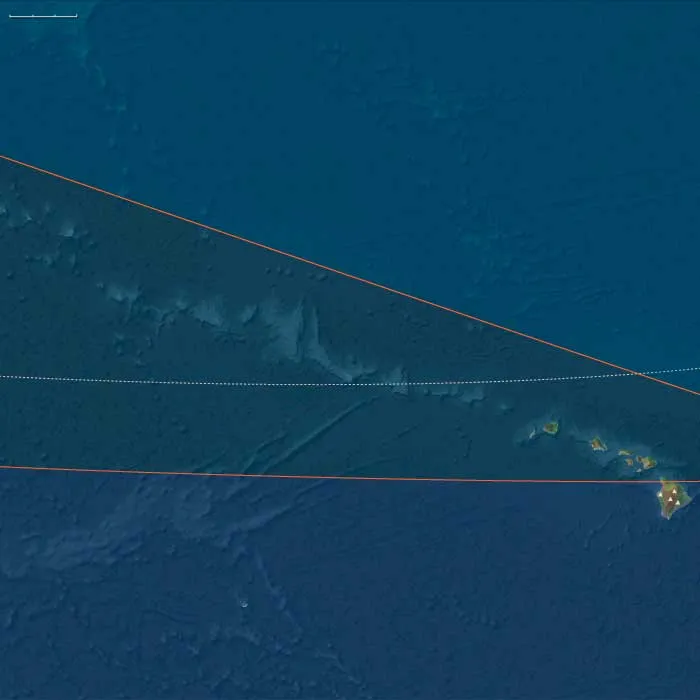
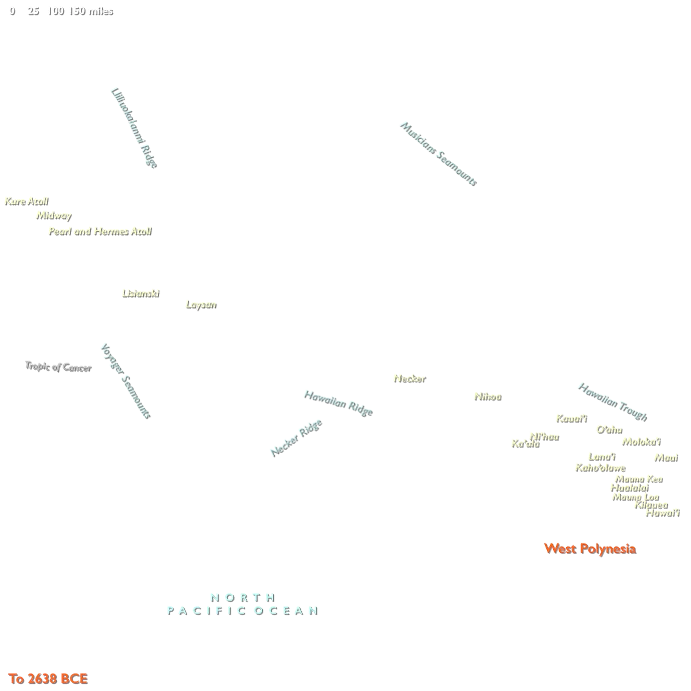
North Polynesia includes the Hawaiian chain except Hawaiʻi Island, principally Oʻahu, Maui, Kauaʻi, Molokaʻi, Lānaʻi, and Niʻihau, together with Midway Atoll.
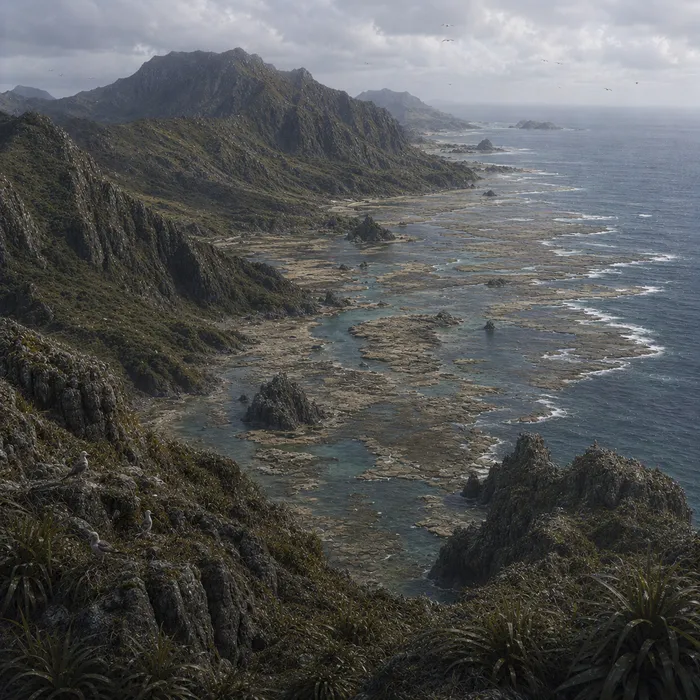
The subregion combined deeply eroded volcanic ranges, steep valleys, coastal plains, sea cliffs, reef systems, and low carbonate environments distributed across an immense stretch of the North Pacific.
Maui Nui formed a much larger connected or nearly connected landmass during low sea levels, as Maui, Molokaʻi, Lānaʻi, and Kahoʻolawe were joined across exposed shelves or separated by much narrower passages than today. Elsewhere, lower sea level broadened coastal benches and altered reef and shoreline geometry without joining the major Hawaiian islands into a single landmass.
The older high islands already displayed strong contrasts between deeply weathered interiors and active coastal erosion, while Midway represented a fundamentally different low reef-and-carbonate environment.
Climate and Environmental Shifts
Marine Isotope Stage 3 conditions were cooler than today and repeatedly altered rainfall, trade winds, storm patterns, sea level, and vegetation.
Windward slopes continued to intercept moisture, supporting wetter forest and montane vegetation, while leeward districts remained substantially drier. During cooler or less humid phases, dry woodland, shrubland, and more open vegetation expanded in exposed settings; wetter intervals allowed forest to regain ground in favorable valleys and uplands.
Sea level remained well below modern through much of the interval but fluctuated considerably. Shorelines shifted across exposed shelves, changing reef flats, beaches, wetlands, coastal plains, and connections within the Maui Nui complex.
Coral systems likewise responded dynamically to changing depth and temperature. Reef surfaces could be exposed, eroded, drowned, or recolonized rather than remaining fixed in their later Holocene configurations.
Human Presence
North Polynesia remained entirely without humans during this interval.
No population had yet reached the Hawaiian chain. Its forests, reefs, valleys, seabird colonies, and coastal ecosystems developed without settlement, cultivation, introduced mammals, or other cultural disturbance.
Human occupation of Hawaiʻi belongs to a vastly later Pacific world.
Baseline Ecology
Native vegetation ranged from wet montane forest and cloud-influenced upland communities to dry woodland, shrubland, grassier openings, and coastal strand vegetation.
Terrestrial ecosystems were dominated by birds, insects, land snails, and other endemic lineages in the absence of introduced terrestrial mammals. Long isolation encouraged evolutionary divergence among islands and elevational zones.
Seabirds nested in very large numbers on coastal cliffs, offshore rocks, low islands, and suitable open ground. Their movement between ocean and land transferred marine nutrients into otherwise isolated terrestrial ecosystems.
Hawaiian monk seals and marine turtles used suitable shores, while reefs and nearshore waters supported diverse fish, mollusks, crustaceans, sharks, and other marine organisms.
Midway and other low carbonate environments depended especially strongly on reef productivity, seabird nutrient input, rainfall, and the persistence of low terrestrial surfaces above changing sea level.
Movement and Connectivity
Connectivity in North Polynesia was entirely biological, geological, and oceanographic.
Trade winds and currents transported drifting organisms, seeds, larvae, nutrients, and floating material across the North Pacific. Seabirds moved regularly among islands and distant marine feeding grounds, while turtles and pelagic fish crossed far larger oceanic circuits.
Within the Maui Nui complex, lower sea level created unusually broad terrestrial connections among islands that would later become separated. On other islands, exposed shelves enlarged coastal habitat but did not erase the deep-water barriers among major volcanic systems.
These processes connected ecosystems without creating a human network. Each island or island group remained an independent biological world shaped by isolation and rare natural dispersal.
Environmental Adaptation and Resilience
North Polynesian ecosystems responded to climatic and geological change through shifts in elevation, habitat range, reef position, and recolonization.
Forest communities moved upslope or downslope as temperature and rainfall changed. Dry-adapted vegetation expanded across exposed or leeward terrain during less favorable phases, while humid valleys and uplands acted as refugia for moisture-dependent species.
Reef organisms tracked suitable water depth and temperature as sea level fluctuated. Newly exposed coastal ground was colonized gradually, while storms and marine erosion repeatedly disturbed shorelines.
Seabirds could shift breeding sites among cliffs, cays, and offshore rocks as local conditions changed. The absence of terrestrial mammalian predators allowed many ground- and cliff-nesting populations to persist at densities that would be drastically reduced after much later human settlement.
Transition
By 28,558 BCE, North Polynesia remained an isolated, entirely nonhuman archipelago shaped by volcanism, erosion, changing shorelines, ocean circulation, and extraordinary biological endemism.
Maui Nui still possessed a geography very different from its later island configuration, broad lowstand shores extended beyond many modern coastlines, and reef systems occupied positions unlike those of the Holocene.
At the close of Late Pleistocene I, North Polynesia was therefore a world of old volcanic mountains, exposed shelves, shifting reefs, native forests, seabird colonies, and open ocean—its ecological history still unfolding entirely without people.