
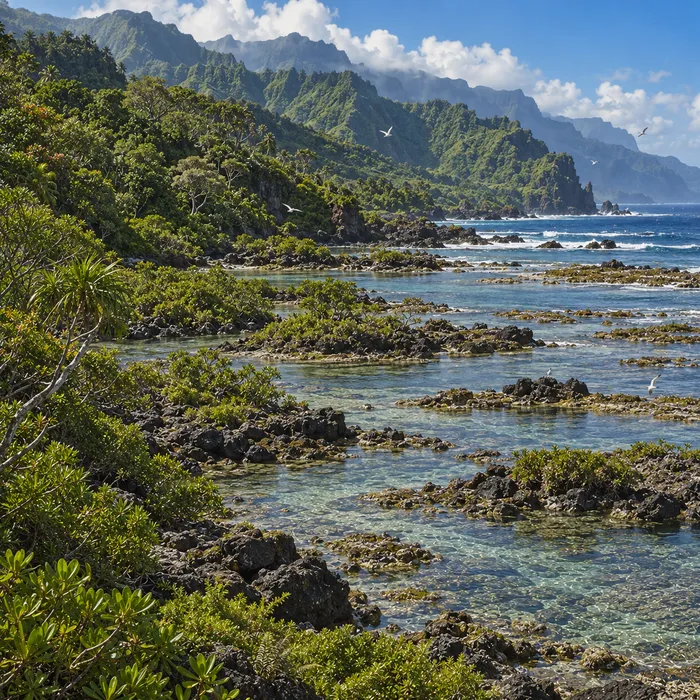
The plate could not be loaded.
North Polynesia Collapse Brief Rising Seas, Evolving Shores, and a Human-Free Hawaiian World Brief ‹ Polynesia Rising Seas, Evolving Shores, and a Human-Free Hawaiian World Explore events
Rising Seas, Evolving Shores, and a Human-Free Hawaiian World
North Polynesia · Polynesia · Northern Oceania
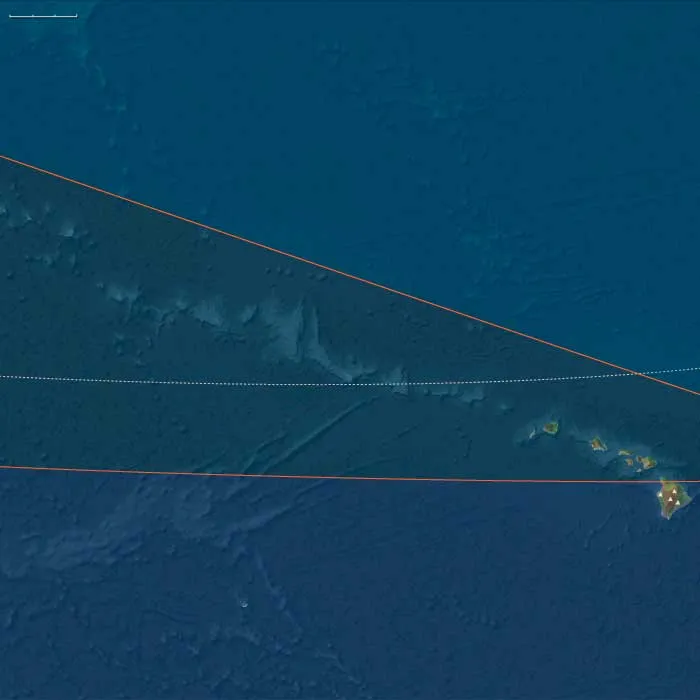
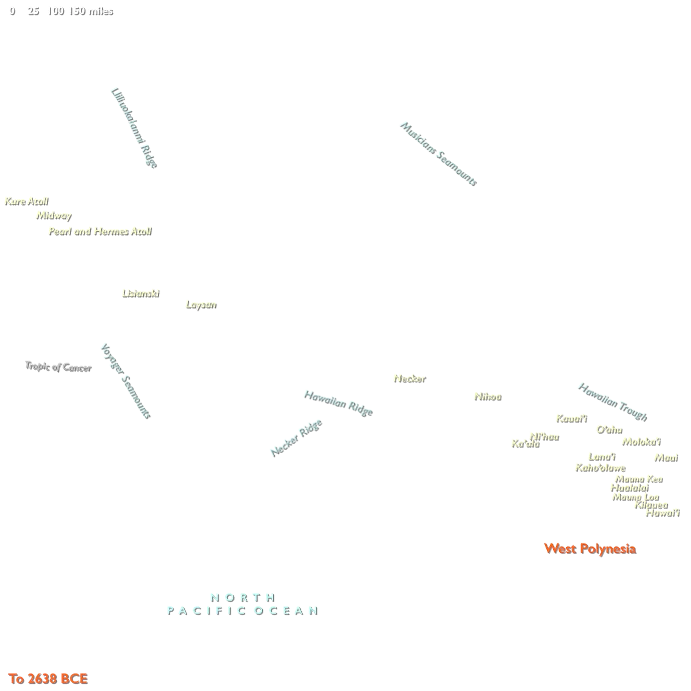
North Polynesia remained entirely without human inhabitants throughout the Middle Holocene. Across Kauaʻi, Niʻihau, Oʻahu, Molokaʻi, Lānaʻi, Maui, and the smaller islands of the northern Hawaiian chain, native ecosystems continued to develop in isolation, while far to the northwest Midway Atoll followed its own low-island history of reef growth, carbonate deposition, storms, and shifting lagoon margins.
Continue reading
North Polynesia remained entirely without human inhabitants throughout the Middle Holocene. Across Kauaʻi, Niʻihau, Oʻahu, Molokaʻi, Lānaʻi, Maui, and the smaller islands of the northern Hawaiian chain, native ecosystems continued to develop in isolation, while far to the northwest Midway Atoll followed its own low-island history of reef growth, carbonate deposition, storms, and shifting lagoon margins.
The high islands differed markedly from one another. Older Kauaʻi possessed deeply eroded valleys, broad weathered uplands, perennial streams, wetlands, and mature forest communities. Oʻahu combined eroded volcanic ranges with intervening lowlands and increasingly developed coastal plains. Molokaʻi, Lānaʻi, and Maui occupied the remnants of the formerly larger Maui Nui landmass, whose low Pleistocene connections had been drowned as postglacial seas rose. By this epoch the channels separating the islands were well established, while reefs, shore platforms, bays, beaches, wetlands, and river mouths continued adjusting to changing relative sea level.
Marine transgression was slowing but had not ceased to reshape the islands. Rising water flooded low coastal margins, altered stream mouths, reorganized shallow reefs and embayments, and encouraged the development of wetlands, lagoons, beach ridges, and sediment-filled coastal plains in favorable settings. These changes varied from island to island according to subsidence, wave exposure, reef growth, sediment supply, and local topography. The later Middle- and Late-Holocene Hawaiian relative sea-level highstand had not yet reached its fullest expression across most of this interval.
Vegetation followed steep climatic gradients. Windward mountain slopes supported wet and mesic forests, cloud-fed vegetation, bogs, ferns, and dense understories, while leeward areas carried drier forests, shrublands, grasslands, and seasonally stressed vegetation. Young volcanic surfaces supported different communities from the deeply weathered soils of the older islands. Native plants dispersed across the archipelago over long evolutionary timescales, producing highly distinctive island floras without agriculture, intentional burning, grazing, or introduced weeds.
The islands also supported exceptionally rich native bird communities. Forest birds occupied elevational and rainfall zones across the high islands, while wetlands and shorelines supported waterbirds and migratory visitors. Seabirds nested along cliffs, beaches, offshore islets, and other predator-free coastal habitats in numbers far greater than would survive after human settlement. With no introduced rats, cats, pigs, dogs, or other terrestrial predators, ground- and burrow-nesting species could use lowland and coastal environments that would later become much more hazardous.
Streams linked mountain watersheds to the sea. Native amphidromous fishes, crustaceans, and mollusks moved between freshwater and marine environments, while estuaries and sheltered coastal waters supported fish and invertebrate communities adapted to changing salinity and sediment conditions. Offshore, coral reefs, rocky bottoms, kelp and algal communities, deeper slopes, and pelagic waters supported diverse marine ecosystems visited by sharks, turtles, monk seals, cetaceans, fishes, and seabirds.
Midway Atoll formed a sharply different northern landscape. Its low carbonate islands, lagoon, reef rim, passes, beaches, and shifting sand bodies lacked the mountains and freshwater valleys of the main Hawaiian Islands. Marine productivity and immense seabird colonies dominated its ecology, while storms, waves, reef growth, and sediment movement continually reshaped the exposed land.
Across North Polynesia there were no settlements, cultivated clearings, paths, hearths, canoes, managed ponds, or planted groves. Coastal wetlands remained natural wetlands; reef flats remained unmanaged marine habitats; forests evolved without human cutting or burning. The ecological patterns visible during this epoch belonged entirely to volcanic, climatic, oceanographic, and biological processes operating long before Polynesian voyagers reached the archipelago.
Legacy of the Age
By 4,366 BCE, North Polynesia had become an increasingly mature Holocene island world. The drowning of former low connections had reinforced the separation of the principal high islands, while reefs, beaches, wetlands, estuaries, coastal plains, forests, and stream systems continued adjusting to slower sea-level change. Endemic terrestrial communities and abundant seabird populations developed without human disturbance, and Midway remained a remote reef-atoll ecosystem governed by waves, storms, marine productivity, and carbonate accumulation. The defining inheritance of the age was a complex, geographically differentiated Hawaiian environment that remained entirely independent of human occupation for thousands of years to come.