
The plate could not be loaded.
Polynesia Collapse Brief Volcanic Islands, Reef Platforms, and the Deep Ecology of Isolation Brief ‹ 3 subregions Volcanic Islands, Reef Platforms, and the Deep Ecology of Isolation Explore events
Late Pleistocene I
Volcanic Islands, Reef Platforms, and the Deep Ecology of Isolation
Polynesia · Northern Oceania · Central Oceania · The Ends of the Earth
Read the brief
Geographic and Environmental Context
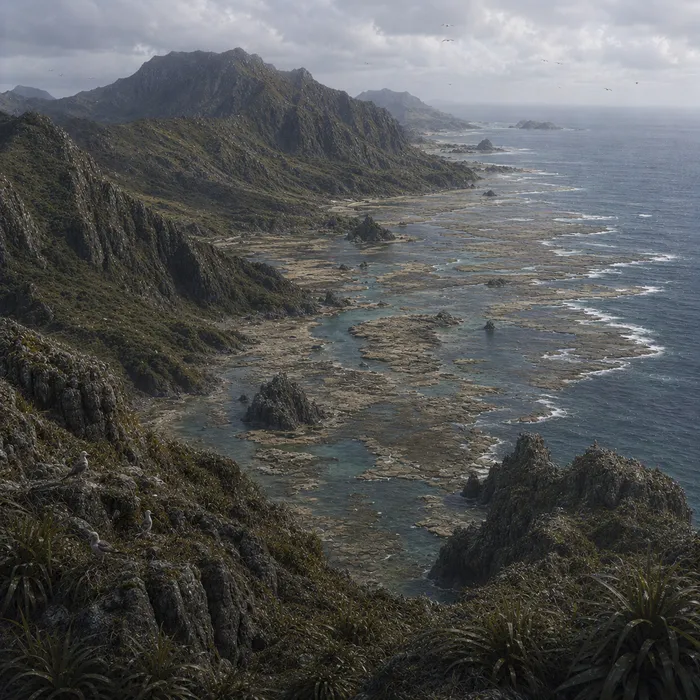
During Marine Isotope Stage 3, Polynesia was an immense oceanic realm of volcanic high islands, raised carbonate platforms, reef systems, and isolated seamount chains scattered across the central and eastern Pacific.
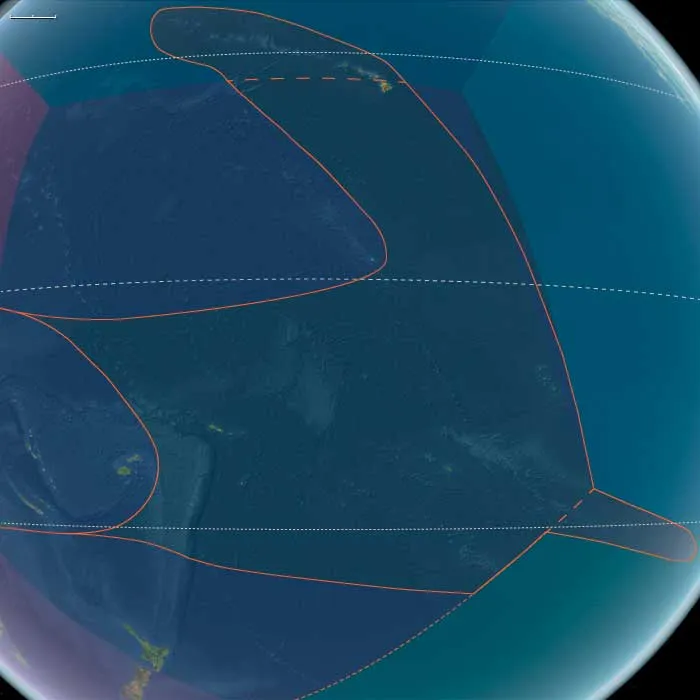
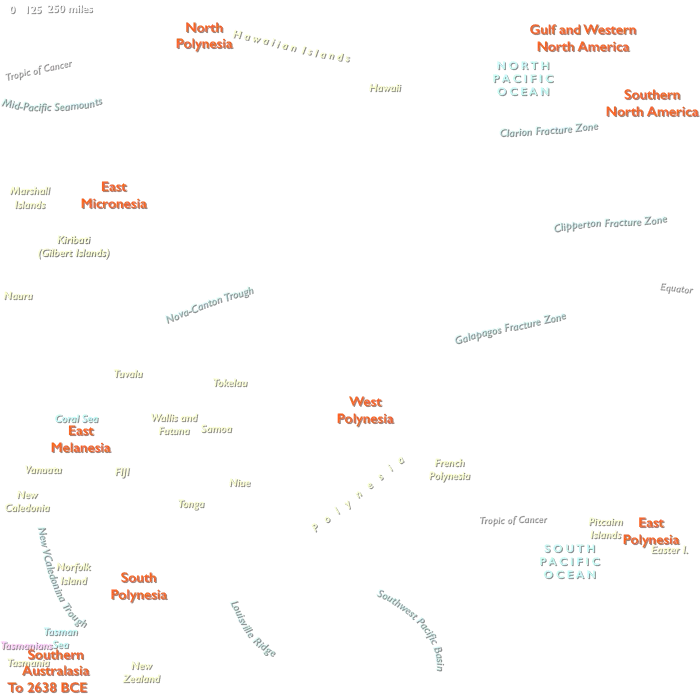
Its three subregions occupied very different parts of that oceanic world.
- North Polynesia comprised the Hawaiian chain outside Hawaiʻi Island, including Oʻahu, Maui, Molokaʻi, Kauaʻi, Niʻihau, and Midway. These islands ranged from deeply eroded volcanic highlands to lower carbonate systems and broad lowstand shorelines.
- West Polynesia included Hawaiʻi Island, Tonga, Samoa, Tuvalu, Tokelau, the Cook Islands, Society Islands, and Marquesas. This was a mixed landscape of young and old volcanic islands, uplifted limestone, developing reef platforms, and isolated low islands.
- East Polynesia included Rapa Nui, the Pitcairn Islands, and associated eastern-Pacific island systems. These islands were among the most isolated landforms on Earth, separated by enormous ocean distances and shaped by volcanism, erosion, reef growth, and marine exposure.
Sea level remained substantially below modern for much of MIS 3. Coastal benches widened around high islands, reef flats were exposed or partly drowned according to local topography, and modern lagoons often had very different forms from their Holocene successors.
Polynesia was therefore not a single archipelago in any practical ecological sense, but a constellation of separate oceanic ecosystems linked only by wind, current, migrating animals, and long-term geological processes.
Climate and Environmental Shifts
MIS 3 brought repeated changes in Pacific temperature, rainfall, trade winds, and sea level.
Sea-surface temperatures were generally cooler than today, while trade-wind intensity and rainfall patterns shifted with broader glacial–interstadial oscillations. Windward slopes on high islands continued to intercept moisture, while leeward sectors became relatively drier and more open during colder or less humid phases.
The region did not experience one uniform “glacial Polynesia.” Climatic effects varied greatly according to latitude, elevation, island size, and exposure.
- In North Polynesia, cooler subtropical conditions strengthened contrasts between wetter high slopes and drier coastal or leeward zones.
- In West Polynesia, tropical high islands retained substantial forest cover, while exposed low islands and leeward volcanic slopes experienced more seasonal dryness.
- In East Polynesia, isolated high islands and raised-carbonate surfaces supported patchy woodland, scrub, exposed lava, and wind-pruned coastal vegetation.
Volcanic activity continued throughout the region. Hawaiʻi Island remained volcanically active, while other volcanic chains underwent episodic eruption, erosion, subsidence, and soil development.
The dominant pattern was one of oceanic isolation combined with repeated ecological adjustment to climate and sea level.
Human Presence
Polynesia was entirely uninhabited during this interval.
No human population had yet reached the Hawaiian chain, Tonga, Samoa, the Cooks, Societies, Marquesas, Pitcairn, Rapa Nui, or the other islands of the region.
There were no canoes, camps, gardens, hearths, trails, stone structures, cleared landscapes, or managed food systems.
The eventual settlement of Polynesia belonged to the much later Holocene world of Austronesian and Polynesian voyaging.
During 49,293–28,558 BCE, the region remained a fully pre-human oceanic biosphere.
Volcanic High-Island Ecologies
High volcanic islands supported the richest terrestrial ecosystems.
Windward slopes carried humid forest, montane woodland, and cloud-fed vegetation. Sheltered valleys accumulated deep soils and maintained more stable freshwater systems. Leeward slopes were drier and often more open, with scrub, grassland, or sparse woodland.
Older islands such as Kauaʻi and parts of the Society and Marquesas groups had already developed deeply incised valleys, steep cliffs, amphitheaters, and broad erosion surfaces.
Younger volcanic systems such as Hawaiʻi Island retained extensive lava fields, fresh volcanic soils, and active geomorphic change.
These islands supported distinctive assemblages of:
- land birds;
- seabirds;
- insects;
- snails;
- reptiles in some archipelagos;
- highly endemic plant communities.
In the absence of human-introduced predators and herbivores, many island species occupied ecological niches that would later disappear.
Reef, Shore, and Marine Systems
Lower sea levels exposed broad areas of reef and coastal bench.
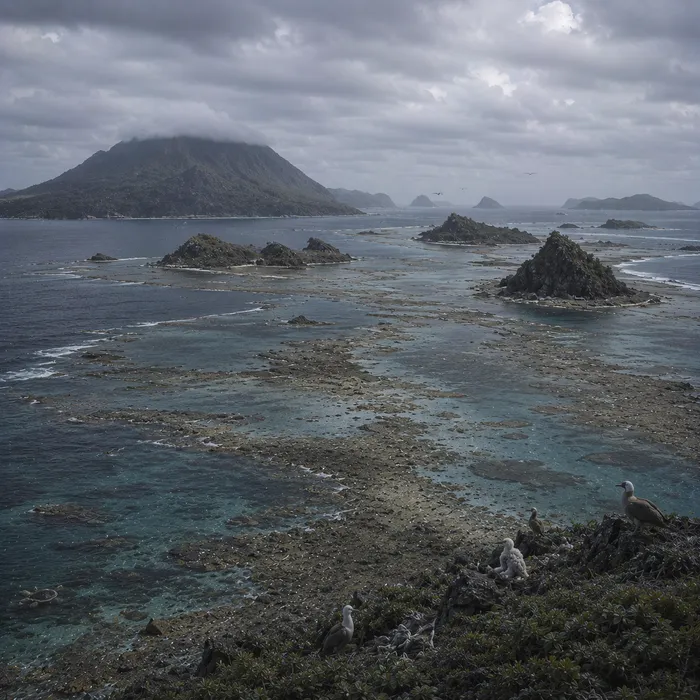
Coral systems did not remain static. Reef flats could be exposed, eroded, partly submerged, or recolonized as sea level and temperature changed. Some modern lagoons did not yet exist in their later form, while older reef surfaces emerged as dry or intertidal carbonate platforms.
Shorelines included combinations of:
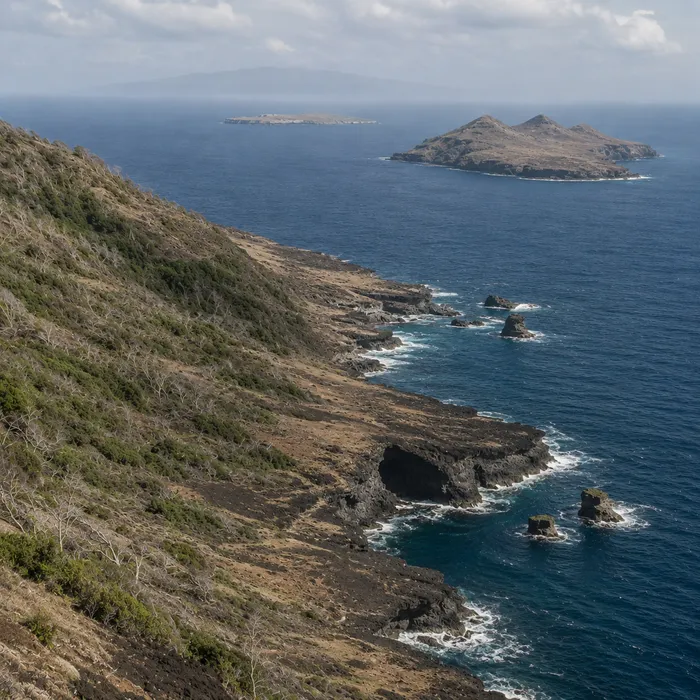
- basalt cliffs;
- lava benches;
- coral flats;
- pale limestone terraces;
- sandy and gravelly strand surfaces;
- rocky stacks and sea caves;
- shallow reef channels and deeper ocean passages.
Marine ecosystems remained highly productive around many islands.
Reef fish, sharks, turtles, mollusks, crustaceans, seabirds, and pelagic species occupied the region’s coastal and open-water environments. In cooler subtropical sectors, monk seals and other marine mammals used remote shores and offshore islands.
Seabird colonies could be locally enormous, especially on low predator-free islands and cliff systems, although colony size varied with available breeding ground and marine productivity.
Island Biogeography and Evolution
Isolation was the defining force in Polynesian ecology.
Each island or island group functioned as a separate evolutionary laboratory. Species reached islands through rare long-distance dispersal by wind, rafting, or flight, then diverged in isolation.
This produced:
- extreme endemism;
- unusual bird radiations;
- giant or reduced body forms in some island lineages;
- highly localized plant communities;
- fragile freshwater and terrestrial ecosystems.
High islands could support vertical ecological zonation from coastal strand to montane forest. Low coral islands depended far more heavily on rainfall, groundwater lenses, seabird nutrient input, and reef productivity.
The absence of humans preserved these systems in forms that would later be profoundly altered after settlement.
Movement and Connectivity
No human movement linked Polynesia during MIS 3, but the islands were connected biologically and oceanographically.
Trade winds and currents moved:
- coral larvae;
- seeds;
- drifting vegetation;
- marine animals;
- seabirds;
- nutrients and sediments.
Migratory seabirds crossed enormous distances between island groups and continental margins. Turtles moved through broad oceanic circuits. Pelagic fish followed fronts, currents, and productive feeding zones.
These connections created an ecological network across the Pacific without creating a shared terrestrial biota.
The region’s unity was therefore oceanographic rather than cultural.
Environmental Adaptation and Resilience
Polynesian island ecosystems responded to repeated climatic and geological disturbance through range shifts, recolonization, and isolation.
Forest boundaries moved upslope or downslope with moisture and temperature. Reef systems adjusted to changing sea level. Volcanic eruptions destroyed and renewed local habitats. Storms stripped vegetation from exposed coasts while sheltered valleys preserved refugia.
Seabirds repeatedly recolonized disturbed islands. Plants established on fresh lava and ash. Coral communities retreated and advanced with temperature and water depth.
Resilience was highly local. Large high islands could preserve complex ecosystems through severe changes, while small low islands were far more vulnerable to sea-level fluctuation, drought, and storm disturbance.
Toward Colder Late-MIS-3 Conditions
By 28,558 BCE, Polynesia remained entirely outside the human world.
Its volcanic high islands, reef platforms, raised limestone, forests, seabird colonies, and open-ocean ecosystems had undergone repeated MIS 3 climatic fluctuations without cultural disturbance.
Sea level remained low, coastal benches were broad, and reef systems occupied positions different from their later Holocene configurations. Vegetation patterns reflected cooler conditions, stronger wind exposure, and pronounced windward–leeward contrasts.
The enduring significance of the interval lay in the formation and preservation of deep island ecologies long before human arrival.
Polynesia at the close of MIS 3 was not a civilization waiting to happen, but a vast archipelago of independent natural worlds—volcanic, reef-bound, biologically distinctive, and profoundly isolated across the central Pacific.