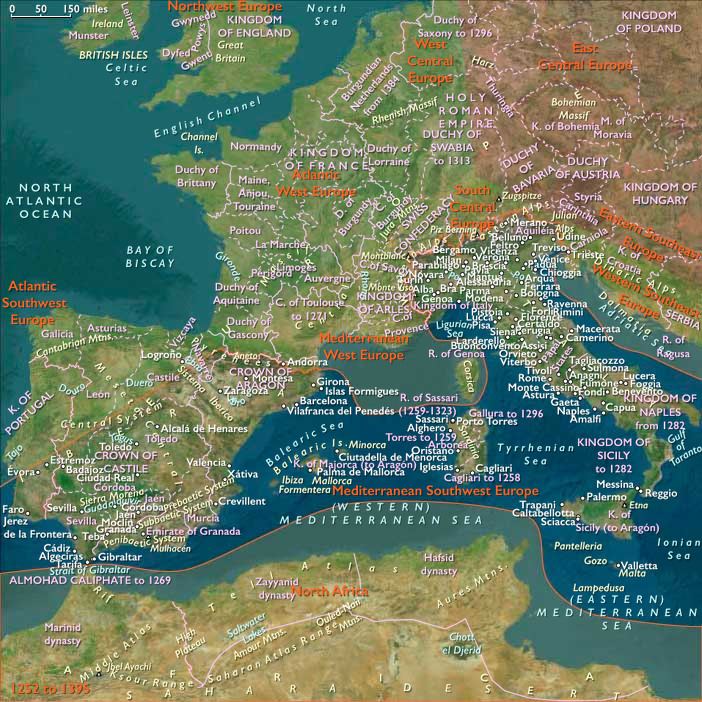
A few officials notable for their good…
1282 CE
A few officials notable for their good conduct are spared, and the city of Messina still holds for Charles, who had been preparing to launch the body of his Crusade (four hundred ships carrying twenty-seven thousand mounted knights) against Constantinople in the spring of 1282.
However, through the diplomatic errors of Charles' vicar, Herbert of Orléans, Messina, too, revolts on April 28, 1282.
Herbert retreats to the castle of Mategriffon, but is forced to abandon the Crusader fleet, which is burnt.
The news surprises Peter of Aragon, who had expected to intervene only after Charles had left for Constantinople.
But the conspirators, aided by Emperor Michael (who wished to see Charles balked in his expedition), had set the revolt in motion early.
Peter does not immediately intervene; he sails with the fleet to Tunis, where he discovered that the would-be convert on whose behalf the Crusade had ostensibly been undertaken had been caught and executed.
While he bides his time, the Sicilians make an appeal to Pope Martin to take the Communes of their cities under his protection.
But Martin is far too deeply committed to Charles and French interests to heed them; instead, he excommunicates the rebels, Emperor Michael, and the Ghibellines in north Italy.
Charles gathers his forces in Calabria, lands near Messina, and begins a siege.
Several attempts to assault the city are unsuccessful.
Rejected by the Pope, the Sicilians now appeal to King Peter and Queen Constance; he duly accepts, and landed at Trapani on August 30, 1282.
He is proclaimed king in Palermo on September 4, but as the archibishopric of Palermo is vacant, he cannot immediately be crowned.
In the face of the Aragonese landing, Charles is compelled to withdraw across the Straits of Messina into Calabria in September, but the Aragonese move swiftly enough to destroy part of his army and most of his baggage.
The Angevin house is forever ousted from Sicily.
Locations
Groups
Topics
Commodities
Subjects
Regions
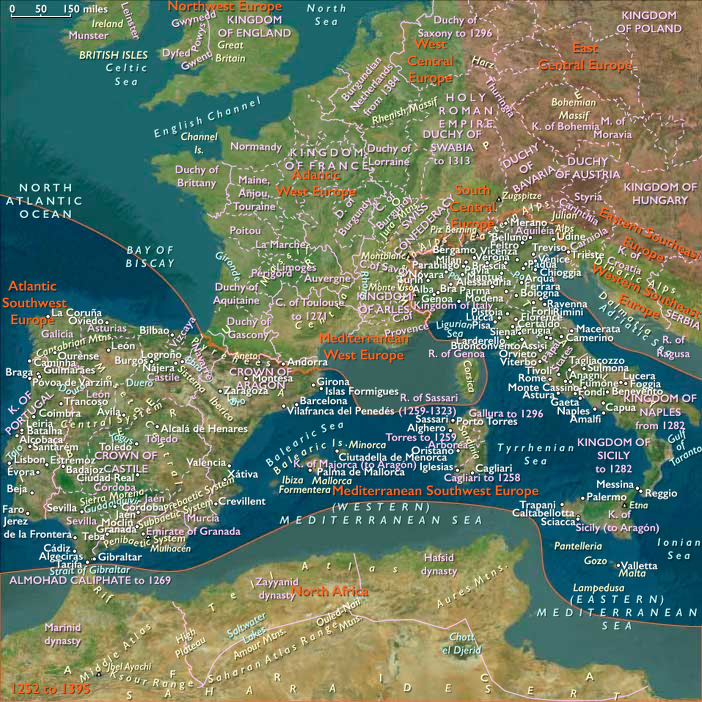
Southwest Europe
View →Subregions