
The Russians had taken Amursana to Tobolsk,…
September 1757 CE
The Chinese have demanded the return of the fugitive and his followers under the terms of Article X to the Treaty of Kiakhta, but the Russians have hid the facts behind his flight and death hoping to gain leverage through the possession of his body.
After Qing envoys were told that Amursana had died crossing the Irtysh River, they spent the next month dredging it but found nothing.
After a long period of wrangling, the Russians finally agreed to ship Amursana's frozen body from Tobolsk to Kiakhta for viewing but refuse a request that it be handed over for "posthumous punishment"; they instead bury it.
Repeated Qing requests to St. Petersburg for the return of Amursana's corpse will be rebutted by the Russians on the grounds that their amicable relations should not be upset by "a few rotten bones".
Qianlong piled on the pressure: he places Russian Orthodox monks in Beijing under house arrest and threatens to cut off trade altogether.
In the end, Amursana's body is not returned.
Qianlong's obsession with the matter appears to have been influenced by his grandfather Kangxi's treatment of the body of his arch-enemy Galdan Boshugtu Khan, whose head was placed on public display and his ashes crushed on the military parade ground in the Chinese capital.
Groups
Regions
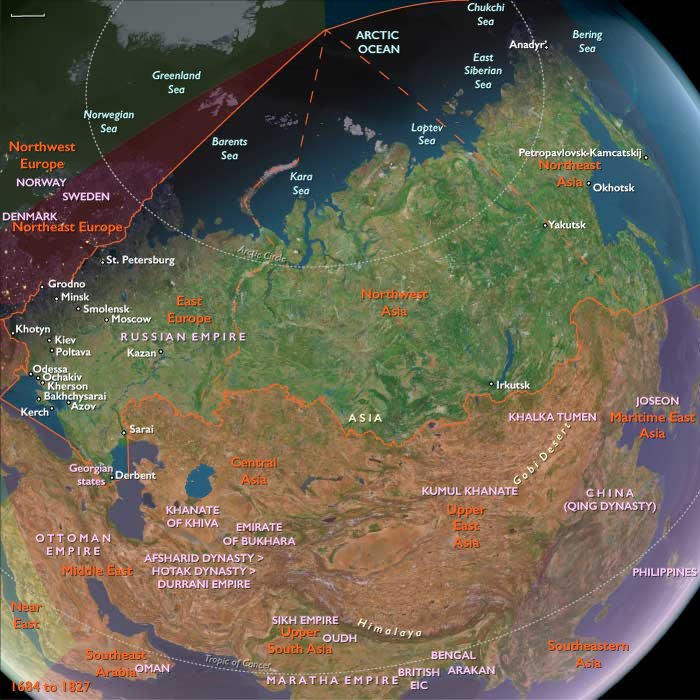
Northeastern Eurasia
View →Subregions
