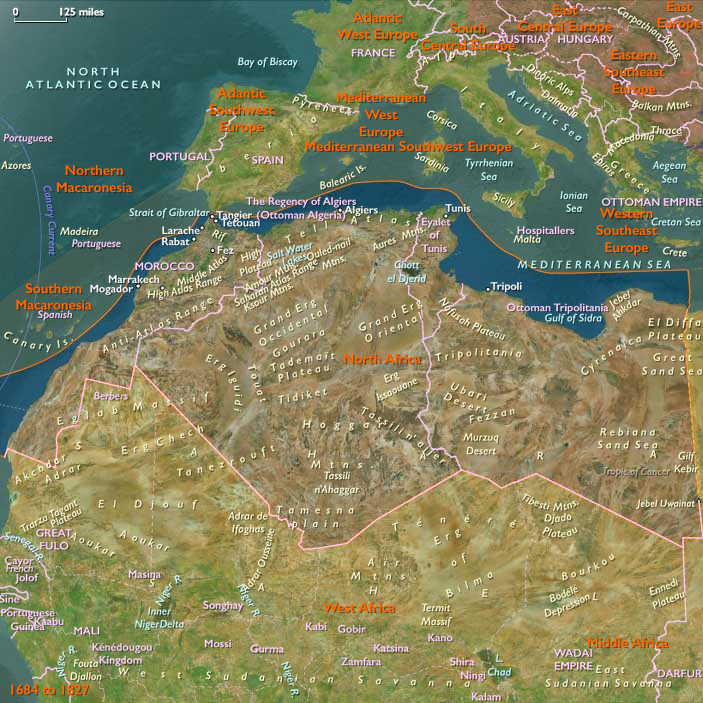
The right to select the dey of…
1684 CE to 1827 CE
The divan at first is dominated by the ojaq, but by the eighteenth century it becomes the dey's instrument.
In 1710 the dey persuades the sultan to recognize him and his successors as regent, replacing the pasha in that role.
Although Algiers remains a part of the Ottoman Empire, the Sublime Porte, or Ottoman government, ceases to have effective influence here.
The dey is in effect a constitutional autocrat, but his authority is restricted by the divan and the taifa, as well as by local political conditions.
The dey is elected for a life term, but in the one hundred and fifty-nine years (1671-1830) that the system survives, fourteen of the twenty-nine deys are removed from office by assassination.
Despite usurpation, military coups, and occasional mob rule, the day-to-day operation of government is remarkably orderly.
In accordance with the millet system applied throughout the Ottoman Empire, each ethnic group—Turks, Arabs, Kabyles, Berbers, Jews, Europeans—is represented by a guild that exercises legal jurisdiction over its constituents.
The dey has direct administrative control only in the regent's enclave, the Dar as Sultan (Domain of the Sultan), which includes the city of Algiers and its environs and the fertile Mitidja Plain.
The rest of the territory under the regency is divided into three provinces (beyliks): Constantine in the east; Titteri in the central region, with its capital at Medea; and a western province that after 1791 has its seat at Oran, abandoned that year by Spain when the city is destroyed in an earthquake.
Each province is governed by a bey appointed by the dey, usually from the same circle of families.
A contingent of the ojaq is assigned to each bey, who also has at his disposal the provincial auxiliaries provided by the privileged makhzen tribes, traditionally exempted from paying taxes on condition that they collect them from other tribes.
Tax revenues are conveyed from the provinces to Algiers twice yearly, but the beys are otherwise left to their own devices.
Although the regency patronizes the tribal chieftains, it never has the unanimous allegiance of the countryside, where heavy taxation frequently provokes unrest.
Autonomous tribal states are tolerated, and the regency's authority is seldom applied in the Kabylie region.
Locations
Groups
Arab people
View →
Berber people (also called Amazigh people or Imazighen, "free men", singular Amazigh)
View →
Jews
View →
Islam
View →
Christians, Roman Catholic
View →
Turkish people
View →
Ottoman Empire
View →
Ottoman Algeria
View →
Tunis, Ottoman eyalet of
View →
Morocco, 'Alawi (Filali) Sultanate of
View →
Spain, Bourbon Kingdom of
View →
Commodities
Subjects
Regions
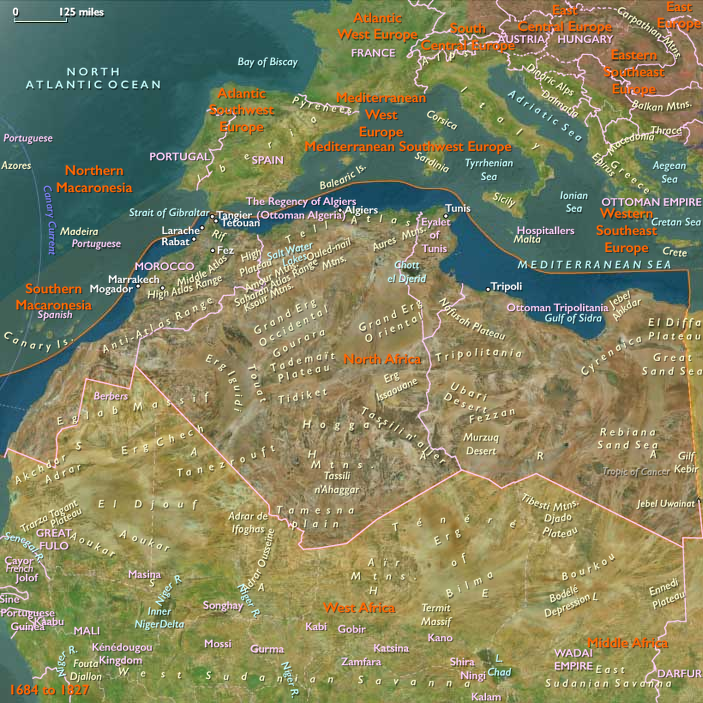
North Africa
View →Subregions