Atlantic Southwest Europe (700–711 CE): Collapse of…
700 CE to 711 CE
Atlantic Southwest Europe (700–711 CE): Collapse of Visigothic Power and Prelude to Islamic Invasion
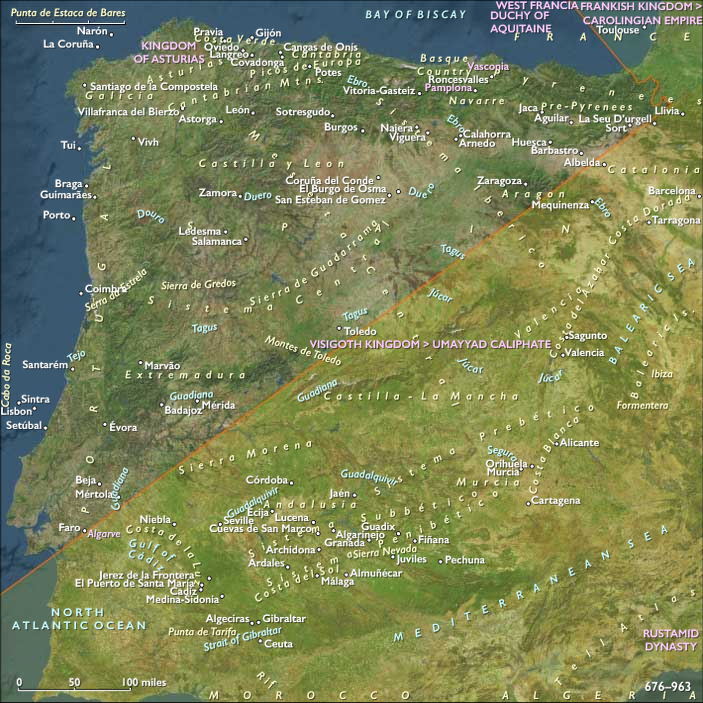
Between 700 and 711 CE, Atlantic Southwest Europe—covering Galicia, northern and central Portugal, Asturias, Cantabria, and northern Spain south of the Franco-Spanish border (43.05548° N, 1.22924° W)—entered a decisive transitional era. This period saw the dramatic collapse of centralized Visigothic authority amid internal conflict and weakening royal legitimacy, setting the stage for the transformative Islamic invasion of Iberia. Yet even in this turbulent environment, regional governance, ecclesiastical leadership, and cultural resilience provided continuity and stability.
Political and Military Developments
Final Years of Visigothic Fragmentation
Under Visigothic kings Egica (687–702 CE) and his son Wittiza (702–710 CE), internal divisions intensified. Succession disputes, aristocratic rebellions, and accusations of tyranny against Wittiza accelerated the erosion of royal legitimacy. Visigothic authority diminished rapidly, particularly in peripheral regions like Galicia, Asturias, and Cantabria, allowing local magnates to assert near-complete autonomy.
Rise of Local Powers
Regional aristocratic families, particularly in Galicia, Asturias, and northern Lusitania, further entrenched their independent authority, bolstering local defenses, forging regional alliances, and consolidating their territorial control. These emerging local powers formed the foundations for the future independent Christian kingdoms that would rise following the imminent collapse of the Visigothic state.
Economic Developments
Sustained Local Economies amid Turmoil
Regional economies, especially villa-based agriculture, livestock husbandry, mining activities (notably gold and silver in Galicia and Asturias), and artisanal crafts, maintained their resilience despite political upheaval. The continuing productivity of these local economies provided stability even as central authority disintegrated.
Maritime Trade Resilience
Coastal settlements such as Bracara Augusta (Braga) and Olissipo (Lisbon) maintained modest yet vital maritime commerce, ensuring ongoing economic links with broader Atlantic and Mediterranean markets. These trade networks provided economic stability and continuity amid the impending dramatic political shifts.
Cultural and Religious Developments
Ecclesiastical Leadership and Authority
Influential bishoprics—particularly those in Braga, Emerita Augusta, and Asturica Augusta—solidified their leadership roles amid declining secular governance. Bishops acted as key civic administrators, effectively managing local communities and maintaining social order, laying the groundwork for future medieval ecclesiastical influence.
Growth and Influence of Monasticism
Monastic communities continued their expansion, preserving literacy, education, manuscript production, agricultural innovation, and social welfare. Monasteries increasingly served as essential economic and cultural centers, further strengthening ecclesiastical influence throughout Atlantic Southwest Europe.
Enduring Cultural Syncretism
The distinctive blending of orthodox Christianity with indigenous Celtic and Iberian traditions persisted robustly, especially in rural Galicia, Asturias, and northern Portugal. These enduring local customs helped communities maintain a strong regional identity and resilience amidst broader political uncertainty.
Civic Identity and Governance
Continued Decentralization and Regional Autonomy
Local governance structures, led by powerful aristocratic families, bishops, and tribal leaders, operated independently from the weakened Visigothic court at Toledo. Civic identities remained local and stable, reinforcing a deeply decentralized political order.
Notable Tribal Groups and Settlements
-
Galicians and Lusitanians: Further consolidated autonomous regional governance structures, laying firm foundations for emerging medieval polities.
-
Astures and Cantabri: Preserved indigenous governance and autonomy, largely unaffected by collapsing royal power.
-
Vascones: Maintained their longstanding neutrality, cultural identity, and territorial independence, insulated from broader Iberian conflicts.
Long-Term Significance and Legacy
Between 700 and 711 CE, Atlantic Southwest Europe:
-
Witnessed the final collapse of centralized Visigothic authority, marking a decisive turning point in Iberian history.
-
Preserved resilient local governance and strong ecclesiastical structures, providing crucial continuity and stability.
-
Established critical foundations for emerging medieval Christian kingdoms and identities, shaping the region’s subsequent historical trajectory.
This era set the stage for the transformative events of 711 CE, notably the Islamic invasion, which would decisively reshape Iberian society, politics, and culture for centuries to come.
People
Groups
Topics
Commodities
Subjects
Regions
Southwest Europe
View →Subregions