
Atlantic West Europe (400–411): Roman Collapse, Barbarian …
Years: 400 - 411
Atlantic West Europe (400–411): Roman Collapse, Barbarian Migrations, and Regional Transformation
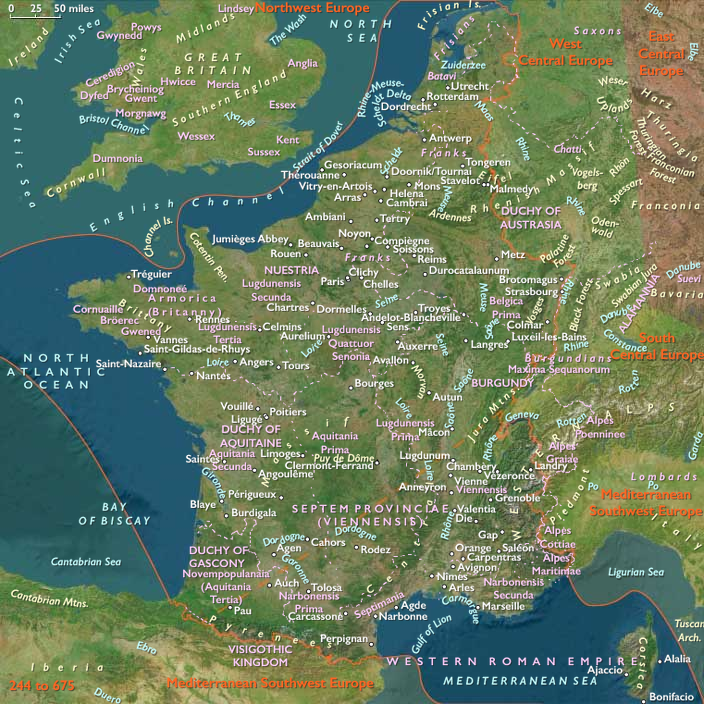
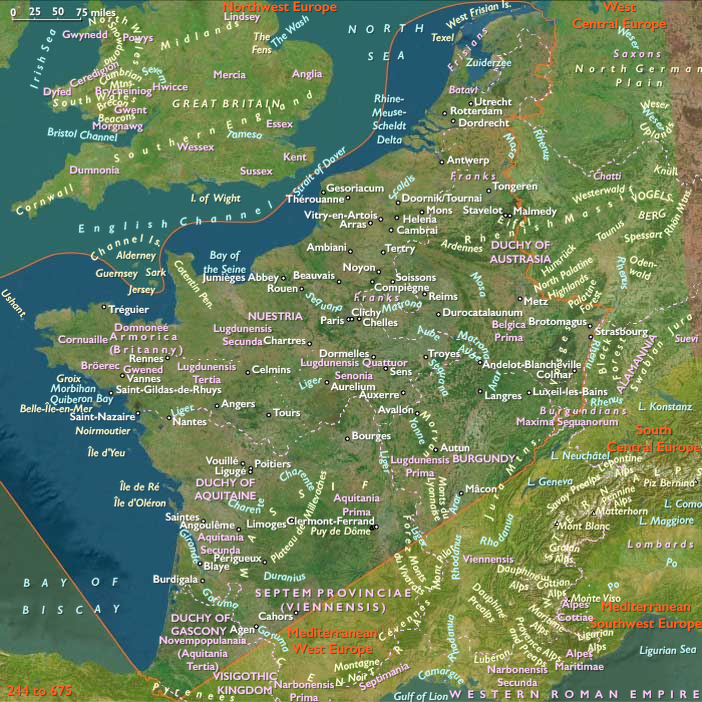
Between 400 and 411, Atlantic West Europe—including Roman Gaul (Aquitania, Gallia Belgica, Gallia Lugdunensis), Armorica (later Brittany), Britannia, and the Rhine frontier—faced profound upheaval, as Roman power rapidly disintegrated, barbarian invasions intensified, and the region descended into political fragmentation.
Political and Military Developments
Collapse of Roman Frontier (406)
-
On December 31, 406, a massive confederation of barbarians—including Vandals, Suebi, and Alans—crossed the frozen Rhine into Gaul. This unprecedented breach shattered Roman defenses, permanently destabilizing Roman rule in the region.
-
The invaders swiftly penetrated Gaul, devastating towns and countryside, triggering widespread fear and population dislocation.
Usurpation and Political Fragmentation
-
Roman authority crumbled as regional commanders and elites struggled to respond effectively. In 407, Roman general Constantine III was proclaimed emperor by troops in Britain, quickly crossing to Gaul to assert authority.
-
Constantine III attempted to stabilize Gaul but faced relentless internal rebellions, including challenges by rival usurpers such as Jovinus (411).
Withdrawal from Britannia (410)
-
In 410, Honorius famously instructed the cities of Britannia to "look to their own defense," effectively marking Rome’s abandonment of Britain. This led to local power vacuums, internecine conflict, and vulnerability to Germanic (Anglo-Saxon) incursions.
Emergence of Localized Barbarian Kingdoms
-
The Suebi, Alans, and Vandals established autonomous enclaves across Gaul, especially Aquitaine and the Loire valley.
-
The Salian Franks, now settled in northeastern Gaul, expanded their territorial control along the lower Rhine region, establishing early Frankish political structures.
Economic and Social Developments
Urban Collapse and Ruralization
-
The barbarian invasions accelerated the collapse of urban centers such as Trier, Reims, and Bordeaux, hastening population shifts from urban to rural settings.
-
Villas were abandoned or fortified as self-sufficient rural enclaves, reflecting declining trade networks and monetary economy.
Population Displacement and Migration
-
Massive disruptions, including population flight, contributed to internal migrations, notably the settlement of Romano-Britons into Armorica (Brittany), laying the foundations for the Breton identity.
Religious and Cultural Developments
Christianity as a Stabilizing Force
-
Amidst societal collapse, the Christian Church gained prominence as a stabilizing institution. Bishops emerged as key political and spiritual leaders in the absence of Roman governance.
-
Saints such as Honoratus of Arles (founded Lérins monastery in 410) and Victricius of Rouen strengthened the Church’s influence.
Decline of Paganism
-
Pagan practices sharply declined, largely replaced by Christianity as the central cohesive cultural force, although pockets of resistance persisted in rural areas.
Key Figures
-
Constantine III (usurper emperor, r.407–411): Briefly stabilized parts of Gaul before ultimate failure.
-
Honorius (Western Roman Emperor, r.395–423): Incapable of effectively defending Gaul and Britain, precipitating Roman withdrawal.
-
Honoratus of Arles (d.430): Influential monastic founder and spiritual leader who symbolized the growing power of Christian institutions.
Long-Term Significance
The period 400–411 marked a decisive turning point in Atlantic West Europe:
-
The irreversible collapse of Roman authority paved the way for new barbarian polities, notably the Frankish and Visigothic kingdoms.
-
Urban centers and economic structures severely weakened, accelerating regional fragmentation and ruralization.
-
Christianity’s ascendancy provided crucial continuity amidst collapse, influencing future political and social structures profoundly.
This era initiated a transformation that defined the region's early medieval identity, shifting from imperial administration to localized political entities and cultures.
People
Groups
- Polytheism (“paganism”)
- Franks
- Alans (Sarmatian tribal grouping)
- Gallo-Roman culture
- Vandals (East Germanic tribe)
- Armorica
- Gallia Lugdunensis (Roman province)
- Gallia Belgica (Roman province)
- Gallia Aquitania (Roman province)
- Britain, Roman
- Suebi (Suevi), Realms of the
- Gaul, Diocese of
- Christianity, Nicene
- Gaul, Praetorian prefecture of
- Roman Empire: Theodosian dynasty (Constantinople)
- Visigoths, Realm of the
- Roman Empire, Western (Milan)
- Roman Empire, Western (Ravenna)
Topics
Commodoties
Subjects
Regions
Subregions
Years: 400 - 411
People
Groups
- Polytheism (“paganism”)
- Franks
- Alans (Sarmatian tribal grouping)
- Gallo-Roman culture
- Vandals (East Germanic tribe)
- Armorica
- Gallia Lugdunensis (Roman province)
- Gallia Belgica (Roman province)
- Gallia Aquitania (Roman province)
- Britain, Roman
- Suebi (Suevi), Realms of the
- Gaul, Diocese of
- Christianity, Nicene
- Gaul, Praetorian prefecture of
- Roman Empire: Theodosian dynasty (Constantinople)
- Visigoths, Realm of the
- Roman Empire, Western (Milan)
- Roman Empire, Western (Ravenna)
Topics
Commodoties
Subjects
Regions
Subregions