
The Angles, Saxons and Jutes, members of…
448 CE to 459 CE
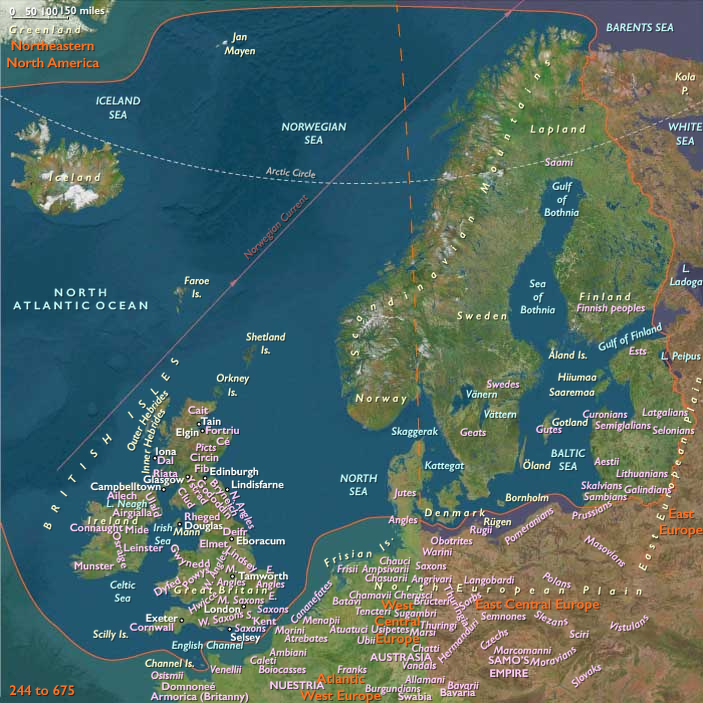
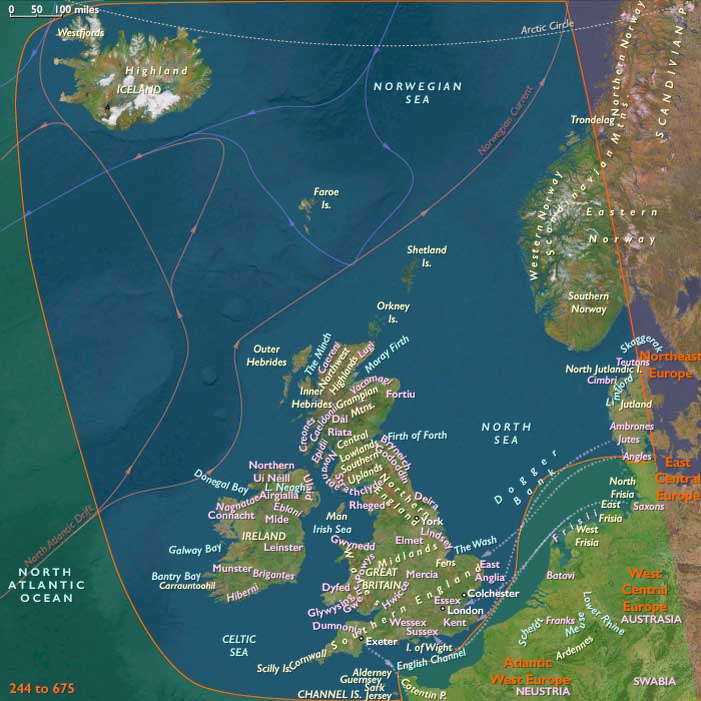
The Angles, Saxons and Jutes, members of the three tribes of northern Germany and southern Denmark (present Schleswig-Holstein), beginning in about 450 join in the widespread migrations of the age and cross the North Sea to seek new homes in a Britain now unprotected by Roman legions.
Nonroyal tyrants have begun to take control of various territories in Britain.
One such, a Briton named Vortigern, hires a large group of the would-be colonists from northern Germany and southern Denmark, along with a number of Frisians and some Franks, to fight the Picts, offering land in Kent as a reward.
These continental mercenaries rebel, demand additional territory, and send for their relatives, who help them to win victories against the Britons in about 455 at Aylesford and in about 457 at Crayford.
The Germanic dialects of the Jutes, Angles, and Saxons are the foundation of the Old English language.
Groups
Topics
Commodities
Subjects
Regions
North Europe
View →Subregions
Northwest Europe
View →Related Events
Showing 10 events out of 22 total
Atlantic West Europe (1684–1827 CE): Ports, Polders, and Revolutions on an Ocean Rim
Geography & Environmental Context
Atlantic West Europe includes the Atlantic and English Channel coasts of France, the Loire Valley, Burgundy, northern France (including Paris), and the Low Countries: Belgium, the Netherlands, and Luxembourg. Anchors include the Seine, Loire, Somme, Scheldt (Escaut), Meuse (Maas), and Rhine–Meuse–Scheldt delta, the Brittany and Cotentin peninsulas, and the Flemish and Dutch polders. The mix of estuaries, dunes, chalk cliffs, river basins, and reclaimed lowlands made an intensely maritime and fluvial landscape.
Climate & Environmental Shifts
In the tail of the Little Ice Age, the Great Frost (1709) and later 1816–1817 dearths (“Year Without a Summer”) hammered grain and wine. North Sea gales and storm surges tested dikes in the Low Countries; Channel tempests menaced fishing fleets and convoys. Yet temperate rains and silt-laden rivers regenerated soils, while coastal upwelling sustained rich fisheries.
Subsistence & Settlement
-
Grain & dairying: Wheat and rye dominated Paris’s provisioning basins; Flanders and Holland balanced grain with dairy, butter, and cheese.
-
Vine & orchard belts: Loire and Burgundy vineyards (Sancerre, Touraine, Côte d’Or) specialized in high-value wines; cider zones dotted Normandy and Brittany.
-
Maritime economies: Herring and cod fisheries (Channel/North Sea); salt works and oyster beds along the French Atlantic; river and coastal shipping sustained small ports and market towns.
-
Urban network: Paris concentrated administration, crafts, print, and finance; Amsterdam, Rotterdam, Antwerp, Ostend, and French ports—Le Havre, Rouen, Saint-Malo, Nantes, La Rochelle, Bordeaux, Brest, Dunkirk—linked hinterlands to Atlantic circuits.
Technology & Material Culture
Wind- and water-power drove mills, sawyers, and paper works; polder engineering (dikes, sluices, windpumps) extended arable land. Canalization—Briare, Centre, Loire–Bretagne, Saint-Quentin, Ourcq, and Dutch canal grids—knit river basins to seaports. Shipyards on the Seine, Loire, Gironde, and Dutch estuaries turned out warships and merchantmen. Textiles flourished: Flemish linens and lace; northern French woolens and printed cottons; Dutch and French faience and porcelain; urban book trades and scientific instruments fed Enlightenment cultures.
Movement & Interaction Corridors
-
Sea lanes & estuaries: Convoys moved colonial staples and manufactures through the Channel, Bay of Biscay, and Dutch delta; river barges provisioned Paris, Rouen, Nantes, Bordeaux, and the Low Countries’ ports.
-
Atlantic empires: Dutch carrying trade persisted though eclipsed by Britain; the Ostend Company briefly challenged monopolies (1720s). French ports (Nantes, Bordeaux, La Rochelle, Saint-Malo) prospered on Caribbean sugar and the triangular trade, then reeled under wartime blockades.
-
War regimes: The War of the Spanish Succession, Seven Years’ War, and Napoleonic Wars re-routed commerce; the Continental System and British blockades choked Atlantic exports, while smuggling through the North Sea and Brittany coasts proliferated.
-
Roads & canals: Turnpikes and towpaths, Dutch trekvaart passenger boats, and French royal canals shortened time–distance to market.
Cultural & Symbolic Expressions
Parisian salons, academies, and presses circulated Enlightenment ideas; the French Revolution (1789) unleashed sans-culottes politics, civic festivals, and new symbols. The Code civil (Code Napoléon) recast property and family law across annexed territories. In the Low Countries, Catholic processions and guild traditions coexisted with a vigorous print and mercantile culture; Antwerp and Amsterdam remained art and publishing hubs. Coastal ritual calendars—fishermen’s blessings, harvest fairs—endured beside neoclassical boulevards in rebuilt Le Havre and Bordeaux quays.
Environmental Adaptation & Resilience
-
Risk spreading: Mixed farming (grain–dairy–flax) and vineyard diversification buffered climate shocks; cider and beer substituted when wine failed.
-
Water management: Continuous dike raising, dune fixation, canal dredging, and bank revetments defended land and kept arteries open.
-
Provisioning systems: Parisian grain police, port granaries, and charitable confraternities cushioned bad years; Dutch urban poor relief and fish protein mitigated famine pulses.
-
Wartime elasticity: Neutral flags (at times), coastal cabotage, and river relays sustained minimal flows when ocean routes were interdicted.
Transition
Between 1684 and 1827, Atlantic West Europe moved from Dutch-led carrying trade toward a Paris-centered, French revolutionary–Napoleonic epoch and a rebalanced Low Countries. Port cities rose and fell with war and blockade; canals and polders bound sea to field; vineyards and dairying financed dense towns. By the 1820s, despite scars from blockades and dearth, the region had the infrastructure, market linkages, and legal reforms to launch nineteenth-century industrial and commercial expansion—its estuaries and capitals poised once more to meet the Atlantic winds.
The reunification of the Low Countries as the United Kingdom of the Netherlands occurs at the dissolution of the First French Empire in 1815, after the defeat of Napoleon.
Two years later, the Congress of Vienna adds the southern Netherlands to the north to create a strong country on the northern border of France.
William Frederick raises this United Netherlands to the status of a kingdom and proclaims himself King William I.
In addition, William becomes hereditary Grand Duke of Luxembourg in exchange for his German possessions.
However, the Southern Netherlands have been culturally separate from the north since 1581, and will soon rebel.
The Netherlands had been annexed to the French Empire by Napoleon in 1810, but now city after city has been evacuated by the French occupation troops.
In the ensuing power vacuum a number of former Orangist politicians and former Patriots form a provisional government in November 1813.
It is headed by a triumvirate of three Dutch noblemen, Frans Adam van der Duyn van Maasdam, Leopold of Limburg Stirum and Gijsbert Karel van Hogendorp.
This Driemanschap formally takes control over the liberated country on November 20 and declares the Principality of the United Netherlands a day thereafter.
It is taken for granted that any new regime will have to be headed by William Frederick, the son of the last Stadtholder of the Dutch Republic, William V.
Although many members of the provisional government had helped drive out William V eighteen years earlier, most of its leading members agree that it will be better for the Dutch to invite William Frederick themselves rather than have him imposed by the Allies.
William Frederick accepts sovereignty over the principality on December 2, proclaiming himself "Sovereign Prince" of the United Netherlands.
William Frederick, Prince of Orange, feeling threatened by Napoleon, who has escaped from Elba, proclaims the Netherlands a kingdom on March 16, 1815, at the urging of the powers gathered at the Congress of Vienna.
The Congress of Vienna form,ally confirms as hereditary ruler of what is known as the United Kingdom of the Netherlands, created through a fusion of territories that had belonged to the former Dutch Republic, Austrian Netherlands, and Prince-Bishopric of Liège.
His son, the future king William II, will fight as a commander at the Battle of Waterloo.
After Napoleon has been sent into exile, William will adopt a new constitution that includes many features of the old constitution, such as extensive royal powers.
The Post-Napoleonic Order – The Congress of Vienna (1815) and the Rise of the Holy Alliance
Following Napoleon’s defeat, the Congress of Vienna (1815) aimed to restore Europe’s monarchies, reestablish national borders, and prevent future revolutionary upheaval. While France, Britain, Portugal, and Spain retained their pre-Revolutionary boundaries, new states emerged, and a reactionary alliance sought to crush liberalism across Europe.
Territorial Adjustments and the Kingdom of the Netherlands
- France reverted to its pre-1789 borders, undoing Napoleon’s territorial expansions but keeping its core territories intact.
- Great Britain emerged as the world’s dominant global power, expanding its colonial influence while maintaining its maritime supremacy.
- Portugal and Spain retained their traditional Iberian boundaries, though Spain remained weakened by the Peninsular War.
- The Netherlands was reconfigured:
- The formerly Spanish, later Austrian Netherlands (modern Belgium) merged with the Dutch Republic (United Provinces).
- This formed the Kingdom of the Netherlands, ruled by William I of Orange-Nassau, intended to serve as a buffer state against future French aggression.
The Holy Alliance – A Reactionary Coalition Against Liberalism
-
The Holy Alliance, formed in 1815, included:
- Austria (Habsburg Empire)
- Russia (Tsarist Empire)
- Prussia
- Spain
- The Pope (representing the Papal States and the Catholic Church’s interests)
-
The alliance aimed to suppress revolutionary movements, democracy, and individual rights, reinforcing absolute monarchies and religious conservatism across Europe.
Britain’s Refusal to Join – A Strategic Move
- Britain refused to join the Holy Alliance, seeing it as a reactionary force that threatened its global influence.
- The British had used liberalism as a tool against their rivals, particularly against:
- The Vatican’s Catholic Church, which Britain saw as an opponent to Protestant and constitutional governance.
- The Russian Orthodox Church and Tsarist autocracy, which Britain viewed as a rival in Eastern Europe and Asia.
- Instead of joining conservative monarchies, Britain pursued a policy of controlled liberalism, using constitutional monarchy and economic expansion to further its global dominance.
Conclusion – The Post-Napoleonic World Order
- Britain emerged as the supreme global power, using trade, naval dominance, and controlled liberalism as strategic tools.
- The Holy Alliance sought to restore absolute monarchy and religious authority, but its repression would spark new revolutionary movements in the coming decades.
- The Congress of Vienna restored the balance of power, but the ideological struggle between reactionary forces and liberal movements would define 19th-century Europe, leading to future conflicts, including the Revolutions of 1848.
The post-Napoleonic world was one of monarchical restoration, political repression, and imperial expansion, yet the seeds of liberal and national revolutions had already been planted, ensuring that the struggles unleashed by the French Revolution were far from over.
Atlantic West Europe (1816–1827): Restoration, Economic Recovery, and the Rise of Liberalism
From 1816 to 1827, Atlantic West Europe—covering northern France, the Low Countries (modern Belgium, the Netherlands, and Luxembourg), and regions along the Atlantic and English Channel coasts—underwent a period of political restoration, economic reconstruction, and burgeoning liberal and nationalist sentiments following the upheaval of the Napoleonic Wars. This era saw conservative attempts to re-establish traditional monarchies and social orders clashing increasingly with rising demands for constitutional reform, economic liberalization, and national self-determination.
Political and Military Developments
Post-Napoleonic Restoration (1815–1818)
-
Following Napoleon’s defeat at Waterloo (1815), the Congress of Vienna (1814–1815) reshaped Europe, emphasizing balance of power and legitimacy, leading to the re-establishment of Bourbon monarchy in France under Louis XVIII (r. 1814–1824).
-
The Low Countries were united into the newly formed United Kingdom of the Netherlands under King William I (r. 1815–1840), intended as a buffer state against French aggression. Belgium, dominated by Catholic, French-speaking elites, was merged uneasily with Protestant, Dutch-speaking northern provinces.
French Monarchical Consolidation and Challenges
-
Louis XVIII established a constitutional monarchy with the Charter of 1814, providing limited parliamentary governance while preserving royal authority. His reign saw efforts to balance conservative royalists and liberal factions.
-
After Louis XVIII’s death in 1824, Charles X (r. 1824–1830) attempted stronger conservative restoration, antagonizing liberals through press restrictions and increased clerical influence, laying foundations for future conflicts.
Growing National and Political Tensions in the Netherlands
-
Belgium’s forced union with the Netherlands created political, religious, and cultural friction, as southern (Belgian) provinces increasingly resented Dutch political dominance and Protestant policies. Initial liberal resistance emerged strongly in Brussels and other Belgian cities by the late 1820s, foreshadowing eventual revolution (1830).
Economic Developments: Recovery and Early Industrialization
Post-War Economic Recovery
-
Following severe wartime economic disruptions, Atlantic West Europe experienced gradual economic recovery, aided by peace, agricultural revival, and renewed commercial activity through ports such as Antwerp, Rotterdam, Nantes, and Bordeaux.
-
Infrastructure restoration became essential, notably improving canal and road networks to facilitate regional and international trade, stimulating commerce and urban revival.
Early Industrial Growth
-
Northern France, particularly Lille, Rouen, and areas around the Loire and Seine valleys, saw early industrial growth in textiles, coal mining, and iron production. This marked the beginning of significant industrialization that later accelerated mid-century.
-
In the Low Countries, Belgium’s industrialization rapidly expanded, notably around Liège and Ghent, focused on textiles, iron, and machinery, setting the stage for Belgium’s prominent industrial role in continental Europe.
Maritime Commerce and Atlantic Trade
-
Atlantic and Channel ports regained importance, notably Bordeaux’s wine exports, Antwerp’s re-established trade networks, and Amsterdam’s revival as a financial and mercantile hub. These developments significantly boosted regional prosperity.
Social and Cultural Developments
Liberalism and Nationalism
-
Intellectual and political liberalism gained strength, influenced by Enlightenment ideas, emphasizing constitutional government, civic freedoms, press liberties, and parliamentary representation. These ideals gained support in urban centers across northern France and Belgium.
-
Nationalist sentiment grew, especially in Belgium, where distinct cultural identity strengthened opposition to Dutch rule. Increasingly vocal demands for political autonomy and cultural recognition became prominent.
Urban Revival and Social Change
-
Urban centers, particularly Paris, Brussels, Antwerp, and Amsterdam, experienced rapid growth, driven by industrialization and trade. A dynamic urban middle class emerged, advocating for economic liberalization and political reforms.
-
Improved educational institutions and expanding literacy facilitated greater political consciousness among urban populations, laying the groundwork for future political activism and cultural vibrancy.
Intellectual and Religious Developments
Revival of Catholic Influence
-
Post-Napoleonic restorations revived Catholic institutional strength, particularly evident in Belgium and northern France, influencing social policies, education, and cultural life. This resurgence sometimes fueled conflicts between liberal secularists and conservative Catholics.
-
Belgium became a key center of Catholic cultural revival, reflecting broader European patterns of post-revolutionary religious revival.
Liberal Intellectual Movements
-
Liberal intellectual circles in Brussels, Ghent, Paris, and Amsterdam advocated constitutional reform, freedom of expression, and economic liberalization, influencing public debates and setting the stage for political changes in subsequent decades.
-
Prominent figures such as François Guizot in France began formulating doctrines combining conservative order with liberal governance principles, significantly shaping political thought in France and beyond.
Legacy and Historical Significance
The era 1816–1827 represented a crucial transitional phase for Atlantic West Europe, bridging the turbulent Napoleonic era and the subsequent revolutionary period:
-
Politically, it established fragile restorations of conservative monarchies, which encountered mounting challenges from liberal and nationalist forces.
-
Economically, it marked initial recovery and significant early industrialization, laying essential foundations for future economic transformation and prosperity.
-
Socially and culturally, rising liberalism and nationalism increasingly shaped political identities, influencing societal values, political organization, and intellectual debates.
Ultimately, this period set the stage for major revolutionary and constitutional upheavals, notably Belgium’s independence (1830) and France’s July Revolution (1830), critically defining the region’s path toward modern nation-states, constitutional governance, and industrial economies.
William I became king and also became the hereditary Grand Duke of Luxembourg, that was part of the Netherlands but at the same time part of the German Confederation.
The newly created country has two capitals: Amsterdam and Brussels.
The new nation has two equal parts.
The north (Netherlands proper) has two million people, speaking chiefly Dutch but divided religiously between a Protestant majority and a large Catholic minority.
The south (which will be known as "Belgium" after 1830) has a population of three point four million people.
Nearly all are Catholic, but the region is divided between French-speaking Walloons and Dutch-speaking Flemings.
The upper and middle classes in the south are mostly French-speaking.
About sixty thousand Belgians are eligible to vote, compared to about eighty thousand Dutch people.
Officially Amsterdam is the capital, but in a compromise the government meets alternately in Brussels and The Hague.
An enlightened despot, he accepts the modernizing transformations of the previous twenty-five years, including equality of all before the law.
However, he resurrects the estates as a political class and elevates a large number of people to the nobility.
Voting rights are still limited, and only the nobility are eligible for seats in the upper house.
The old provinces are reestablished in name only.
The government is now fundamentally unitary, and all authority flows from the center.
William I is a Calvinist and unsympathetic to the religious culture and practices of the Catholic majority.
He promulgates the "Fundamental Law of Holland", with some modifications.
This entirely overthrows the old order of things in the southern Netherlands: it abolishes the privileges of the Catholic Church, and guarantees equal protection to every religious creed and the enjoyment of the same civil and political rights to every subject of the king.
It reflects the spirit of the French Revolution and in so doing does not please the Catholic bishops in the south, who had detested the Revolution.
William I actively promotes economic modernization.
The first fifteen years of the Kingdom show progress and prosperity, as industrialization proceed rapidly in the south, where the Industrial Revolution allows entrepreneurs and labor to combine in a new textile industry, powered by local coal mines.
There is little industry in the northern provinces, but most overseas colonies are restored, and highly profitable trade resumes after a twenty-five-year hiatus.
Economic liberalism combines with moderate monarchical authoritarianism to accelerate the adaptation of the Netherlands to the new conditions of the nineteenth century.
The country will prospers until a crisis arises in relations with the southern provinces.