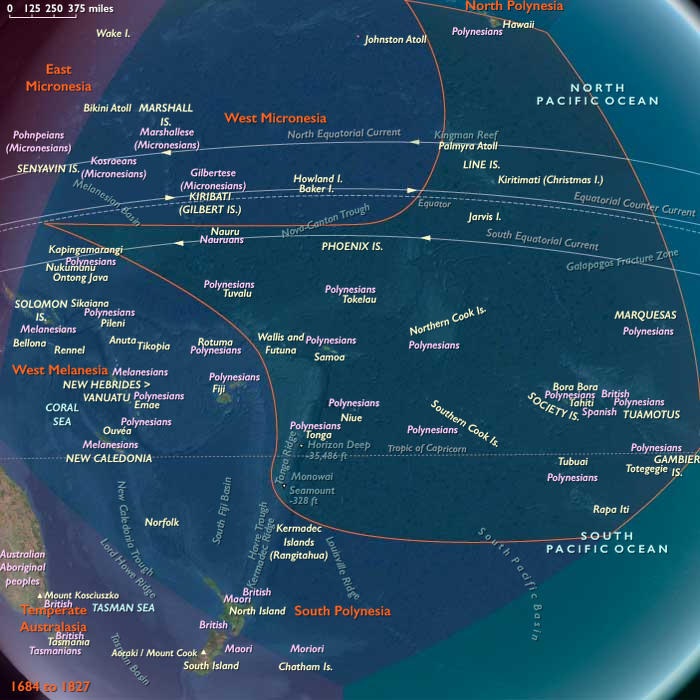
Mutineer James Morrison will write of Tubuai:…
September 1789 CE
After only ten days on the island, the mutineers had sailed for Tahiti to get women and livestock in which they were only nominally successful.
When they returned to Tubuai they built a fort on the northeast part of the island at Ta'ahueia, manned with cannon and swivel gun, that they name Fort George.
Christian knows that settling on Tahiti was sure to mean the mutineers' eventual discovery and arrest, so despite being viewed as intruders, Christian is reluctant to view permanent settlement on Tubuai as unfeasible.
Christian favors using diplomacy over time to eventually obtain wives, but many of the other mutineers insist on raiding parties to take wives by force.
The islanders of Tubuai do not want to allow their women to stay at the mutineer camp, or to allow them to become wives.
They also are not disposed to trade food.
It is not long before armed parties of mutineers start burning houses and desecrating marae during skirmishes to obtain women.
More battles ensue and more natives are killed.
One mutineer, heavily tattooed Thomas Burkett (who will later be tried and hanged in England for mutiny) is speared in the side by one of the islanders during one of the skirmishes.
After only two months since their first arrival on Tubuai, the mutineers leave for good.
Increased contact with Europeans also means more exposure to diseases to which the islanders have no immunity.
This proves particularly devastating to the population of Tubuai.
At some point during the thirty years from when the mutineers leaves the island on September 17, 1789, and the early 1820s when accounts by Christian missionaries will begin to be recorded, the population that had been estimated by the mutineer Morrison to be three thousand will be reduced to no more than three hundred people.
One Protestant minister when visiting a congregation on Tubuai on January 3, 1824, will write that several islanders were still suffering from a devastating illness, describing the symptoms and noting that several hundred had died within the previous four years.
Locations
Topics
Commodities
Subjects
Regions
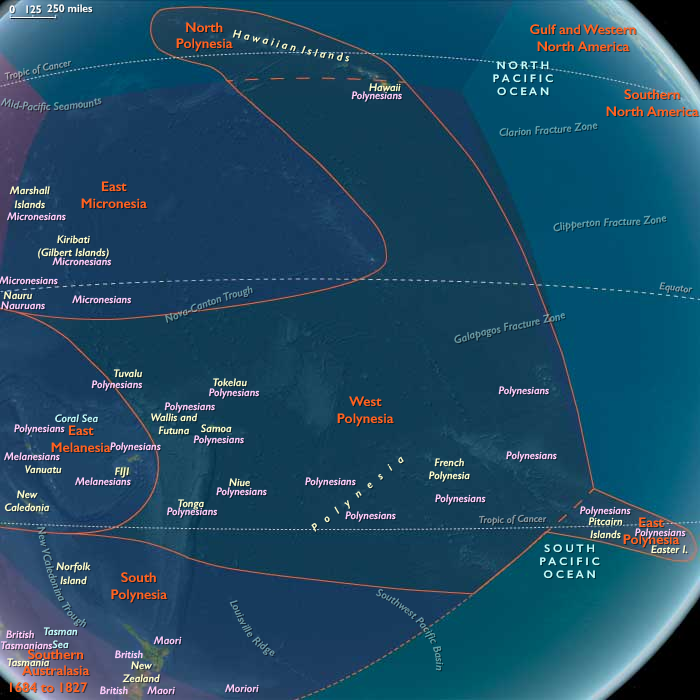
Polynesia
View →Subregions