
It is estimated that over thirty thousand…
1834 CE
It is estimated that over thirty thousand Anglos live in Texas by 1834, compared to only seventy-eight hundred of Spanish heritage.
Stephen F. Austin had eventually secured the repeal of the anti-immigration after three years of working with the Mexican government, but in the meantime military measures had been enacted to enforce this law, which had triggered an uprising in Anahuac, Texas.
This event, the first of what will be called the Anahuac Disturbances of 1832 and 1835, helps to precipitate the Texas Revolution that will lead to the secession of Texas from Mexico and the formation of the Republic of Texas.
Texians are becoming increasingly disillusioned with the Mexican government.
Many of the Mexican soldiers garrisoned in Texas are convicted criminals who had been given the choice of prison or serving in the army in Texas.
Many Texians are also unhappy with the location of their state capital, which moves periodically between Saltillo and Monclova, both of which are in southern Coahuila, some five hundred miles (eight hundred kilometers) away; they want Texas to be a separate state from Coahuila (but not independent from Mexico) and to have its own capital.
They believe a closer location for the capital would help to stem corruption and facilitate other matters of government.
Some American immigrants and Mexican citizens are accustomed to the rights they had had in the U.S. that they do not have in Mexico.
For example, Mexico does not protect Freedom of Religion, instead requiring colonists to pledge their acceptance of Roman Catholicism; Mexican Law requires a "tithe" paid to the Catholic Church.
Cotton is in high demand throughout Europe and most settlers want to raise cotton for big profits, but Mexico demands that the settlers produce corn, grain, and beef and dictate which crops each settler will plant and harvest.
Unlike in the states of the Southern United States where slavery is legal, the status of slaves in Mexico is ambiguous.
People
Groups
Subjects
Regions
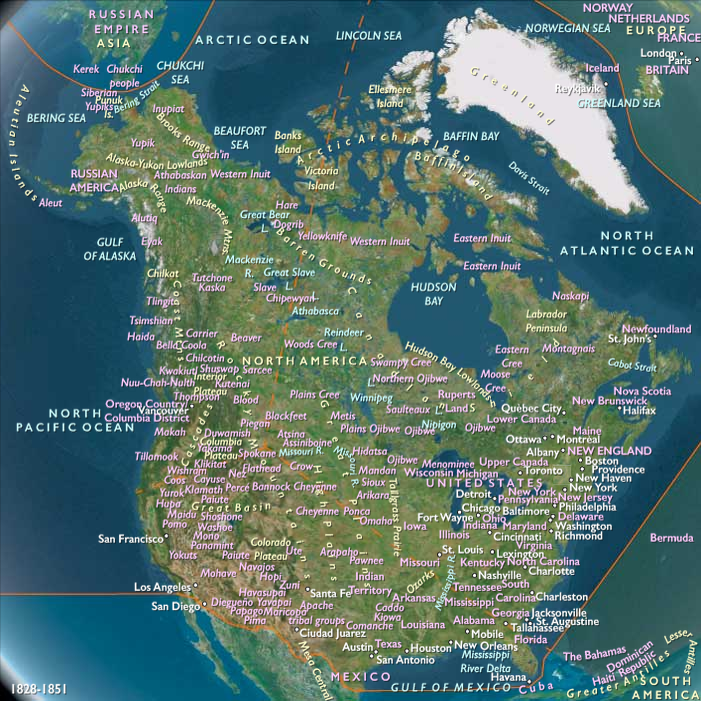
Northern North America
View →Subregions
