Cardinal Cesare Borgia, now twenty-three, renounces his…
August 1498 CE
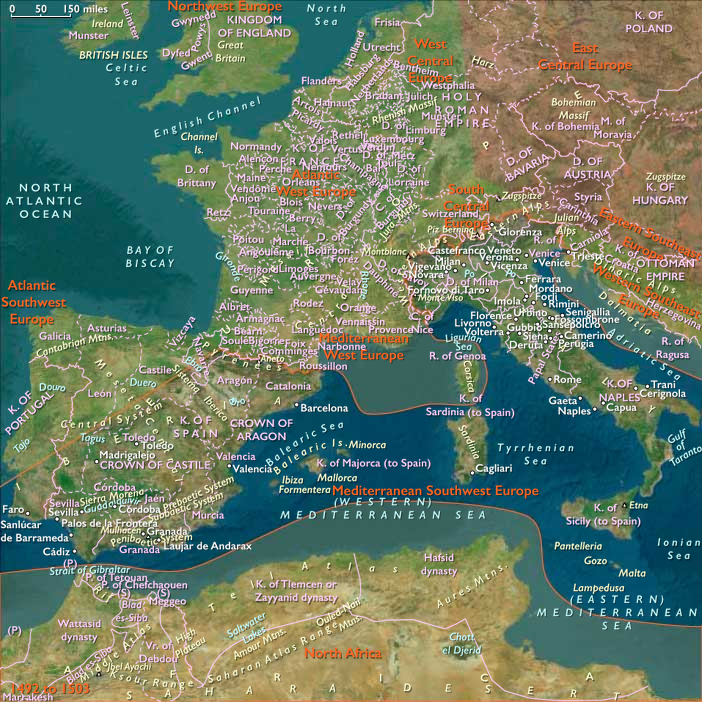
Cardinal Cesare Borgia, now twenty-three, renounces his ecclesiastical career in 1498 and is sent by his father, Pope Alexander VI, to pacify the Romagna in the Papal States.
Like nearly all aspects of Cesare Borgia's life, the date of his birth is a subject of dispute.
He was born in Rome—in either 1475 or 1476—the illegitimate son of Cardinal Roderic Llançol i de Borja, (usually known as Rodrigo Borgia), later Pope Alexander VI, and his mistress Vannozza dei Cattanei, about whom information is sparse.
The Borgia family originally came from the Kingdom of Valencia, and rose to prominence during the mid-fifteenth century; Cesare's grand-uncle Alphonso Borgia (1378–1458), bishop of Valencia, had been elected Pope Callixtus III in 1455.
Cesare's father, Pope Alexander VI, is the first pope to openly recognize his children born out of wedlock.
Stefano Infessura writes that Cardinal Borgia falsely claimed Cesare to be the legitimate son of another man—Domenico d'Arignano, the nominal husband of Vannozza dei Cattanei.
More likely, Pope Sixtus IV had granted Cesare a release from the necessity of proving his birth in a papal bull of October 1, 1480.
Initially groomed for a career in the Church, Cesare had been made Bishop of Pamplona at the age of fifteen.
Following school in Perugia and Pisa, he had studied law at the Studium Urbis (nowadays Sapienza University of Rome), and along with his father's elevation to Pope, had been made Cardinal at the age of eighteen.
Alexander VI had staked the hopes of the Borgia family in Cesare's brother Giovanni, who had been made captain general of the military forces of the papacy.
Giovanni was assassinated in 1497 in mysterious circumstances.
Several contemporaries suggested that Cesare might have been his killer, as Giovanni's disappearance could finally open to him a long-awaited military career and also solve the jealousy over Sancha of Aragon, wife of Cesare's younger brother, Gioffre, and mistress of both Cesare and Giovanni.
Cesare's role in the act has never been clear.
However, he has no definitive motive, as he was likely to be given a powerful secular position, whether or not his brother lived.
It is more likely, in fact, that Giovanni had been killed as a result of a sexual liaison.
On Auguts 17, 1498, Cesare becomes the first person in history to resign the cardinalate.
On the same day, Louis XII of France named Cesare Duke of Valentinois, and this title, along with his former position as Cardinal of Valencia, explains the nickname "Valentino".
Locations
Groups
Topics
Subjects
Regions
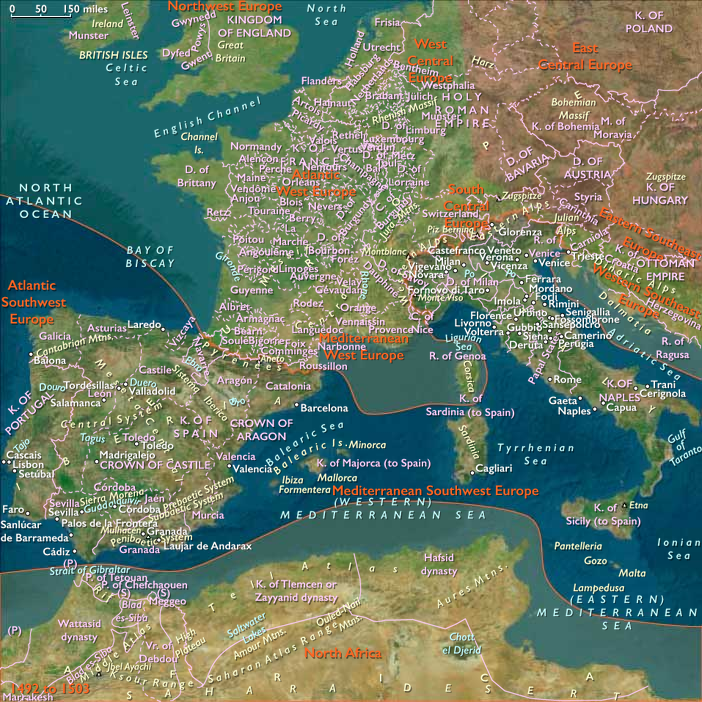
Southwest Europe
View →Subregions