Central Asia (820–963 CE): Samanid Oases, Silver…
820 CE to 963 CE
Central Asia (820–963 CE): Samanid Oases, Silver Circulation, and the Steppe Frontier
Geographic Parameters
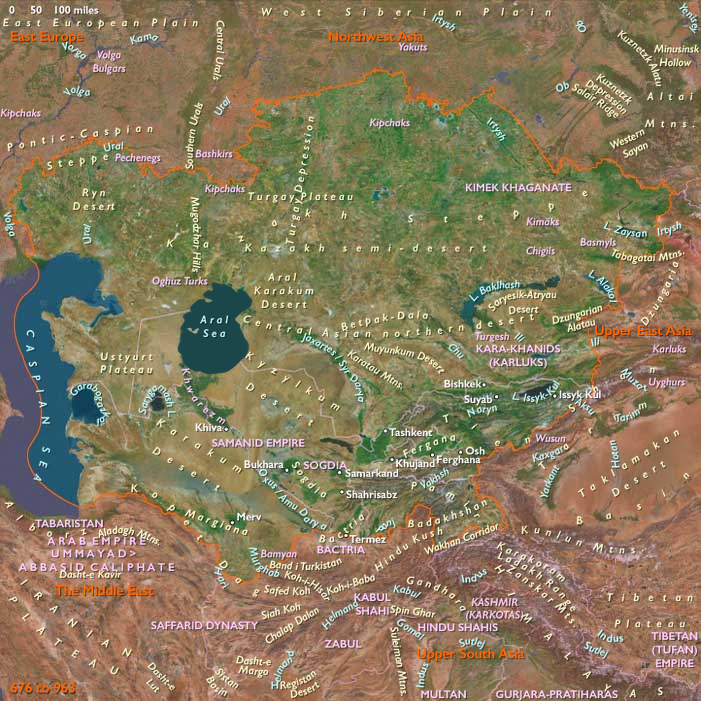
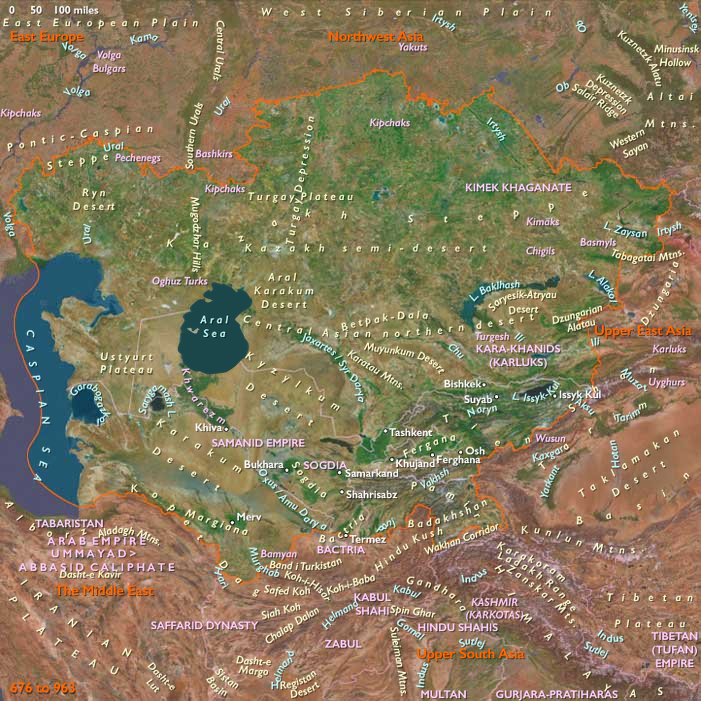
Central Asia encompassed the irrigated basins of the Amu Darya and Syr Darya, the Zarafshan and Kashkadarya valleys, Khwarazm and the Aral delta, the Ferghana Basin, the Kazakh steppe, the Karakum and Kyzylkum deserts, and the Tian Shan–Pamir margins. Bukhara and Samarkand formed the principal political and commercial centers of Transoxiana, while Merv connected the region with Khurasan and the Iranian plateau. Khwarazm opened northward toward the Caspian, Volga, and steppe worlds, and Ferghana led eastward through mountain passes toward Kashgar.
These zones remained environmentally distinct. Dense canal agriculture supported cities and villages in the oases, while pastoral communities occupied the grasslands, desert margins, reed beds, and seasonal mountain pastures beyond them. Central Asia’s unity rested not upon territorial uniformity but upon the circulation of grain, livestock, textiles, coin, labor, knowledge, and people between contrasting ecological districts.
Environmental Continuity
Snowmelt and seasonal river flow sustained wheat, barley, millet, cotton, grapes, melons, apricots, pomegranates, mulberries, and garden crops. Irrigation canals, diversion works, embankments, wells, and underground water galleries required continuous maintenance. Silt, salinization, dune movement, and changing river channels could diminish cultivation even where political stability prevailed.
Pastoral communities raised horses, sheep, goats, cattle, and camels. Seasonal movement allowed households to exploit different grazing zones and respond to drought or severe winter. Oases depended upon these pastoral territories for remounts, meat, wool, hides, transport animals, and military manpower, while herders sought grain, textiles, metal tools, pottery, and access to urban markets.
Samanid Political Consolidation
The decisive political system was the Samanid dynasty, which governed Transoxiana and much of Khurasan from Bukhara. Its rulers operated through provincial governors, military households, tax officials, landed elites, merchants, and religious scholars rather than through an evenly administered territorial state. Samarkand remained an important economic and intellectual center, while Khwarazm and Ferghana retained strong regional interests.
Samanid authority combined Islamic legitimacy with Persianate court culture. The court patronized poets, scholars, administrators, and translators, helping establish New Persian as a major literary and political language written in Arabic script. Arabic remained essential to theology, law, medicine, philosophy, astronomy, and wider Islamic scholarship.
The state’s frontier was not a fixed wall between settled and mobile worlds. Tributary agreements, hostage exchange, military recruitment, intermarriage, markets, and punitive campaigns regulated relations with Turkic-speaking groups along the Syr Darya and beyond. Some pastoral leaders entered Samanid service, while enslaved or recruited Turkic soldiers became increasingly important within Islamic armies.
Productive Landscapes and Commerce
Irrigated agriculture formed the fiscal base of the oases. Cotton supported textile production, while orchard crops and processed foods entered regional trade. Samarkand’s paper tradition, ceramic workshops, leatherworking, metal production, dyeing, and weaving strengthened urban economies without severing them from village labor and agricultural supply.
Samanid silver dirhams circulated on an extraordinary scale. Coins struck in Central Asian and Khurasanian mints travelled through Khwarazm and the Volga corridor into the lands of the Volga Bulghars, the Rus’, and the Baltic. This northern exchange carried silver and manufactured goods outward and brought furs, wax, amber, weapons, captives, and other commodities southward.
Eastward routes joined Samarkand and Ferghana to Kashgar and the Tarim Basin. Southern and western roads led from Bukhara and Merv toward Nishapur, Rayy, Baghdad, and the Persian Gulf. Caravans moved in stages between markets rather than following one uninterrupted transcontinental highway.
Religion and Cultural Life
Sunni Islam, especially Hanafi jurisprudence, became increasingly influential in Transoxiana. Mosques, teaching circles, charitable endowments, book markets, and judicial institutions expanded within ordinary urban neighborhoods. Islamic consolidation remained incomplete, however. Local sacred practices, older Iranian traditions, Christian and Jewish communities, and steppe ancestor rites persisted.
Sufi teachers and ascetics began forming connections among merchants, artisans, villages, and frontier communities. Religious authority was therefore distributed among jurists, scholars, local teachers, shrine communities, and court-supported institutions rather than concentrated solely in monumental mosques or formal schools.
The court of Bukhara supported a Persianate cultural renaissance. Rudakī and other poets helped establish New Persian literature as a vehicle of courtly praise, historical memory, ethical reflection, and regional identity. This cultural development depended upon scribes, papermakers, booksellers, teachers, and urban audiences as much as upon royal patronage.
Adaptation and Resilience
Oasis and steppe systems buffered one another. Grain shortages could be relieved through trade, while livestock losses could be offset through exchange with neighboring pastoral groups. Canal labor, grain storage, diversified crops, and multiple caravan routes reduced local vulnerability.
These systems were never equally beneficial. Tax demands, slave raiding, military recruitment, and elite control of land and water imposed heavy burdens upon ordinary households. Nevertheless, village communities, pastoral kin groups, merchants, artisans, and religious institutions maintained forms of cooperation that survived changes in rulers.
Legacy of the Age
By 963 CE, Central Asia had become a major Persianate-Islamic and commercial center anchored by Bukhara, Samarkand, Khwarazm, Ferghana, and Merv. Irrigated oases generated agricultural and craft surpluses, while silver coinage connected the region to the Volga and Baltic worlds. Steppe communities supplied horses, livestock, military labor, and northern commodities, and eastern routes continued toward the Tarim Basin.
The age’s principal new system was the Samanid coordination of oasis agriculture, Islamic institutions, Persianate court culture, and monetized long-distance exchange. This order did not erase regional autonomy or pastoral power. It created a durable model in which urban courts, irrigated villages, mobile herders, religious scholars, and caravan merchants remained mutually dependent.
Images

Central Asia in the Early Mediveal (Upper) age
Groups
Commodities
Subjects
Regions
Central Asia
View →Subregions