
Charles the Good: Count of Flanders and…
1125 CE
Charles the Good: Count of Flanders and the Road to Martyrdom (1119–1127 CE)
Charles the Good, the only son of King Canute IV of Denmark (Saint Canute) and Adela of Flanders, was born in Odense, Denmark but spent most of his life in Flanders, far from his father's kingdom.
After his father’s assassination in Odense Cathedral in 1086, his mother fled to Flanders, taking the young Charles with her, while leaving behind his twin sisters, Ingeborg and Cecilia.
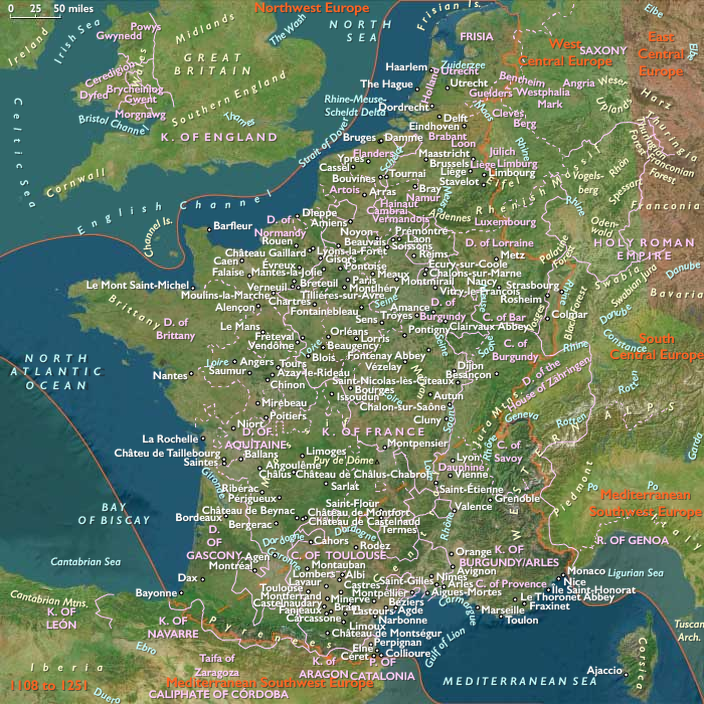
Raised at the comital court of his grandfather Robert I and his uncle Robert II, Charles became a trusted nobleman in Flanders.
Rise to Power and Marriage Alliance (1111–1119)
- When Count Robert II died in 1111, Charles’s cousin Baldwin VII became count.
- Charles became a close advisor to Baldwin, who arranged his marriage around 1118 to Margaret of Clermont, the heiress of the Count of Amiens.
- Baldwin, who had been wounded in battle while fighting for King Louis VI of France, designated Charles as his successor before dying on July 17, 1119.
Thus, Charles became Count of Flanders, a position of great power and responsibility in northern France.
The Great Famine of 1125 and the Expulsion of the Jews
In 1125, a severe famine struck Flanders, creating economic and social instability. As ruler, Charles took active measures to provide relief:
- He distributed bread to the poor, reinforcing his reputation as a just and charitable leader.
- He intervened in grain markets, preventing grain from being hoarded and sold at excessively high prices.
- However, he also blamed the Jewish community for the famine, leading to their expulsion from Flanders—a decision likely influenced by economic pressures and growing anti-Jewish sentiment in medieval Europe.
Conflict with the Erembald Family and the Assassination Plot
- The influential Erembald family, particularly Bertulf FitzErembald, the provost of the Church of St. Donatian in Bruges, was heavily involved in the grain trade.
- Encouraged by his advisors, Charles attempted to reduce the Erembalds to the status of serfs, stripping them of their privileges and influence.
- This move provoked a dangerous conspiracy, as Bertulf FitzErembald organized a plot to assassinate Charles and his advisors.
This conspiracy would culminate in one of the most infamous political murders of medieval Flanders, leading to Charles the Good’s assassination in 1127 and the subsequent violent power struggle for control of Flanders.
Groups
Commodities
Regions
West Europe
View →Subregions
