Northwestern North America (1540–1683 CE): Indigenous Continuity…
1540 CE to 1683 CE
Northwestern North America (1540–1683 CE): Indigenous Continuity and the First Maritime Frontiers
Geographic Parameters
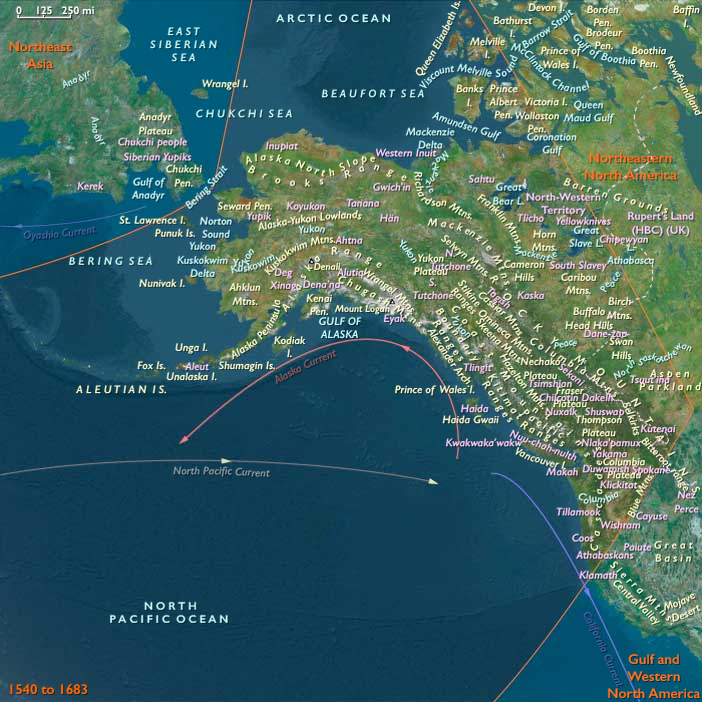
Northwestern North America comprised Alaska, the Yukon, British Columbia, Washington, northern Idaho, northwestern Montana, Oregon, and the far northern Pacific coast of California. The subregion encompassed the Gulf of Alaska, the Aleutian chain, the Alexander Archipelago, Haida Gwaii, Vancouver Island, the Salish Sea, the Fraser and Columbia river systems, the interior plateaus, the Coast and Cascade Mountains, and the western slopes of the Rockies.
From the Arctic Ocean to the Pacific, interconnected rivers, forests, mountain corridors, and coastal waterways continued to sustain one of the world's most environmentally integrated Indigenous landscapes.
Environmental Continuity
The Little Ice Age remained the dominant climatic influence. Glaciers persisted in the coastal mountains, winter snowpacks remained substantial across the interior, and annual variability continued to affect individual salmon runs and marine ecosystems.
Despite these fluctuations, the ecological framework of the region changed little. Vast cedar and conifer forests still enclosed the Pacific coast, major river systems continued supporting abundant salmon migrations, and marine environments from California's northern coast to the Bering Sea remained exceptionally productive.
Human societies continued adapting to environmental variability rather than transforming the landscape itself.
Human Adaptation
Communities maintained highly diversified seasonal economies that combined salmon fishing, marine harvesting, terrestrial hunting, root gathering, berry collecting, and extensive food preservation.
Permanent villages remained concentrated around productive estuaries, protected bays, and major river mouths, while interior Dene and Plateau peoples continued seasonal movement between fisheries, hunting territories, upland meadows, and winter settlements. Arctic communities coordinated whale, seal, walrus, fish, and caribou harvests through carefully timed seasonal cooperation.
Long-established ecological knowledge continued to provide stability despite climatic uncertainty.
Economic Organization
The regional economy remained overwhelmingly Indigenous. Salmon, eulachon oil, marine products, hides, native copper, obsidian, dentalium shells, woven goods, carved cedar products, and other resources continued circulating through well-established exchange networks linking coast, plateau, interior, and Arctic communities.
The Inside Passage remained the principal maritime corridor, while the Fraser, Skeena, Nass, Columbia, Yukon, and Copper rivers carried both goods and knowledge across the subregion. Grease trails continued connecting coastal fisheries with interior societies, reinforcing economic interdependence across contrasting ecological zones.
By the close of the age, only the faintest indications of distant overseas commerce existed at the margins of the North Pacific. Indigenous exchange systems remained entirely dominant.
Institutions
House societies continued providing the principal institutional framework of the Pacific coast. Hereditary stewardship of fisheries, forests, villages, ceremonial traditions, names, and trade relationships remained embedded within enduring kinship systems whose authority rested upon customary law and reciprocal obligation.
Ceremonial exchange continued evolving as an increasingly sophisticated institution through which succession, diplomacy, territorial rights, marriage alliances, conflict resolution, and public generosity were affirmed.
Monumental carving, ceremonial regalia, woven textiles, canoe construction, woodworking, and artistic traditions reached exceptional levels of refinement while remaining integral components of inhabited communities rather than isolated monuments.
Interior and Arctic societies likewise maintained institutions emphasizing seasonal mobility, oral tradition, ritual knowledge, cooperative subsistence, and ecological expertise.
Political Systems
Political authority remained overwhelmingly Indigenous and decentralized.
Coastal hereditary leaders continued exercising influence through stewardship of productive resources, ceremonial leadership, diplomacy, and generous redistribution rather than territorial conquest. Interior Dene, Plateau, and Arctic communities preserved leadership grounded in experience, consensus, environmental knowledge, and successful management of seasonal economies.
Local warfare, competition over fisheries, and occasional raiding continued to occur, but extensive networks of trade, marriage, ceremony, and customary law generally preserved stability across the wider region.
Foreign political influence remained negligible throughout almost the entire subregion.
Legacy of the Age
Between 1540 and 1683 CE, Northwestern North America remained one of the least externally affected regions of the inhabited world. While European empires expanded rapidly elsewhere across the Americas, no permanent colonial settlements yet reshaped the forests, fjords, river systems, or Arctic coasts of the far Northwest.
Instead, Indigenous societies continued refining institutions that had matured over many centuries. Salmon economies, house communities, grease-trail commerce, Arctic maritime adaptations, and interior seasonal networks remained the principal organizing systems of regional life.
By the close of the age, however, the North Pacific was becoming more closely connected. Although sustained foreign settlement had not yet begun, expanding Russian exploration across Siberia foreshadowed the first enduring maritime encounters that would gradually reshape portions of the subregion during the following century, while leaving its ecological foundations and Indigenous majority firmly intact.
Images
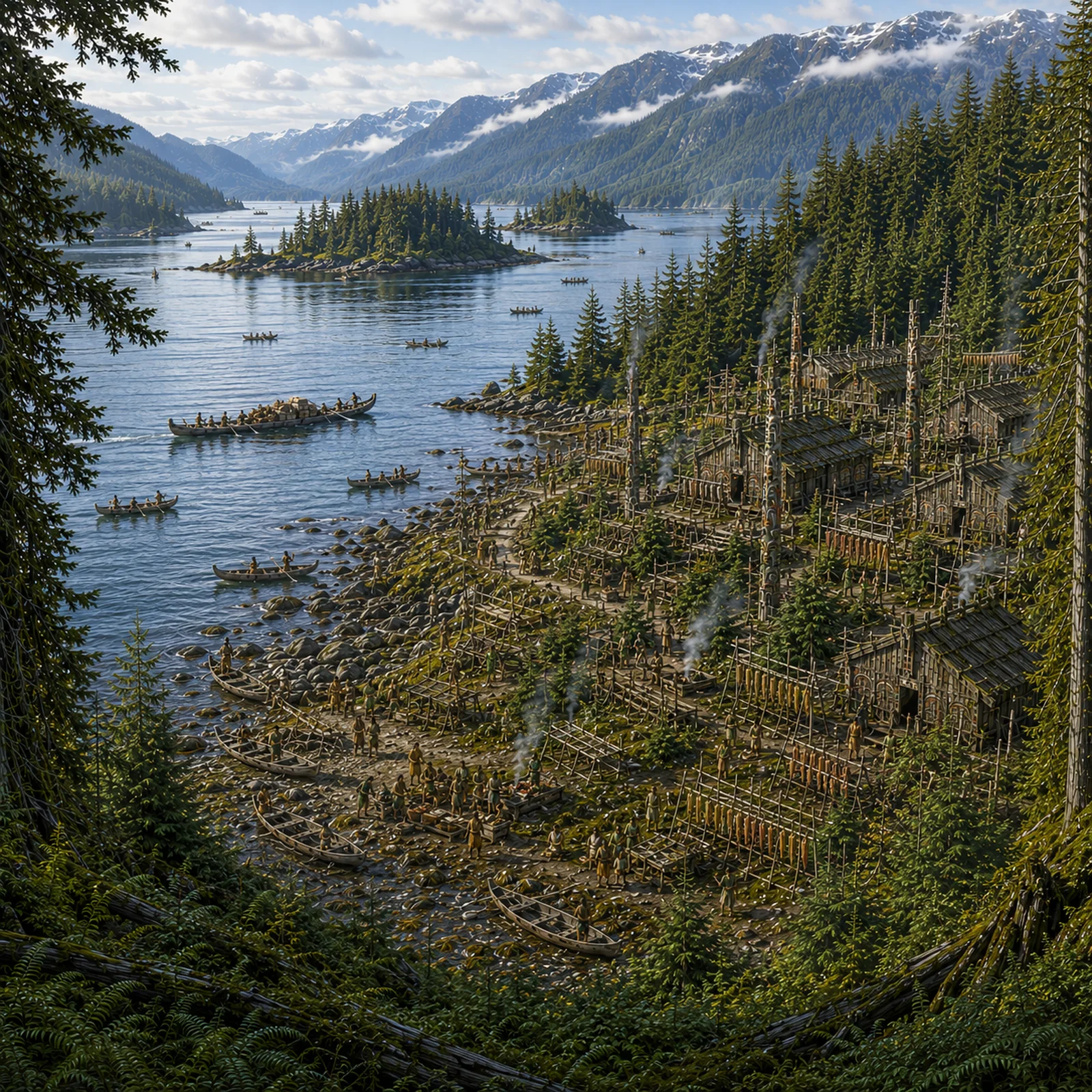
Northwestern North America in the Early Modern age
Groups
Commodities
Subjects
Regions
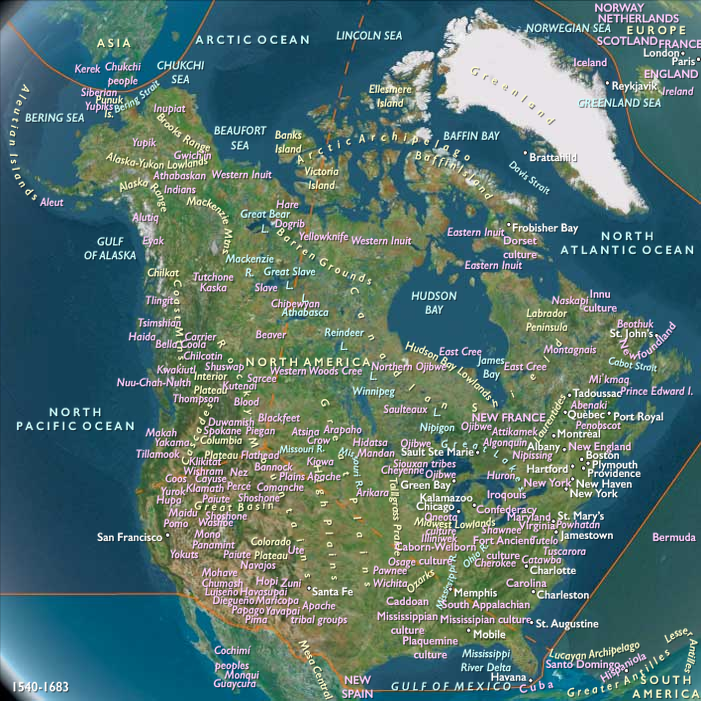
Northern North America
View →Subregions