Christopher Bainbridge comes from a Westmorland family…
March 1511 CE
Christopher Bainbridge comes from a Westmorland family with roots in Bainbridge, North Yorkshire, and is a maternal nephew of Thomas Langton, Bishop of Winchester, which may account for his charmed early life.
He had been granted an indult in 1479 which allowed him to hold church benefices while still unordained and under the age of sixteen, and another in 1482 that allowed him to hold more than one benefice concurrently.
Said to have been fifty years old at his death, he must therefore have been born about 1464.
He was described as a magister, or scientist, by 1486; at Bologna he was admitted DCL in 1492; he was in Rome between 1492–1494.
Appointed Provost of Queen's College, Oxford in 1496, and Master of the Rolls in 1504, he was incorporated at Lincoln's Inn on January 20, 1505.
By 1497, he had become chaplain to Henry VII; in 1503 dean of York; in 1505 he was Dean of St. George's Chapel, Windsor.
He was appointed Bishop of Durham on August 27, 1507.
Bainbridge had been translated to York on September 22, 1508, a sign of the favor he enjoys at court.
On September 24, 1509, King Henry VIII (whose coronation he had attended) had appointed Bainbridge to be his ambassador to Pope Julius II.
Just at this time Julius had taken alarm at the invasion of Italy by Louis XII of France, and the support of England was therefore of great importance.
Julius had left Rome to relieve Bologna, and was nearly taken prisoner in the war.
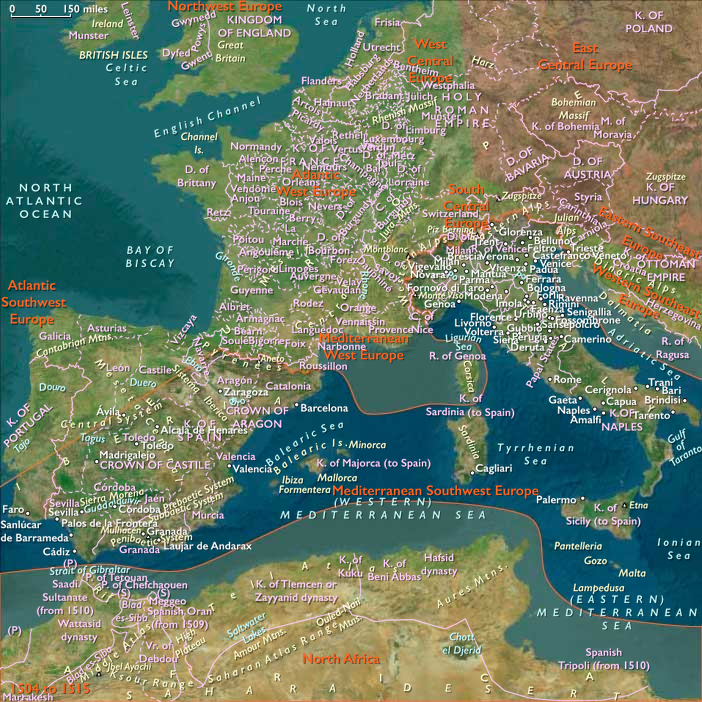
A group of pro-French cardinals had summoned a council in opposition to him at Pisa, which Julius opposed by calling another council at Rome, the Fifth Lateran Council, in the course of which he creates (in March 1511) several new Cardinals, of which Bainbridge is one, with the title of "Cardinal of St. Praxed's" or Santa Prassede.
Bainbridge is immediately sent with an army to lay siege to Ferrara, but the creation of the Holy League relieves the papacy of some pressure by involving Spain against the French forces.
Locations
People
Groups
Commodities
Subjects
Regions
Southwest Europe
View →Subregions