
Event
East Europe (1540–1683 CE): Muscovite Expansion, Cossack…
East Europe (1540–1683 CE): Muscovite Expansion, Cossack Revolt, and the Reconstruction of State Power
Geographic Parameters
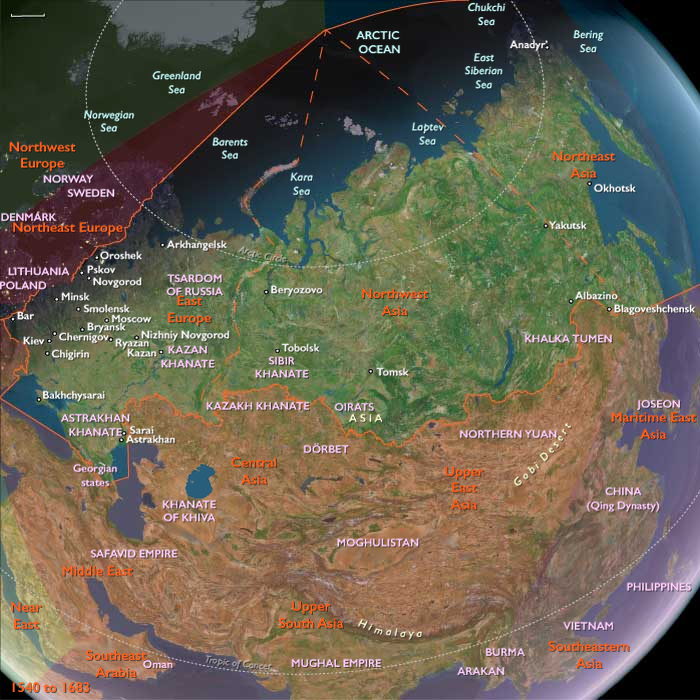
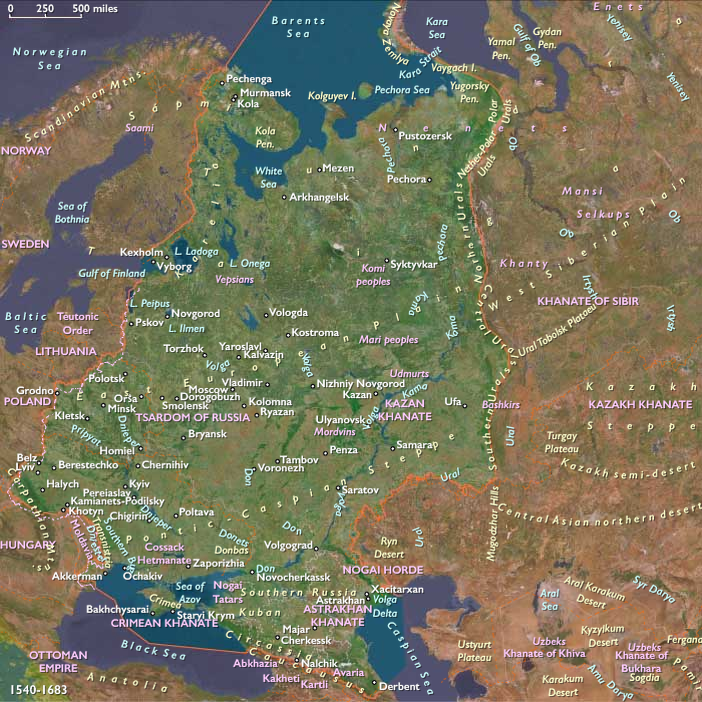
East Europe continued to include Belarus, Ukraine, European Russia west of the Urals, and the adjoining forest, forest-steppe, steppe, marshland, river, and Black Sea systems assigned to the subregion. Its political geography remained divided among several large and overlapping systems.
The Tsardom of Russia controlled the upper Volga, Oka, northern forest districts, former Novgorodian lands, and an expanding corridor toward Kazan, Astrakhan, and the lower Volga. The Grand Duchy of Lithuania, increasingly integrated with Poland, governed most Belarusian and Ukrainian lands west of the Muscovite frontier. The Crimean Khanate, under Ottoman suzerainty, remained a major power across the Black Sea steppe. The middle and lower Dnieper, Don, and adjoining frontier zones supported increasingly organized Cossack communities.
The Volga, Dnieper, Don, Dvina, Oka, Desna, and their tributaries remained the subregion’s principal arteries. Rivers carried grain, salt, timber, fish, troops, artillery, migrants, tax goods, and diplomatic missions. Fortified roads, river ports, watch lines, estate districts, and frontier settlements extended state authority unevenly across the same environmental framework.
Environmental Continuity
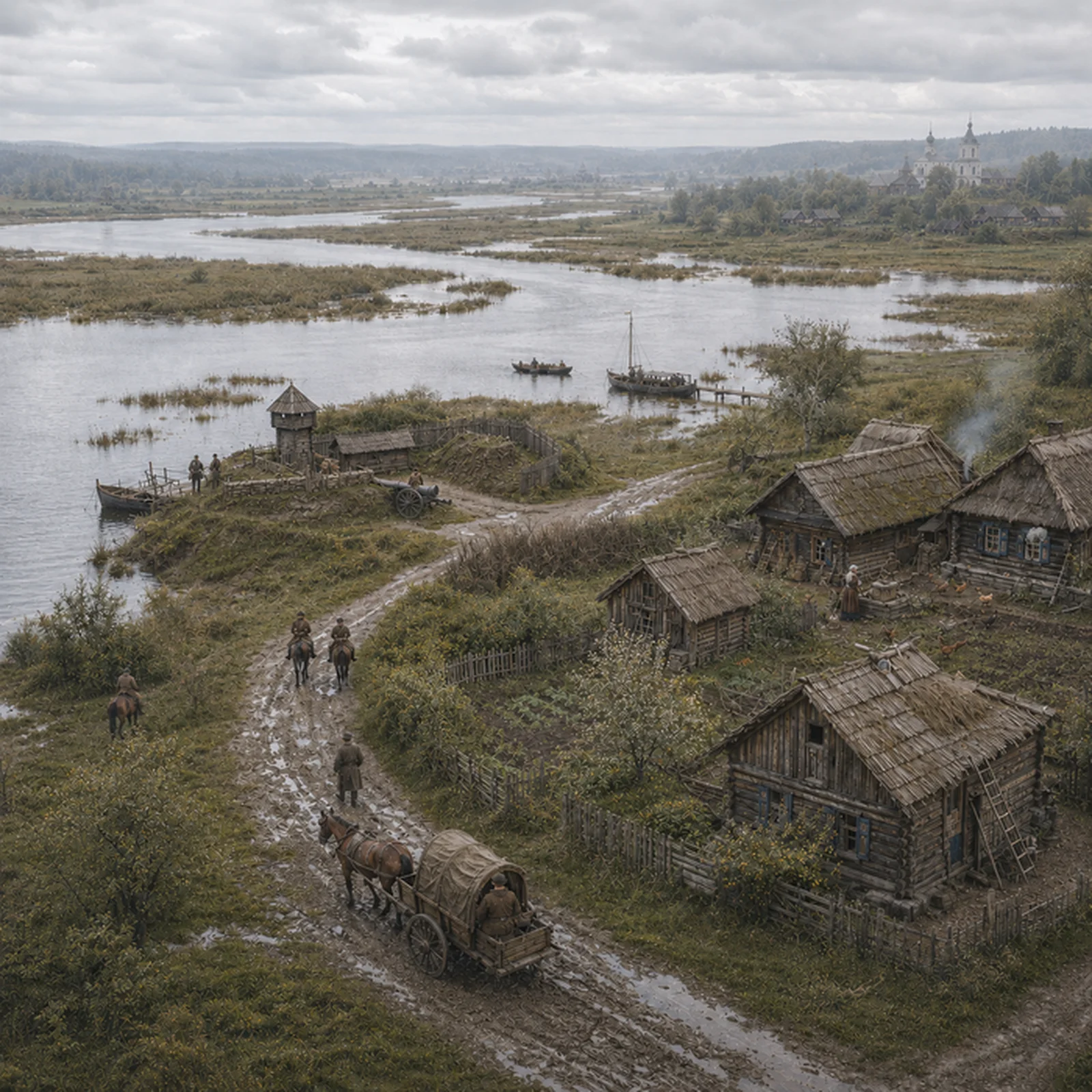
Forests, wetlands, black-earth plains, river meadows, orchards, village fields, and steppe pastures continued to shape daily life. Most households depended upon mixed agriculture, livestock, fishing, woodland products, beekeeping, gardening, and seasonal labor.
The principal new system of the age was expanded gunpowder state and frontier administration. Muscovy conquered the middle and lower Volga khanates, built new fortified corridors, expanded chancery government, and reorganized military service. Poland-Lithuania developed a more integrated Commonwealth while relying upon magnate estates, noble privilege, Ruthenian law, and regional institutions. Cossack communities transformed frontier mobility into increasingly durable military and political organizations.
This expansion did not create uniform control. State authority remained strongest around capitals, forts, monasteries, estate centers, river ports, and military roads. Forest districts, steppe margins, marshlands, and frontier islands continued to support local autonomy, evasion, migration, and resistance.
Climate and Environmental Change
The Little Ice Age continued to produce severe winters, wet summers, droughts, floods, and abrupt harvest variation. Northern districts remained dependent upon rye, oats, barley, buckwheat, flax, hemp, livestock, fisheries, and woodland resources. The forest-steppe could yield large grain surpluses but was vulnerable to drought, warfare, requisition, and raiding.
River freeze-up remained essential for sled transport and campaigning. Frozen waterways allowed heavy goods, officials, artillery, and troops to move across terrain that became nearly impassable during spring thaw. Flooding damaged settlements, mills, bridges, and fields, while summer drought reduced navigation and pasture.
The Russian famine of 1601–1603 followed several failed harvests during a period of unusual cold and rain. Political disorder, hoarding, disrupted transport, and unequal access to stored grain intensified the catastrophe. Large numbers died or migrated, and abandoned households contributed to the broader instability of the Time of Troubles.
Ivan IV and the Transformation of Muscovy
In 1547, Ivan IV was crowned tsar, giving Muscovite rulership a more explicitly imperial and sacred form. His early reign combined military expansion with legal, ecclesiastical, fiscal, and administrative reform.
The Sudebnik of 1550 revised legal procedure and strengthened central courts. The Stoglav council of 1551 attempted to regulate church practice, clerical discipline, icon painting, education, and relations between ecclesiastical and secular authority. Chancery offices, or prikazy, became increasingly important in taxation, diplomacy, military organization, landholding, and frontier administration.
The tsar did not govern through a complete centralized bureaucracy. Authority still depended upon service elites, provincial governors, monasteries, town communities, village institutions, local officials, and negotiated obligations.
The Conquest of Kazan
The Kazan Khanate controlled the middle Volga and remained a major commercial and political power. Its population included Tatars, Chuvash, Mari, Udmurts, Bashkirs, Russians, and others connected through agriculture, pastoralism, forest economies, tribute, and river trade.
After repeated campaigns, Muscovite forces captured Kazan in 1552. The conquest involved siege artillery, fortified encampments, river supply, engineering, and a large service army. The fall of the city brought mass death, enslavement, displacement, confiscation, and the destruction or conversion of religious and political institutions.
Muscovite authorities established forts, monasteries, Orthodox churches, service estates, and administrative settlements along the Volga. Muslim and Indigenous communities persisted, but their lands, taxation, political authority, and religious life came under increasing pressure.
The conquest opened the Volga more fully to Muscovite military and commercial control while requiring constant negotiation and coercion across a culturally plural region.
Astrakhan and the Lower Volga
In 1556, Muscovy annexed the Astrakhan Khanate, extending authority to the lower Volga and Caspian approaches. This linked the Russian state more directly to Persian, Central Asian, Caucasian, and steppe trade.
Astrakhan developed as a fortified commercial and administrative node. Grain, salt, fish, livestock, textiles, metal goods, spices, and captives moved through its markets and river landings.
Control remained uneven. Nogai groups, local elites, merchants, fishing communities, and pastoralists continued to use the lower Volga and Caspian corridors according to their own seasonal and political needs. Muscovite expansion created a chain of forts and customs points rather than immediate mastery of the entire region.
The Livonian War
Ivan IV’s attempt to gain direct access to Baltic trade led to the Livonian War beginning in 1558. Muscovy initially captured several fortified towns, but the conflict widened to include Lithuania, Poland, Sweden, and Denmark.
The war devastated frontier districts through siege, requisition, fire, disease, forced labor, and population displacement. Fortified towns changed hands repeatedly, and rural settlements were abandoned or stripped of livestock and grain.
The Union of Lublin in 1569 created the Polish-Lithuanian Commonwealth, transferring many Ukrainian lands from Lithuanian to Polish administration while joining the two states more closely under a shared monarch and parliament.
Muscovy ultimately failed to secure a lasting Baltic outlet. The war exhausted state finances, weakened service estates, disrupted trade, and intensified internal repression.
The Oprichnina
In 1565, Ivan IV created the oprichnina, dividing the realm into territories under his direct control and those governed through existing institutions. The policy involved confiscation, forced resettlement, execution, surveillance, and attacks upon aristocratic, clerical, urban, and regional communities.
The destruction of Novgorod in 1570 became the most notorious episode. Residents were killed, imprisoned, dispossessed, or displaced, while churches, warehouses, estates, and commercial networks were plundered.
The oprichnina weakened established elites but did not produce efficient central government. It disrupted agriculture, taxation, military service, and local administration at a time when the Livonian War and Crimean pressure demanded coordinated resources.
Its historical significance lay in the expansion of coercive state power and the demonstration that territorial consolidation could destabilize the productive systems on which the state itself depended.
Crimean and Ottoman Pressure
The Crimean Khanate remained a formidable military and political power. Crimean forces raided Muscovite and Commonwealth lands for captives, livestock, tribute, and strategic advantage.
In 1571, the forces of Khan Devlet I Giray reached Moscow and burned much of the city. The following year, Muscovite forces defeated another large Crimean army at Molodi, limiting but not ending the threat.
Crimean, Nogai, Ottoman, Muscovite, Cossack, and Commonwealth interests overlapped across the steppe. Raids, alliances, tribute, trade, and military service tied these powers together even as they fought.
The slave trade remained central to frontier violence. Captives from Ukrainian, Belarusian, Russian, Polish, Caucasian, steppe, and other communities were transported through Crimea and Black Sea markets. Frontier prosperity and state military systems were inseparable from coercion and human displacement.
The Polish-Lithuanian Commonwealth
The Polish-Lithuanian Commonwealth, established in 1569, created a federated political system governed by an elected monarch, parliament, noble privileges, regional law, and extensive local institutions.
The Commonwealth included most of Belarus and Ukraine. Ruthenian remained important in administration and legal practice, especially in the Grand Duchy of Lithuania. The Lithuanian Statutes continued to regulate property, service, courts, and social status.
Magnate estates expanded across fertile Ukrainian and Belarusian lands. Grain, livestock, timber, potash, flax, hemp, wax, and other products moved toward Baltic and regional markets. Estate growth increased agricultural production while strengthening noble control over peasant labor.
The Commonwealth was religiously plural. Orthodox, Catholic, Protestant, Jewish, Muslim Tatar, Armenian, and other communities lived within its territories. The Warsaw Confederation of 1573 offered a notable framework of noble religious toleration, though protection was unequal and social tensions persisted.
The Union of Brest
In 1596, several Orthodox bishops entered communion with Rome through the Union of Brest, creating the Ruthenian Uniate Church, later known as the Ukrainian and Belarusian Greek Catholic traditions.
The union preserved the Byzantine rite while accepting papal authority. It was supported by some bishops and elites but opposed by many Orthodox clergy, monasteries, townspeople, nobles, and Cossacks.
Religious conflict became intertwined with political, social, and cultural tensions. Orthodox confraternities established schools, printing houses, hospitals, and charitable institutions. Uniate communities developed their own institutional networks, while Catholic and Jesuit education expanded.
This confessional competition strengthened literacy, printing, and urban organization but also produced dispossession, legal conflict, polemical campaigns, and periodic violence.
Printing, Education, and Written Culture
Printing expanded across Muscovy and the Commonwealth. In Moscow, Ivan Fedorov and Petr Mstislavets printed the Apostol in 1564. Fedorov later worked in Ruthenian and Polish-Lithuanian territories, contributing to Orthodox print culture.
The Ostroh Bible of 1581 became a major Church Slavonic publication. Schools and printing houses associated with Orthodox confraternities, monasteries, Catholic orders, and Protestant patrons expanded access to religious and legal texts.
The Kyiv-Mohyla educational tradition began to form through Orthodox schools and institutions in the early seventeenth century. These networks connected Ruthenian scholars to Polish, Latin, Greek, and wider European intellectual traditions.
Written administration also deepened. Chancery records, military registers, estate accounts, tax books, diplomatic correspondence, and court documents allowed states and landholders to coordinate resources more intensively.
Peasant Labor and the Expansion of Serfdom
Across both Muscovy and the Commonwealth, states and landholders increased control over peasant labor and movement.
In Muscovy, restrictions on legal departure intensified during the late sixteenth and seventeenth centuries. Search periods for fugitives expanded, and the Law Code of 1649, or Sobornoye Ulozhenie, established indefinite pursuit of runaway peasants and strengthened hereditary servitude.
In the Commonwealth, noble estates expanded labor dues, rents, and jurisdiction over dependent peasants. The grain-export economy encouraged magnates and lesser nobles to enlarge cultivated estates and intensify corvée obligations.
Peasants responded through negotiation, evasion, migration, petitions, hidden cultivation, flight to frontier zones, and participation in revolt. The expansion of serfdom did not make rural society passive; it created continuous conflict over land, labor, taxation, and movement.
Cossack Communities
Cossack societies along the Dnieper, Don, and other frontier rivers became increasingly organized. The Zaporozhian Cossacks established fortified and mobile centers in the lower Dnieper region, including successive forms of the Sich.
Cossack economies combined fishing, hunting, herding, farming, trade, escort service, military employment, and raiding. Their communities attracted peasants escaping estate obligations, townspeople, minor nobles, adventurers, and frontier specialists.
The Commonwealth attempted to register and employ a limited number of Cossacks while restricting the status of the larger unregistered population. This produced recurrent conflict over military pay, noble privilege, Orthodox religion, landholding, and social recognition.
The Don Cossacks developed parallel but distinct institutions in the Don basin, maintaining relationships with Muscovy while preserving substantial autonomy.
Cossack authority was neither purely democratic nor socially equal. Elected councils and officers coexisted with military hierarchy, wealth differences, patronage, and dependence upon neighboring states.
The Time of Troubles
The death of Tsar Fyodor I in 1598 ended the ruling Rurikid dynasty. Boris Godunov became tsar, but famine, elite rivalry, social unrest, disputed legitimacy, and foreign intervention destabilized the realm.
Pretenders claiming to be the surviving son of Ivan IV gained support among disaffected nobles, Cossacks, townspeople, peasants, and foreign powers. Successive rulers rose and fell, while Polish-Lithuanian forces occupied parts of Muscovy and Swedish forces intervened in the northwest.
The Time of Troubles brought widespread famine, warfare, banditry, village abandonment, forced recruitment, and the collapse of regular taxation and administration in many districts.
Local militias, towns, monasteries, noble forces, and Cossack groups organized resistance and survival. In 1612, a militia associated with Kuzma Minin and Prince Dmitry Pozharsky expelled the Polish garrison from Moscow.
The election of Michael Romanov in 1613 restored dynastic government but did not immediately repair the countryside or administrative system.
Romanov Reconstruction
The early Romanov dynasty rebuilt state authority through taxation, service obligations, chancery administration, military reform, and negotiation with regional elites.
Forts, roads, postal routes, monasteries, markets, and estate districts were restored. The government expanded census-taking and tax assessment while attempting to stabilize the service class and recover fugitives.
Recovery remained uneven. Many villages rebuilt with salvaged timber, reclaimed abandoned fields, and relied upon communal labor, fishing, forests, and local markets.
The state’s reconstruction depended upon the same households burdened by taxation, military recruitment, labor obligations, and restrictions on movement.
Military Reform
During the seventeenth century, Muscovy adopted “new formation” regiments trained and equipped partly according to western European infantry, cavalry, and artillery practices.
Foreign officers, artisans, gunners, physicians, merchants, and engineers entered Muscovite service. Firearms, artillery, uniforms, drill, fortified lines, and supply depots became more important.
Traditional service cavalry remained essential, and military reform proceeded gradually. The state maintained mixed forces rather than replacing older systems all at once.
Gunpowder warfare increased demand for taxes, grain, horses, metal, timber, powder, roads, and specialized labor. Military modernization therefore deepened administrative intervention in productive landscapes.
Smolensk and Western Warfare
The Commonwealth retained Smolensk after the Time of Troubles. Muscovy attempted to recover it during the Smolensk War of 1632–1634 but failed.
The conflict demonstrated the growing importance of artillery, fortified positions, supply organization, and new-model troops. It also exposed weaknesses in Muscovite command and logistics.
Smolensk remained a fortified hinge between the Dnieper, Lithuanian-Ruthenian lands, and Muscovy until the mid-seventeenth century.
Frontier warfare continued to damage villages, consume grain and livestock, and require populations to maintain refuges, watch systems, and alternative routes.
The Khmelnytsky Uprising
In 1648, a major uprising led by Bohdan Khmelnytsky began among the Zaporozhian Cossacks and spread across much of Ukraine.
The revolt arose from conflict over Cossack status, noble and magnate authority, peasant labor, Orthodox rights, taxation, landholding, and the political position of Ruthenian society within the Commonwealth.
Cossack armies allied with the Crimean Khanate and defeated several Commonwealth forces. Peasants and townspeople joined the uprising, while estate systems collapsed across wide areas.
The violence was extensive. Polish nobles, officials, Catholic and Uniate clergy, Jewish estate intermediaries and communities, and others were attacked, expelled, or killed. Commonwealth and allied forces carried out reprisals. The conflict produced massacres, enslavement, famine, disease, and large-scale displacement.
Jewish communities suffered catastrophic losses because many were associated—fairly or unfairly—with estate administration, taxation, trade, and noble economic systems. Their destruction must be treated directly rather than absorbed into a generalized narrative of social revolution.
The Cossack Hetmanate
The uprising created the Cossack Hetmanate, a new political system centered upon regiments, councils, officers, towns, monasteries, village communities, and the authority of the hetman.
The Hetmanate reorganized taxation, military service, landholding, and administration across much of central Ukraine. Orthodox institutions gained political and cultural influence, while the old magnate estate order was disrupted.
Cossack officers increasingly accumulated land and privilege, producing new inequalities. Peasant and urban communities that had expected broad liberation often found themselves subject to renewed obligations.
The Hetmanate’s political survival depended upon alliances with Crimea, the Commonwealth, Muscovy, the Ottoman Empire, and neighboring powers. These relationships were unstable and frequently contradictory.
Pereiaslav and the Russo-Polish War
In 1654, representatives of the Hetmanate entered an agreement with Tsar Alexis of Russia at Pereiaslav. The exact constitutional meaning of the agreement remained disputed even at the time.
Khmelnytsky and many Cossack leaders sought military protection and recognition of Hetmanate rights. Muscovy interpreted the relationship as submission to the tsar while initially confirming broad autonomy.
The agreement initiated a major war between Russia and the Commonwealth. Muscovite and Cossack forces captured extensive territories, including Smolensk, while Swedish intervention transformed the wider conflict.
The war devastated Belarus and Ukraine through sieges, requisition, famine, epidemic disease, deportation, and shifting occupation. Many towns and villages lost large portions of their populations.
The Ruin
After Khmelnytsky’s death in 1657, succession disputes and competing foreign alliances plunged Ukraine into the period known as the Ruin.
Rival hetmans aligned with Muscovy, the Commonwealth, Crimea, or the Ottoman Empire. The Dnieper territories became divided, while armies crossed the same agricultural districts repeatedly.
The Treaty of Andrusovo in 1667 divided the Hetmanate broadly along the Dnieper. Left-Bank Ukraine and Kiev came under Russian authority, while Right-Bank Ukraine remained largely within the Commonwealth.
This partition did not end conflict. Communities continued to experience recruitment, taxation, forced movement, crop destruction, enslavement, and political uncertainty.
The Ruin demonstrated that the creation of a Cossack polity did not resolve the struggle among regional empires, local elites, peasant communities, and military institutions.
Religious Schism in Russia
The seventeenth-century reforms of Patriarch Nikon sought to standardize Russian Orthodox rites and texts according to contemporary Greek practice.
Many clergy and laypeople rejected the reforms, creating the Old Believer movement. The Church councils of the 1660s condemned the old rites, and state authorities imposed persecution, exile, imprisonment, and execution.
Old Believer communities fled into forests, northern districts, frontier zones, and neighboring territories. They established settlements, workshops, merchant networks, monasteries, and clandestine religious institutions.
The schism showed that stronger church-state coordination could create enduring internal religious frontiers rather than uniform belief.
Urban and Commercial Development
Moscow expanded as an administrative, craft, and commercial center. Its timber neighborhoods, markets, monasteries, foreign quarter, workshops, storehouses, and river landings surrounded the Kremlin’s stone and brick core.
Arkhangelsk remained the principal maritime outlet for trade with western Europe until the foundation of St. Petersburg in the next age. English, Dutch, German, Armenian, Persian, Central Asian, and other merchants participated in Muscovite trade.
The Volga connected Moscow and the interior to Kazan, Astrakhan, the Caspian, and Persian markets. Grain, salt, fish, furs, leather, timber, metal goods, textiles, and luxury products moved through river ports.
In the Commonwealth, Kiev, Lviv, Vilnius, Minsk, Mogilev, and other towns supported trade, printing, education, religious institutions, crafts, and regional administration.
Urban growth remained closely tied to surrounding agriculture, estates, monasteries, and river corridors.
Productive Landscapes
Agriculture continued to support state power, estate wealth, military provisioning, and urban growth. Rye, oats, barley, buckwheat, wheat, millet, flax, hemp, peas, and garden crops varied by region.
In Ukrainian and southern forest-steppe districts, grain production expanded when warfare allowed. In Belarus and northern Russia, mixed farming remained closely connected to livestock, forests, marshes, and seasonal labor.
Hay and fodder were essential for cavalry and transport animals. Mills, granaries, barns, distilleries, salt works, fisheries, and textile workshops expanded near estates and towns.
The Volga fisheries and salt districts became especially important to the Russian state and merchants. Monasteries and elite households controlled some large productive complexes, while village and Cossack communities retained substantial local economies.
Repeated war, famine, and requisition left many fields abandoned. Recovery often involved migrants, returning households, Cossack settlers, monastic colonization, and state incentives.
Movement and Interaction Corridors
The Volga corridor became more tightly integrated into the Russian state after the conquest of Kazan and Astrakhan. Forts, river ports, customs points, military settlements, and monasteries extended along the route.
The Oka defensive line and later fortified corridors protected the Muscovite heartland from steppe raids. Watch posts, signal systems, patrol roads, and service settlements formed discontinuous but increasingly coordinated barriers.
The Dnieper remained central to Cossack movement, trade, warfare, and political organization. River islands, rapids, fisheries, and fortified settlements supported the Zaporozhian system.
The upper Dnieper and Dvina linked Muscovy, Smolensk, Belarus, Lithuania, and Baltic-facing trade. The Don connected Cossack, Muscovite, Crimean, and Ottoman zones.
Postal and courier systems improved, but roads remained highly seasonal. Rivers and winter routes continued to carry much of the region’s bulk transport.
Violence, Extraction, and Displacement
The age brought repeated conquest, civil war, famine, enslavement, religious persecution, deportation, and forced labor.
Muscovite expansion displaced and subordinated communities along the Volga. The oprichnina devastated towns and estates. The Time of Troubles fractured ordinary administration and food distribution. Crimean and Nogai raids carried captives south.
The Khmelnytsky uprising and subsequent wars destroyed estate systems, towns, Jewish communities, villages, churches, and markets. The Ruin divided populations among rival authorities.
The expansion of serfdom restricted movement and deepened landlord control in both Russia and the Commonwealth. Old Believers, religious minorities, fugitives, peasants, and frontier settlers often survived by moving into forests, marshes, Cossack territories, or newly conquered lands.
State reconstruction repeatedly depended upon populations already damaged by war and extraction.
Adaptation and Resilience
Households survived through mixed crops, livestock, fishing, forests, gardens, communal labor, hidden storage, migration, and informal exchange.
Cossack territories offered escape from some estate obligations but imposed military discipline and exposed settlers to frontier warfare. Monasteries provided food storage, refuge, credit, education, and charity while also controlling land and dependent labor.
Towns rebuilt timber neighborhoods quickly after fire or siege. Merchants redirected goods among Volga, Dnieper, Baltic, Caspian, and northern routes when war closed particular corridors.
Religious communities preserved ritual and identity through confraternities, clandestine worship, printed books, migration, family networks, and local patronage.
Political resilience depended upon negotiated autonomy. Cossack officers, boyars, magnates, clergy, merchants, town councils, and local officials adapted to changing sovereigns while attempting to preserve property and institutional continuity.
These strategies could not prevent catastrophe. They allowed parts of society to reconstruct themselves after repeated episodes of violence and state collapse.
Legacy of the Age
By 1683 CE, East Europe had been reorganized by conquest, gunpowder administration, confessional conflict, Cossack state-building, and the restoration of dynastic authority.
The Russian state controlled the Volga from its upper reaches to the Caspian, had recovered from the Time of Troubles, annexed Smolensk, and extended authority into Left-Bank Ukraine. The Romanov monarchy governed through chancery offices, service elites, codified serfdom, fortified corridors, new-model regiments, and an expanding Orthodox state.
The Polish-Lithuanian Commonwealth remained a major regional power but had been weakened by Cossack revolt, Muscovite war, Swedish invasion, demographic loss, and magnate rivalry. Its Ruthenian lands were politically divided, while Belarus and Right-Bank Ukraine bore severe wartime destruction.
The Cossack Hetmanate had established a durable political and military tradition, though its autonomy was divided and increasingly constrained by Russian, Commonwealth, Ottoman, and Crimean power.
The Crimean Khanate remained a major steppe force under Ottoman suzerainty. Raiding, slave trading, pastoralism, diplomacy, and Black Sea commerce continued to shape the southern frontier.
The principal historical development of the age was the creation and reconstruction of larger gunpowder states and militarized frontier systems. Authority operated through forts, artillery, service landholding, chancery records, census-taking, codified labor control, regimental organization, religious institutions, and strategic river corridors.
These stronger systems did not eliminate local or regional autonomy. They intensified the struggle over who would control villages, labor, faith, trade, frontier movement, and the productive landscapes that sustained political power.
The next age would see Russia transformed into an empire with a Baltic capital, the Cossack order progressively absorbed, the Polish-Lithuanian Commonwealth partitioned, Crimea annexed, the northern Black Sea colonized, and East Europe reorganized around imperial roads, canals, ports, estates, and armies.
-
{# Image navigates to the detail page; the magnifying-glass chip is the only Fancybox lightbox trigger (kept a separate sibling — anchors can't nest). #}
 The Great Crossroads
World
-
{# Image navigates to the detail page; the magnifying-glass chip is the only Fancybox lightbox trigger (kept a separate sibling — anchors can't nest). #}
 Northeastern Eurasia
Region
-
{# Image navigates to the detail page; the magnifying-glass chip is the only Fancybox lightbox trigger (kept a separate sibling — anchors can't nest). #}
 East Europe
Subregion
