Southeast Europe (820 – 963 CE): Bulgar…
820 CE to 963 CE
Southeast Europe (820 – 963 CE): Bulgar Ascendancy, Byzantine Restoration, and the Slavic Christianization
Geographic and Environmental Context
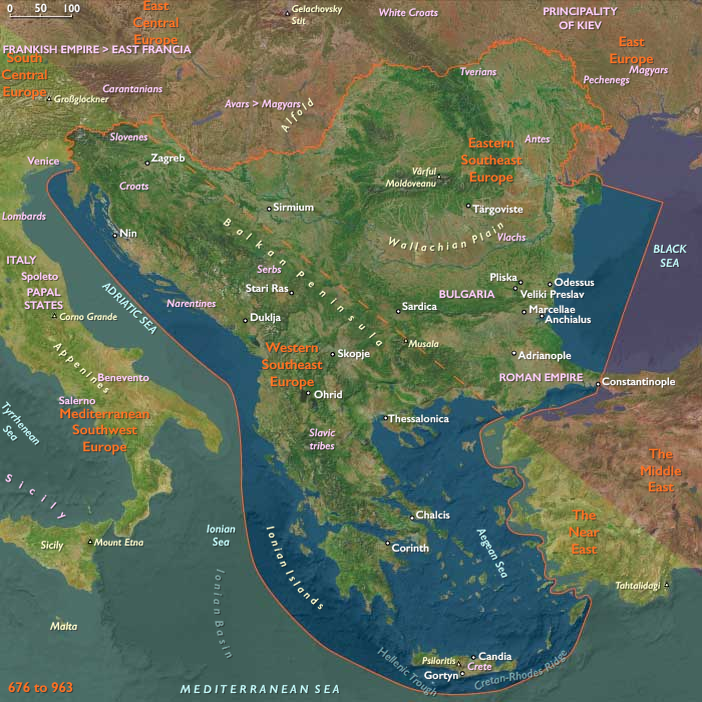
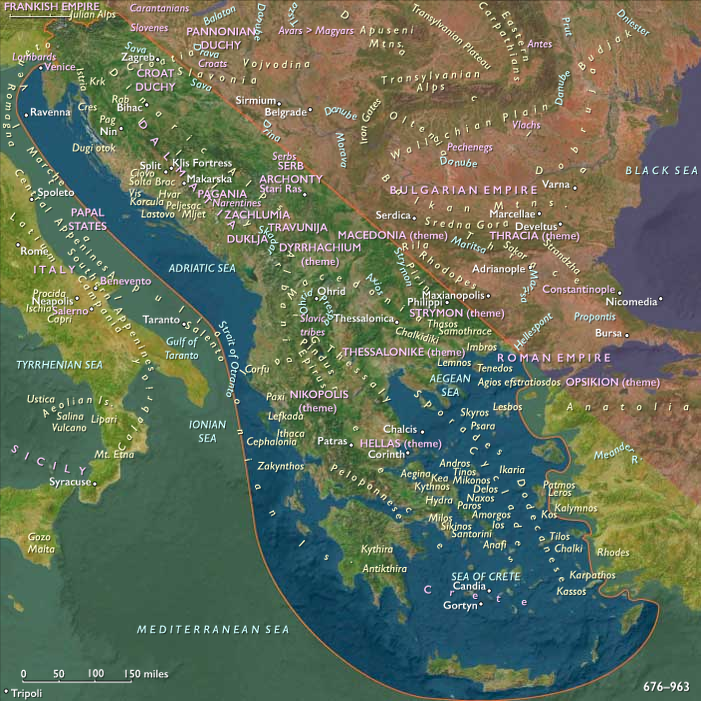
Southeast Europe in this age stretched from Thrace and the Lower Danube through the Haemus/Balkan and Carpathian corridors to the Adriatic coasts and Greek peninsulas.
-
Core lowlands: the Lower Danube–Wallachian plains, Dobruja steppe–coast, and the Thracian plain around Adrianople (Edirne).
-
Mountain gates: Shipka and other Balkan passes; Carpathian gates into Transylvania; the Via Militaris (Belgrade–Niš–Sofia–Adrianople–Constantinople) and Via Egnatia (Dyrrachium–Thessaloniki) bound interior and sea.
-
Sea nodes: Black Sea ports of Dobruja and Adriatic city-ports (Split, Zadar, Trogir, Ragusa) tied agrarian interiors to Mediterranean and Pontic trade.
A cool–temperate regime trended toward the Medieval Warm Period after c. 950, lengthening growing seasons in the Danube–Thrace lowlands while Danube flood pulses and steppe drought cycles continued to shape transport and incursions.
Societies and Political Developments
Eastern Balkans: Bulgaria and the Byzantine–Danubian Frontier
-
First Bulgarian Empire (Pliska → Preslav):
-
Boris I (r. 852–889) adopted Christianity (864/865), aligning diplomatically with Constantinople while pursuing church autonomy.
-
The Cyril–Methodius mission (863) and the return of their disciples founded the Ohrid and Preslav Literary Schools, standardizing Glagolitic → Cyrillic and enabling Slavic liturgy and administration.
-
Simeon I “the Great” (r. 893–927) reached Bulgaria’s apogee—victory at Achelous (917), sieges of Constantinople, imperial titulature, and a brilliant court culture at Preslav.
-
Peter I (r. 927–969) secured peace and imperial recognition (927) but faced rising Magyar (after c. 895) and Pecheneg pressures; the Bogomil movement (c. 930s) signaled social–religious tensions within the new Christian order.
-
-
Byzantine Thrace and Macedonia themes: Under the Macedonian dynasty (Basil I, Leo VI, Constantine VII), the empire restored forts along the Via Militaris, reasserted logistics to Adrianople, and balanced war and diplomacy with Bulgaria. In 963, Nikephoros II Phokas’s accession strengthened the professional army, though Balkan policy still prioritized positional defense and treaty management.
Danubian North and Marchlands
-
South of the Carpathians and across the Lower Danube, Slavic and Romance communities—early loci of Romanian ethnogenesis—moved between Bulgarian suzerainty and Byzantine diplomacy.
-
The Magyars settled the Carpathian Basin (c. 895–907), ending Great Moravia and redrawing the northwest frontier; Pechenegs entered the Lower Danube by the mid-10th century, altering raid/tribute dynamics.
-
Along the Sava–Danube confluences, local principalities leveraged tolls and crossings to navigate Bulgar, Byzantine, and later Magyar power.
Western Balkans and Greece: Adriatic Cities, Croatia, and Serbian Lands
-
Byzantine Greece (outside Thrace): recovery of earlier Sklaviniai; strengthening of the Themes of Hellas and Peloponnēsos; town networks and fiscal-military administration revived under Basil I and Leo VI; Constantine VII codified provincial governance. The age culminated spiritually with St. Athanasios founding the Great Lavra (963) on Mount Athos, inaugurating the Athonite commonwealth.
-
Dalmatian cities (Split, Zadar, Trogir, Ragusa/Dubrovnik): Latin civic traditions under Byzantine suzerainty; maritime brokers between Venice, southern Italy, and the Aegean.
-
Croatia: the duchy consolidated in the 9th c.; under Tomislav (trad. c. 925), a Kingdom of Croatia emerged, mediating between Byzantium (Dalmatian towns) and inland zones; Glagolitic liturgy—heir to Cyril–Methodius—took root alongside the Latin rite.
-
Serbian principalities (Raška, Zahumlje, Travunija, Duklja): Vlastimirović rulers and coastal župans balanced Bulgar–Byzantine–Croatian pressures; baptism and church-building advanced unevenly from gradine hillfort centers.
-
Bosnia & inland Slovenia: clustered hillfort communities under župans and counts tied variably to Croatian and Frankish spheres.
-
North Macedonia & Vardar: Slavic polities faced alternating Bulgar and Byzantine influence; Thessaloniki anchored imperial control; the Cyril–Methodius afterglow radiated west via scriptoria and clergy.
Economy and Trade
-
Agrarian base: wheat, barley, millet, and vines flourished across Thrace and the Danube plain; stock raising dominated Balkan and Carpathian piedmonts.
-
River–sea circuits: Danube and Black Sea nodes (e.g., Drastar/Silistra, Varna) moved grain, salt (Transylvania & Dobruja), wax, honey, furs, and slaves; Byzantine silk, wine, coin and steppe horses circulated inland.
-
Urban & court economies: Preslav developed scriptoria and artisan quarters (metalwork, fine ceramics); Adrianople provisioned troops and caravans on the Constantinople road.
-
Adriatic trade: Via Egnatia carried Balkan grain, timber, wax from Dyrrachium to Thessaloniki; Dalmatian cities shipped to Venice/Apulia; nomismata and Italian denarii accompanied cloth, wine, ceramics, and metalware.
Interior markets (Skopje, Niš) exchanged hides, honey, wax, and slaves for Mediterranean goods.
Subsistence and Technology
-
Fortifications and military systems:
Timber–earth ramparts were upgraded to stone in key sites such as Preslav, Drastar (Silistra), and Adrianople, while chains of fortified theme frontiers guarded Danube crossings and mountain passes.
These defenses largely followed the alignments of the old Roman limes and the late imperial praefectura Illyricum, whose forts and settlements continued to anchor medieval strategy.
Bulgarian forces combined heavy cavalry and infantry for field campaigns, while Byzantine armies relied on the thematic system of provincial troops and garrisons. On the steppe fringes, Magyar and Pecheneg horse archers introduced deep-raiding tactics that reshaped frontier warfare along the Danube and Thrace. -
Agro-tech: terrace vines/olives in Greece; cereal rotations in lowlands; pastoral transhumance across Dinaric/Pindus slopes; lagoon salt/fish production.
-
Scripts & learning: Cyrillic consolidated after 900 at Preslav, enabling Slavic law codes, diplomacy, and liturgy; Latin in Adriatic municipalities; Greek in imperial administration.
Movement and Interaction Corridors
-
Via Militaris—the Balkan spine—linked Belgrade–Niš–Sofia–Adrianople–Constantinople.
-
Danube: moat and highway—boat patrols, ferries, and riparian markets bound Bulgaria, Byzantium, and steppe intermediaries.
-
Carpathian passes mediated Magyar arrival and later commerce; Shipka and allied passes funneled Bulgar–Byzantine armies.
-
Via Egnatia tied Dyrrachium to Thessaloniki and the capital; Adriatic sea-lanes (Venice–Dalmatia–Greece) completed the maritime arc.
Belief and Symbolism
-
Orthodox rulership anchored both Byzantine and Bulgar legitimacy after Boris I’s baptism; Bulgaria’s autocephalous aspirations (archiepiscopal → patriarchal claims) framed imperial style under Simeon I.
-
Bogomilism (c. 930s) voiced dualist critique and social dissent, later diffusing westward.
-
Monastic engines—Preslav and the Ohrid school—produced translations, homilies, and Slavic pedagogy; in the west, Athonite monasticism (from 963) re-mapped sacred geography.
-
Latin and Greek rites coexisted along the Adriatic front, while Glagolitic/Cyrillic extended Slavic Christianization inland.
Adaptation and Resilience
-
Bulgar–Byzantine equilibrium—war, treaty, and tribute—stabilized borders and trade, sustaining cultural florescence despite frontier shocks.
-
Danube redundancy: when steppe raids impeded land routes, riverine caravans and Black Sea shipping re-routed goods.
-
Cultural integration: Slavic liturgy and Cyrillic fostered administrative capacity and cohesion across diverse communities.
-
Theme logistics and kastra–gradina pairings let Byzantine and inland polities absorb defeats, preserve depth, and recover.
Long-Term Significance
By 963 CE, Southeast Europe stood on two pillars:
-
A Bulgar imperial court at Preslav—Christian, literate, and expansionist—radiating Slavic law and culture;
-
A Byzantine Thrace and Greek heartland—re-fortified along the Via Militaris and Via Egnatia, renewing spiritual authority with Athos at the close of the age.
Around them, Magyar settlement in the Carpathian Basin and Pecheneg movements along the Lower Danube reshaped the northern rim, while Croatia’s kingship, Serbian principalities, and Dalmatian cities consolidated the Adriatic interface.
The age fixed the region’s Orthodox Slavic identity, Cyrillic literary infrastructure, and strategic centrality between Aegean, Black Sea, and steppe—foundations that would define the medieval Balkans and the contests of the following age.
Images

Eastern Southeast Europe (with civilization) ©2024-25 Electric Prism, Inc. All rights reserved.
People
Groups
Topics
Commodities
Subjects
Regions