
Eastern Southeast Europe (820 – 963 CE):…
820 CE to 963 CE
Eastern Southeast Europe (820 – 963 CE): Bulgar Ascendancy, Byzantine–Danubian Frontiers, and the Slavic Christianization
Geographic and Environmental Context
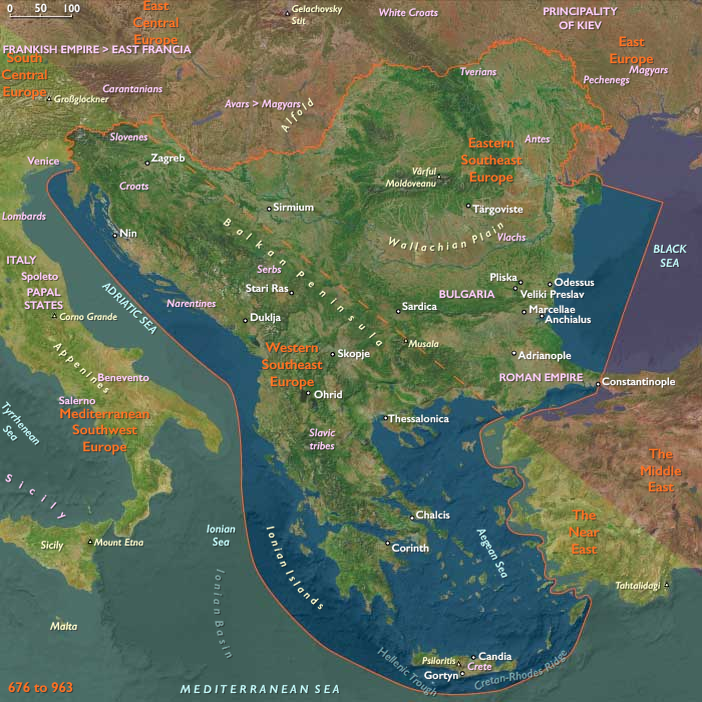
Eastern Southeast Europe includes Turkey-in-Europe (Thrace), northeastern Greece (Thrace-in-Greece), nearly all of Bulgaria (except its southwestern portion), modern-day Romania and Moldova, northeastern Serbia, northeastern Croatia, and extreme northeastern Bosnia and Herzegovina.
-
Core lowlands: the Lower Danube and Wallachian plains, the Dobruja steppe–coast, and the Thracian plain around Adrianople (Edirne).
-
Mountain corridors: Balkan/Haemus passes (e.g., Shipka), the Carpathian gates into Transylvania, and the Via Militaris (Singidunum–Naissus–Serdica–Adrianople) crossing the central Balkans.
-
Black Sea ports (Dobruja) and Danube crossings tied inland agrarian zones to Mediterranean and Pontic trade.
Climate and Environmental Shifts
-
Cool–temperate with improving stability toward the Medieval Warm Period (from c. 950), lengthening growing seasons in the Danube–Thrace lowlands.
-
Flood pulses along the Danube structured transport, while steppe drought cycles influenced nomadic incursions (Magyars, Pechenegs).
Societies and Political Developments
-
First Bulgarian Empire (capital Pliska, later Preslav):
-
Under Khan Boris I (r. 852–889), Bulgaria adopted Christianity (864/865), aligning diplomatically with Constantinople yet asserting ecclesiastical autonomy.
-
The missions of Saints Cyril and Methodius (863) to Great Moravia and the return of their disciples (notably Clement of Ohrid, Naum) created the Ohrid and Preslav Literary Schools, standardizing Glagolitic and then Cyrillic for Slavic worship and administration.
-
Simeon I “the Great” (r. 893–927) expanded Bulgaria to its apogee, defeating Byzantines at the Battle of Achelous (917), besieging Constantinople, and assuming imperial style; Preslav became a major Slavic Christian court.
-
Peter I (r. 927–969) secured peace and recognized imperial titulature from Byzantium (927), but internal tensions and frontier pressures (especially Magyar and later Pecheneg raids) mounted.
-
The Bogomil movement (c. 930s) emerged in Bulgaria—an ascetic Christian dualism that signaled social–religious strains within the new Christian order.
-
-
Byzantine Thrace and the Thracian Theme:
-
The empire under the Macedonian dynasty—Basil I (867–886), Leo VI (886–912), Constantine VII Porphyrogennetos (913–959)—reorganized the Thrace and Macedonia themes for frontier defense; restoration of forts along the Via Militaris protected Adrianople and the approach to Constantinople.
-
In 963, Nikephoros II Phokas ascended, strengthening the professional army; in the Balkans, however, policy remained a mix of diplomacy and positional warfare with Bulgaria.
-
-
Danubian North (Romania/Moldova), NE Balkans & Frontier Zones:
-
South of the Carpathians and across the Lower Danube, Slavic and Romance-speaking communities (later Romanian ethnogenesis) fell within shifting spheres of Bulgarian suzerainty and Byzantine diplomacy.
-
Steppe polities shaped the northern arc: Magyars settled the Carpathian Basin (c. 895–907), ending Great Moravia and altering power balances on the northwestern edge of this subregion; Pechenegs pressed into the Lower Danube by the mid-10th century.
-
-
Northeastern Serbia / NE Croatia / NE Bosnia (marchlands):
-
Local Slavic principalities navigated between Bulgarian, Byzantine, and, later, Magyar pressures; control of Sava–Danube confluences was strategic for tolls and troop movement.
-
Economy and Trade
-
Agrarian base: wheat, barley, millet, and vines in Thrace and the Lower Danube; stock raising in the Carpathian and Balkan piedmonts.
-
Black Sea and Danube trade: grain, salt (from Transylvania and Dobruja), wax, honey, furs, and slaves moved through Silistra (Drastar), Varna, and other river–sea nodes; Byzantine imports (silk, wine, coins) and steppe horses circulated inland.
-
Urban and court economies: Preslav developed scriptoria and artisan quarters (metalwork, ceramics); Adrianople thrived as a provisioning and garrison city on the road to Constantinople.
Subsistence and Technology
-
Frontier fortifications: timber–earth ramparts upgraded to stone in key sites (Preslav, Drastar, Adrianople); praetentura lines guarded Danube crossings and mountain passes.
-
Military systems: Bulgar heavy cavalry and combined arms; Byzantine thematic infantry/cavalry with fortified lines; steppe composites (Magyar, Pecheneg) emphasized mounted archery and deep raiding.
-
Literacy and scriptoria: Cyrillic consolidated in Preslav after 900, enabling administration, law codes, and liturgy in Old Church Slavonic; royal and monastic patronage produced translations and homiletic collections.
Movement and Interaction Corridors
-
Via Militaris (Belgrade–Niš–Sofia–Adrianople–Constantinople) was the empire’s Balkan spine.
-
Danube served as both moat and highway—patrolled boat fleets, ferries, and markets linked Bulgaria, Byzantium, and steppe intermediaries.
-
Carpathian passes mediated Magyar migration and later commerce; Balkan passes (e.g., Shipka) channeled Bulgarian–Byzantine armies.
Belief and Symbolism
-
Orthodox Christianity anchored both Byzantine and Bulgarian rulership after Boris I’s baptism; autocephalous aspirations in Bulgaria (archiepiscopal, later patriarchal status) legitimated imperial claims under Simeon I.
-
Bogomilism articulated social critique and spiritual dualism in mid-10th-century Bulgaria, later radiating to the western Balkans.
-
Monasteries (Preslav, Ohrid school territories) functioned as cultural engines—scriptoria, education, and diplomacy—while rural shrines and relic cults drew pilgrimage.
Adaptation and Resilience
-
Bulgar–Byzantine equilibrium: alternating wars and treaties stabilized borders and trade, allowing cultural florescence despite frontier shocks.
-
Danube redundancy: when steppe raids blocked land routes, riverine caravans and Black Sea shipping re-routed goods.
-
Cultural integration: adoption of Cyrillic and Slavic liturgy created administrative capacity and social cohesion across diverse Slavic populations.
-
Frontier garrisons and theme logistics allowed Byzantium to absorb defeats (e.g., 917) and recover strategic positions.
Long-Term Significance
By 963 CE, Eastern Southeast Europe was a two-pillar system:
-
A Bulgarian imperial court at Preslav, Christian and literate, radiating Slavic culture and law;
-
A Byzantine Thrace fortified along the Via Militaris and Danube, guarding the approaches to Constantinople.
Around them, Magyar settlement in the Carpathian Basin and Pecheneg movements on the Lower Danube reshaped the northern and eastern rims. The age cemented the region’s Orthodox Slavic identity, literary infrastructure (Cyrillic), and strategic centrality between Aegean, Black Sea, and steppe worlds—frameworks that would endure into the next age.
Images

Eastern Southeast Europe (with civilization) ©2024-25 Electric Prism, Inc. All rights reserved.
People
Groups
Topics
Commodities
Subjects
Regions
Southeast Europe
View →Subregions
