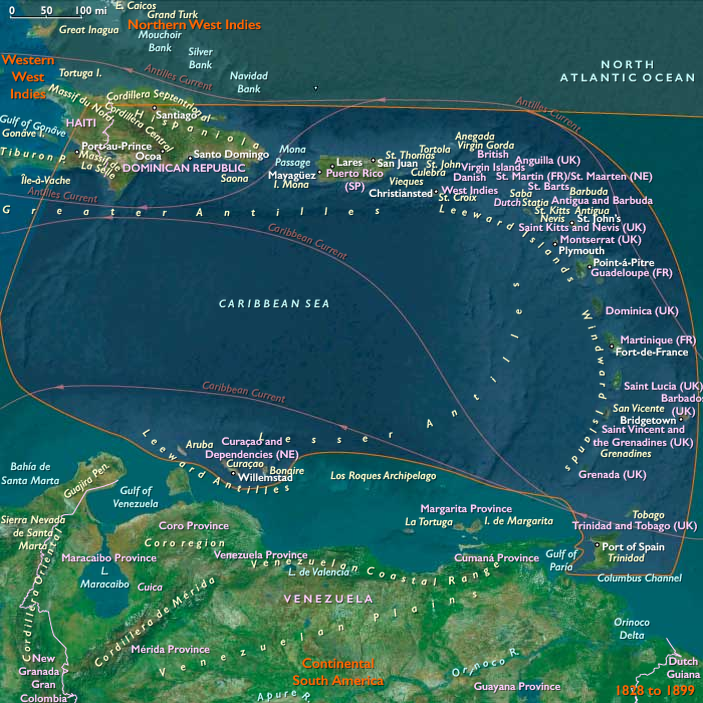
Eastern West Indies (1852–1863 CE): Governance, Labor,…
1852 CE to 1863 CE
Eastern West Indies (1852–1863 CE): Governance, Labor, and Continued Political Strife
British Colonial Administration and Local Governance
Between 1852 and 1863, the British Eastern West Indies experienced diverse governance models, shaped largely by their colonial origins and demographic complexities. Older British colonies such as Barbados, Jamaica, and the Leeward Islands maintained representative assemblies modeled after Britain’s parliamentary structure, with powerful but narrowly enfranchised local legislatures and influential parish vestries managing local governance.
Conversely, territories acquired later, including Trinidad and St. Lucia, operated under a distinct crown colony government. This direct British rule—avoiding local legislative assemblies—reflected concerns about managing large nonwhite populations, preventing foreign planters' dominance, and enforcing anti-slavery laws. Consequently, these territories developed limited local democracy, with municipal councils in major cities like Port-of-Spain and Castries providing minimal grassroots participation.
Indentured Labor Expansion and Societal Change
The continued labor shortages following emancipation drove an expansion of indentured labor from India, China, and Africa. Over 32,000 Africans and more than 14,000 Chinese workers entered primarily British Guiana, significantly reshaping demographics. East Indian laborers notably influenced local agriculture by introducing and expanding rice, cacao, and diverse crops. They maintained distinct cultural identities, predominantly practicing Hinduism and Islam, and built temples and mosques, enriching the cultural landscape. Chinese migrants primarily entered local commerce, becoming a familiar part of Caribbean urban life by the century's end.
Emergence and Growth of Free Villages
The rise of "free villages" marked a dramatic shift in Caribbean social structure. Freed slaves established independent agricultural settlements, significantly expanding their numbers in places like Jamaica, Barbados, St. Vincent, and Antigua. These villages produced diverse agricultural products—coconuts, bananas, rice, coffee, and cacao—fostering economic self-reliance and a vibrant peasant society.
Haiti’s Political Turmoil and Reforms
Haiti endured persistent instability throughout this era. Faustin Soulouque, who crowned himself Emperor Faustin I, attempted multiple invasions of the Dominican Republic, failing disastrously and leading to his downfall. Fabre Geffrard replaced Soulouque in 1859, restoring mulatto elite governance. Geffrard's administration (1859–1867) initiated significant reforms, reducing the army, enhancing education, promoting medical training, and re-establishing ties with the Vatican through an 1860 concordat, thereby gaining international recognition from the United States in 1862.
Dominican Republic: Santana-Báez Rivalry and Spanish Annexation
Dominican politics were dominated by the intense rivalry between Pedro Santana and Buenaventura Báez, characterized by authoritarian rule, political purges, and frequent leadership turnovers. Santana’s authoritarian governance prompted constitutional crises, military confrontations, and continual diplomatic overtures toward foreign powers.
This political volatility culminated in Santana's controversial 1861 annexation of the Dominican Republic to Spain, driven by fears of Haitian aggression and economic collapse. The annexation quickly proved unpopular, triggering rebellions led notably by General Francisco del Rosario Sánchez, who was ultimately executed. Continued rebellion and resentment toward Spanish rule erupted into the War of Restoration (1863), with General José Antonio Salcedo leading the establishment of a provisional government. Santana, forced to suppress his own countrymen as Spain's representative, resigned his command in 1862, dying soon thereafter amid widespread national opposition.
Public Health Crisis
Public health crises also severely impacted the region, notably the devastating cholera epidemic in Puerto Rico (1855–1856), resulting in over 25,000 deaths and profoundly affecting social and economic stability.
Key Historical Events
-
Expansion of indentured labor from Africa, India, and China, significantly altering demographics and economies.
-
Rise of independent free villages, transforming social and agricultural landscapes.
-
Faustin Soulouque’s unsuccessful attempts to invade the Dominican Republic and subsequent overthrow by Fabre Geffrard.
-
Dominican Republic’s annexation by Spain (1861) under Santana and subsequent rebellions sparking the War of Restoration (1863).
-
Cholera epidemic in Puerto Rico (1855–1856), illustrating regional public health vulnerabilities.
Long-Term Consequences and Historical Significance
This era reinforced complex patterns of governance, social transformation, and political volatility in the Eastern West Indies. The varied British colonial systems influenced enduring differences in political traditions and democratic practices. Indentured migration and the growth of free villages reshaped demographic and economic structures, while Haiti and the Dominican Republic experienced continued cycles of authoritarianism, rebellion, and foreign intervention, deeply shaping their political and social trajectories into the late nineteenth century.
People
Groups
Topics
Subjects
Regions
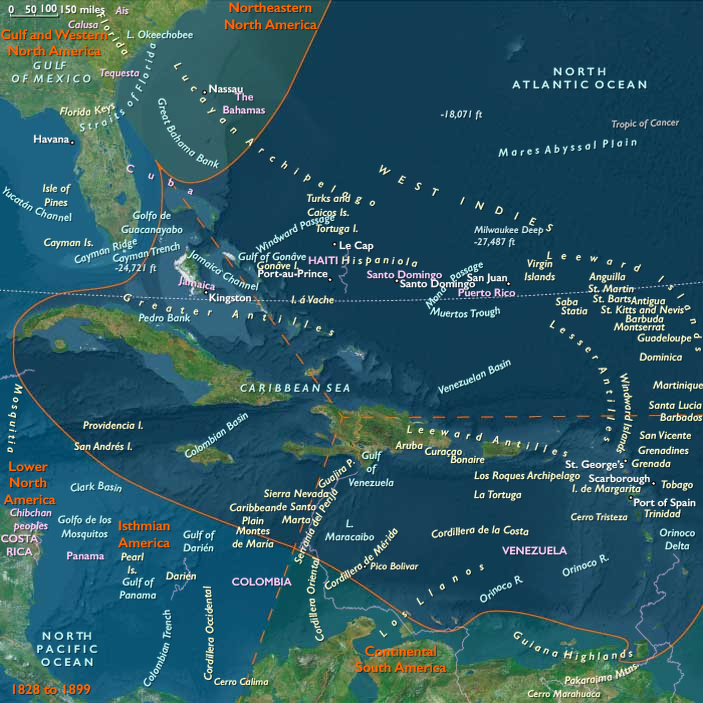
West Indies
View →Subregions