
Event
Edward III’s Final Campaign and the Treaty…
Edward III’s Final Campaign and the Treaty of Brétigny (1360)
After the failed siege of Reims, Edward III marched on Paris, hoping to pressure Dauphin Charles (later Charles V) into a decisive engagement. However, after a few skirmishes in the suburbs, Edward abandoned his attempt to take the city, realizing that the French refused to give battle and that his supply lines were stretched thin. With his army weakened and no significant victories, Edward was forced into negotiations, leading to the Treaty of Brétigny (May 8, 1360).
The Treaty of Brétigny: A Temporary End to War
- The treaty was negotiated at a conference held at Brétigny, securing extensive territorial concessions for England.
- The key English negotiator was Henry of Grosmont, 1st Duke of Lancaster, a seasoned diplomat and military commander.
- The treaty’s favorable terms for England included:
- Full sovereignty over Aquitaine, significantly expanding English-controlled lands in France.
- The ransom of King John II of France, who had been captured at the Battle of Poitiers (1356), set at an enormous 3 million gold crowns.
- The temporary cessation of hostilities, leading to a nine-year truce.
Henry of Grosmont’s Role in the Treaty
- Henry of Grosmont had spent much of the 1350s campaigning and negotiating peace with France.
- His military career had included:
- A crusade in Prussia (1351–52), where he almost dueled Otto, Duke of Brunswick, before King John II of France intervened to prevent it.
- The chevauchée in Normandy (1356) and the siege of Rennes (1358).
- His participation in the Reims campaign (1359–60), the last major offensive of the first phase of the Hundred Years’ War.
- As England’s principal negotiator at Brétigny, he secured highly favorable terms for Edward III, effectively concluding the first phase of the war.
Impact of the Treaty of Brétigny
- The treaty expanded English-controlled territory in France, marking the height of English success in the war.
- However, the French monarchy retained its independence, and Dauphin Charles (later Charles V) used the truce to reorganize France’s military and finances.
- The enormous ransom for King John II placed a heavy burden on France’s economy, fueling internal instability.
- The treaty failed to establish lasting peace, and hostilities resumed in 1369, leading to France’s resurgence under Charles V.
The Treaty of Brétigny (1360) was one of the most favorable treaties for England during the Hundred Years’ War, securing vast territorial gains and a temporary peace, but it ultimately failed to end the conflict.
-
{# Image navigates to the detail page; the magnifying-glass chip is the only Fancybox lightbox trigger (kept a separate sibling — anchors can't nest). #}
 The North Atlantic Lands
World
-
{# Image navigates to the detail page; the magnifying-glass chip is the only Fancybox lightbox trigger (kept a separate sibling — anchors can't nest). #}
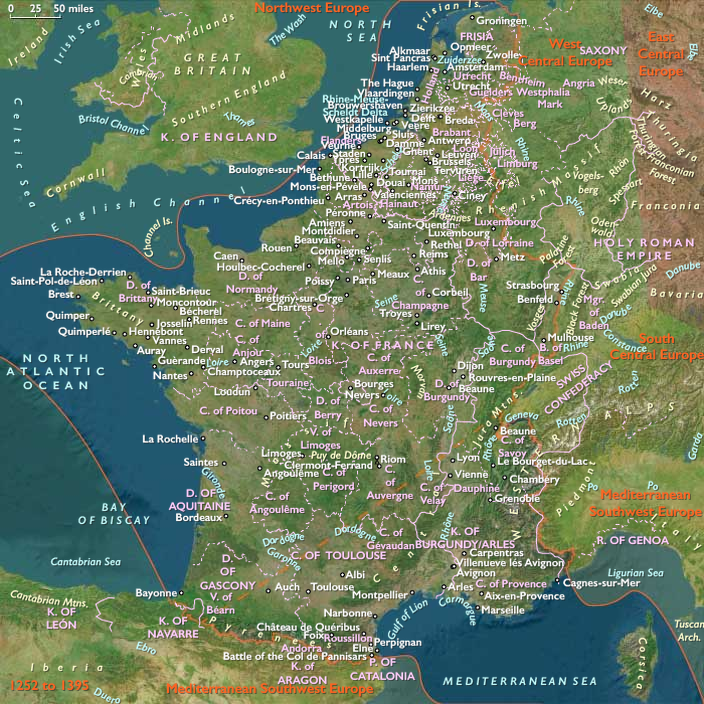 West Europe
Region
-
{# Image navigates to the detail page; the magnifying-glass chip is the only Fancybox lightbox trigger (kept a separate sibling — anchors can't nest). #}
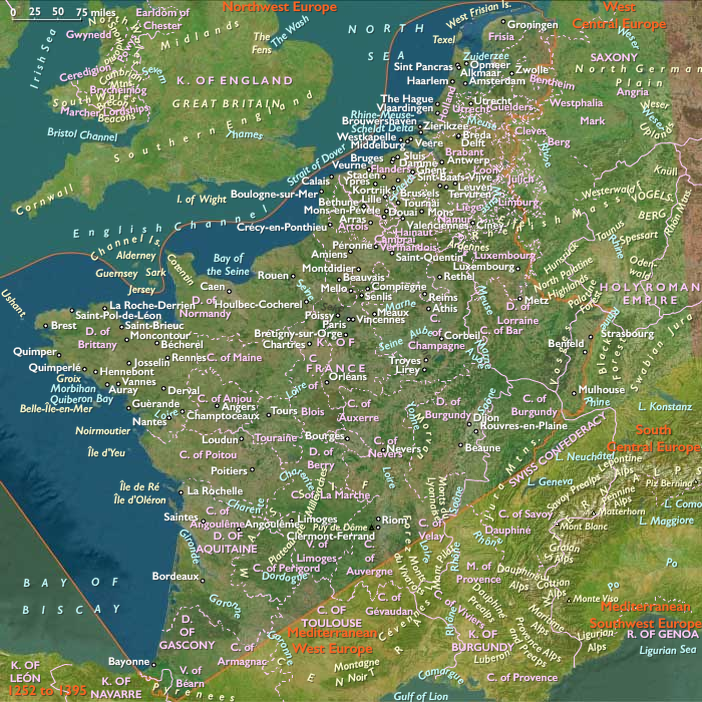 Atlantic West Europe
Subregion
