El Greco had first appeared in Spain…
1579 CE
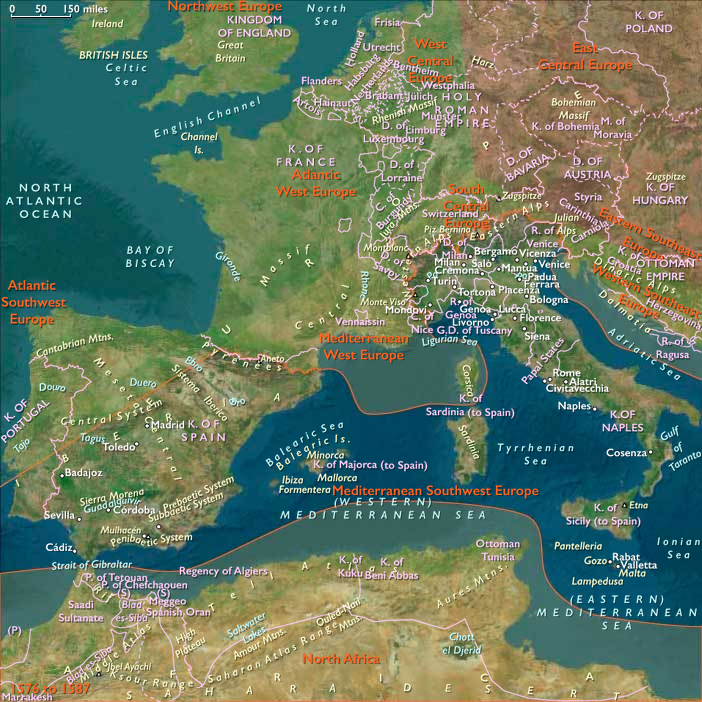
El Greco had first appeared in Spain in the spring of 1577, initially at Madrid, later in Toledo.
One of his main reasons for seeking a new career in Spain must have been knowledge of Philip II's great project, the building of the monastery of San Lorenzo at El Escorial, some twenrty-six miles (forty-two kilometers) northwest of Madrid.
Moreover, the Greek must have met important Spanish churchmen in Rome through Fulvio Orsini, a humanist and librarian of the Palazzo Farnese.
It is known that at least one Spanish ecclesiastic who spent some time in Rome at this period—Luis de Castilla—became El Greco's intimate friend and was eventually named one of the two executors of his last testament.
Luis' brother, Diego de Castilla, gives El Greco his first commission in Spain, which possibly had been promised before the artist left Italy.
The commission is for the high altar and the two lateral altars in the conventual church of Santo Domingo el Antiguo at Toledo (1577–79).
Never before has the artist had a commission of such importance and scope.
Even the architectural design of the altar frames, reminiscent of the style of the Venetian architect Palladio, is prepared by El Greco.
In the painting for the high altar, “Assumption of the Virgin,” the figures are brought close into the foreground, and in the Apostles a new brilliance of color is achieved.
In the painting of the Trinity, in the upper part of the high altar (now in the Prado Museum, Madrid), the powerful sculpturesque body of the nude Christ leaves no doubt of that Michelangelo is the ultimate source of inspiration.
In the lateral altar painting of the “Resurrection,” the poses of the standing soldiers and the contrapposto (a position in which the upper and lower parts of the body are contrasted in direction) of those asleep are also clearly Michelangelesque in inspiration.
At the same time, El Greco creates another masterpiece of extraordinary originality—the Espolio (“Disrobing of Christ”).
In designing the composition vertically and compactly in the foreground he seems to have been motivated by the desire to show the oppression of Christ by his cruel tormentors.
He chose a method of space elimination that is common to Mannerists, and at the same time he probably recalls late Byzantine paintings in which the superposition of heads row upon row is employed to suggest a crowd.
The original altar of gilded wood that El Greco designed for the painting has been destroyed, but his small sculptured group of the Miracle of St. Ildefonso still survives on the lower center of the frame.
El Greco's tendency to elongate the human figure becomes more notable at this time—for example, in the handsome and unrestored St. Sebastian.
The same extreme elongation of body is also present in Michelangelo's work, in the painting of the Venetians Tintoretto and Paolo Veronese, and in the art of the leading Mannerist painters.
The increased slenderness of Christ's long body against the dramatic clouds in Crucifixion with Donors foreshadows the artist's late style.
Images

The Assumption of the Virgin (1577–1579, oil on canvas, 401 × 228 cm, Art Institute of Chicago) was one of the nine paintings El Greco completed for the church of Santo Domingo el Antiguo in Toledo, his first commission in Spain.
Subjects
Regions
Southwest Europe
View →Subregions