
The Battle of Castillon and the Final…
July 1453 CE
The Battle of Castillon and the Final French Reconquest of Aquitaine (July 1453)
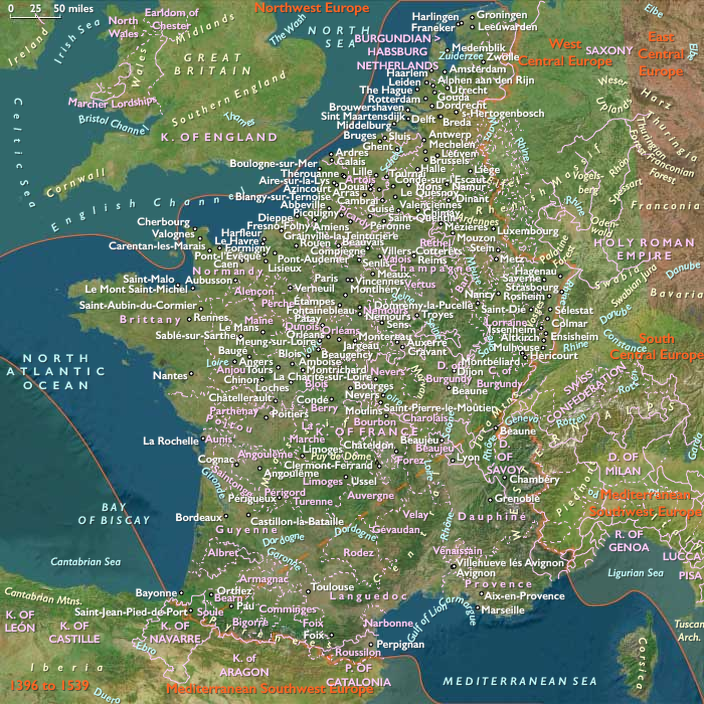
In the summer of 1453, the prolonged struggle over English-held Aquitaine reached a dramatic and decisive conclusion at the Battle of Castillon. Following the earlier capture of Bordeaux, French forces under the command of artillery experts Jean and Gaspard Bureau swiftly advanced to reclaim the remainder of English-held Aquitaine.
The climax came on July 17, 1453, when English veteran commander John Talbot, Earl of Shrewsbury, misinformed about French numbers and strength, launched a frontal assault against the entrenched French camp at Castillon. Unbeknownst to Talbot, he faced an extraordinarily fortified position equipped with formidable artillery arranged wheel-to-wheel, creating an unprecedented defensive advantage for the French.
Talbot’s force was dramatically outnumbered—historically estimated at a staggering ratio of about one hundred and twenty-to-one in overall artillery superiority—and faced devastating firepower from French cannons carefully arranged by artillery commanders Jean and Gaspard Bureau. The ill-advised English assault quickly turned into a catastrophic defeat. Talbot himself was killed, and his army was effectively annihilated.
The decisive French victory at Castillon marked the final episode of the Hundred Years’ War, conclusively ending English territorial rule in southwestern France. The battle demonstrated the tactical dominance of modern artillery, solidifying gunpowder weaponry as the future of European warfare and significantly influencing subsequent military strategy. Symbolically and politically, the French triumph reaffirmed the authority of King Charles VII, completing the restoration of French royal power in Aquitaine and across nearly all historic French territories, excepting only Calais. This transformative victory thus represented both a symbolic and practical turning point in the political and military history of Atlantic West Europe.
People
Groups
Topics
Commodities
Subjects
Regions
West Europe
View →Subregions
