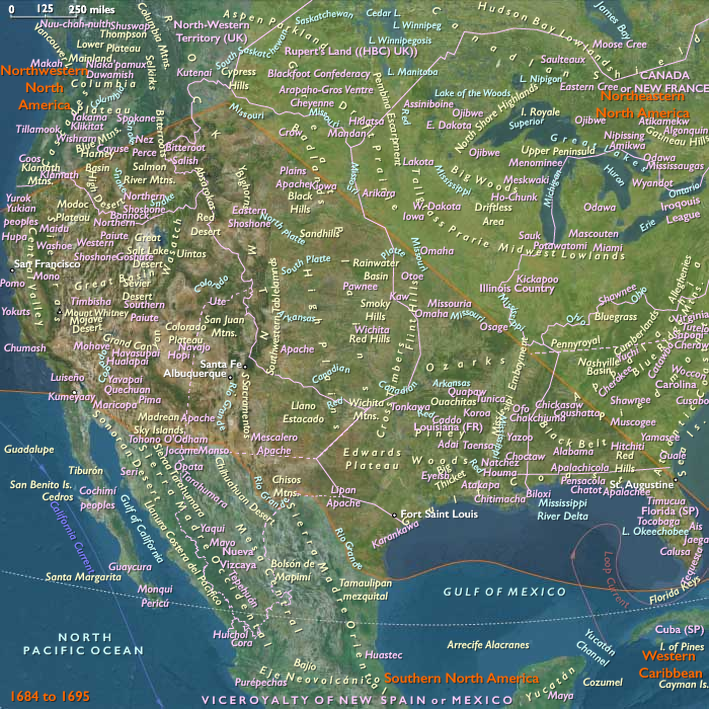
Gulf and Western North America (1684–1695 CE):…
1684 CE to 1695 CE
Gulf and Western North America (1684–1695 CE): European Rivalries and Indigenous Transformation
European Territorial Ambitions
By the late seventeenth century, European powers solidified territorial claims across North America. Spain controlled Florida, Mexico, and much of the Southwest. The English established colonies along the northern Atlantic coast, while France dominated New France, including central Illinois Country. Fearful of encroachment by rivals, France undertook ambitious explorations and colonization attempts to secure its vast territorial claims.
La Salle's Texas Colony
In 1684, French explorer René-Robert Cavelier, Sieur de La Salle, embarked on an expedition intending to establish a colony at the mouth of the Mississippi River. Due to navigational errors, he instead landed near Matagorda Bay in Texas. Despite founding a short-lived colony, La Salle’s expedition ended disastrously, with settlers perishing from disease, exposure, and hostilities with the indigenous Karankawa. Though ultimately a failure, this expedition cemented French claims to Texas, influencing later geopolitical developments, including the Louisiana Purchase.
Spanish Response and Expansion
Alarmed by French activities, the Spanish crown authorized the establishment of new outposts in eastern Texas and Pensacola, reinforcing their defensive presence. Concurrently, in 1692, Spanish forces successfully retook Santa Fe from the Pueblo peoples who had expelled them during the Pueblo Revolt of 1680, reaffirming Spanish dominance in New Mexico.
Indigenous Equestrian Transformation
The introduction of horses from Spanish New Mexico dramatically transformed indigenous life on the Great Plains during this era. Tribes like the Apache capitalized on newfound mobility, enhancing their military capabilities through intensified raiding and warfare. These dynamics profoundly disrupted regional balances of power, as groups such as the Pawnee endured relentless Apache raids. The adoption of equestrianism spread rapidly, forever altering Plains societies.
Arapaho and Arikara Shifts
The ancestral Arapaho migrated westward into the Great Plains by the end of the seventeenth century, displaced from the Great Lakes region by powerful eastern tribes such as the Ojibwe. In their new territories, the Arapaho adapted swiftly, forming new alliances and trading relationships.
Similarly, the Arikara encountered significant pressure from neighboring tribes, including the Omaha/Ponca and the Iowa, influencing their settlement patterns and defensive strategies. Notably, the Arikara taught the Omaha/Ponca the construction techniques for earth lodges, illustrating dynamic intercultural exchanges.
Indigenous Slavery and Conflict
The period also saw an escalation in the capture and trade of indigenous slaves, particularly by the Apache. In a striking episode in 1694, Apaches brought captive children to trade in New Mexico. Failing to find buyers, they executed their captives publicly, underscoring the brutal nature of regional conflicts and slavery practices. In Canada, enslaved indigenous peoples, termed Panis (from "Pawnee"), became central to the colony's labor economy, foreshadowing lasting impacts on indigenous populations.
Key Historical Developments
-
French exploration and colonization attempts under La Salle, asserting French claims in Texas.
-
Spanish defensive expansions in Texas and Pensacola to counter French ambitions.
-
Recapture of Santa Fe by Spanish forces, reestablishing colonial dominance.
-
Rapid spread of horse culture on the Great Plains, transforming indigenous societies like the Apache and disrupting the lives of tribes such as the Pawnee.
-
Increased indigenous slavery and conflicts, exemplified by Apache raids and the trade of "Panis" slaves in French Canada.
Long-Term Consequences and Historical Significance
The era from 1684 to 1695 set the stage for profound shifts in power, territorial control, and cultural practices across Gulf and Western North America. European rivalries intensified colonial expansions, while indigenous societies rapidly adapted to—and were transformed by—new technologies, animals, and escalating conflicts. These dynamics profoundly reshaped the social, political, and economic landscapes of the region, leaving lasting legacies.
Groups
Topics
Subjects
Regions
Northern North America
View →Subregions