Some of Huldrych Zwingli's earliest extant writings,…
1516 CE
Some of Huldrych Zwingli's earliest extant writings, such as The Ox (1510) and The Labyrinth (1516), attack the mercenary system using allegory and satire.
His countrymen are presented as virtuous people within a French, imperial, and papal triangle.
Zwingli has placed himself solidly on the side of the Roman See.
Pope Julius II in return, had honored Zwingli by providing him with an annual pension.
He had taken the role of chaplain in several campaigns in Italy, including the Battle of Novara in 1513.
However, the decisive defeat of the Swiss in the Battle of Marignano had caused a shift in mood in Glarus in favor of the French rather than the pope.
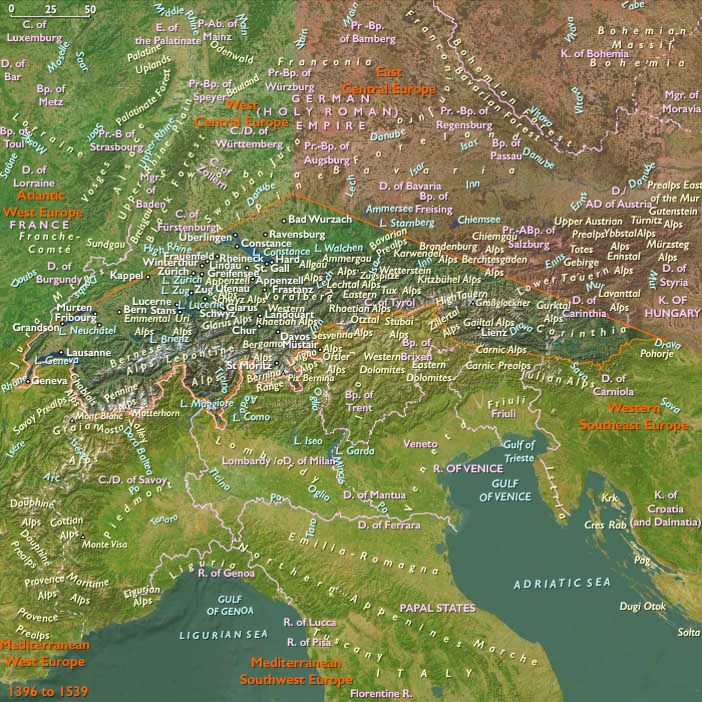
Zwingli, the papal partisan, had found himself in a difficult position and decided to retreat to Einsiedeln in the canton of Schwyz.
T
The son of a prosperous peasant, he had studied music, scholastic philosophy, and humanistic subjects in Vienna, Bern, and Basel.
Ordained in Constance, the seat of the local diocese, he had celebrated his first Mass on September 29, 1506, in his hometown, Wildhaus.
As a young priest he had studied little theology, but this was not considered unusual at the time.
His first ecclesiastical post is the pastorate of the town of Glarus, where he has stayed for ten years.
It is in Glarus, whose soldiers are used as mercenaries in Europe, that Zwingli becomes involved in politics.
The Swiss Confederation is embroiled in various campaigns with its neighbors: the French, the Habsburgs, and the Papal States.
By now, he has become convinced that mercenary service is immoral and that Swiss unity is indispensable for any future achievements.
Locations
People
Groups
Topics
Regions
Central Europe
View →Subregions