
Il Medeghino raises the siege of Siena…
August 1554 CE
Il Medeghino raises the siege of Siena after some days of inactivity and moves to meet Strozzi.
After some initial skirmishes, the two large armies clash when Strozzi, short of food, decides to retire towards Lucignano in the night of August 1.
In the morning of the following day, it is clear that his maneuver has not been successful, and he is forced to do battle with the Florentine-Imperial troops that are stalking and harassing his moving troops.
The battle begins with the attack of Medeghino's cavalry wing, whose impetus easily routs its French-Sienese counterpart, which flees towards Foiano.
It has been reported that the French commanders of that unit, Valleron and Fourquevaux, had been bribed by Medeghino with twelve tin flasks filled with golden coins.
To counter this first setback, Strozzi decides to launch down from the hill the German infantry of his center.
A chaotic melee ensues, but soon the momentum of the Sienese attack begins to wane under the fire of the Imperial artillery, which also disorganizes the Swiss attempting to relieve the first line.
When Il Medeghino orders his men to launch themselves against the enemy, the German and Swiss troops begin to panic.
This becomes a complete route when Colonna's heavy cavalry, who had for some while pursued the French-Sienese cavalry, attack from behind the Germans fighting across the Scannagallo.
The French infantry on the right wing maintains its battle order, and, surrounded on every side, defends itself desperately to the finish.
Strozzi himself is wounded three times and is carried away by his guards.
His lieutenant Clemente della Cervara dies shortly after the battle from wounds received.
The battle lasts for only two hours, from 11 AM to 1 PM.
The Sienese army suffers 4,000 dead, 4,000 wounded or prisoners.
Strozzi escapes the capture.
People
Groups
Topics
Commodities
Subjects
Regions
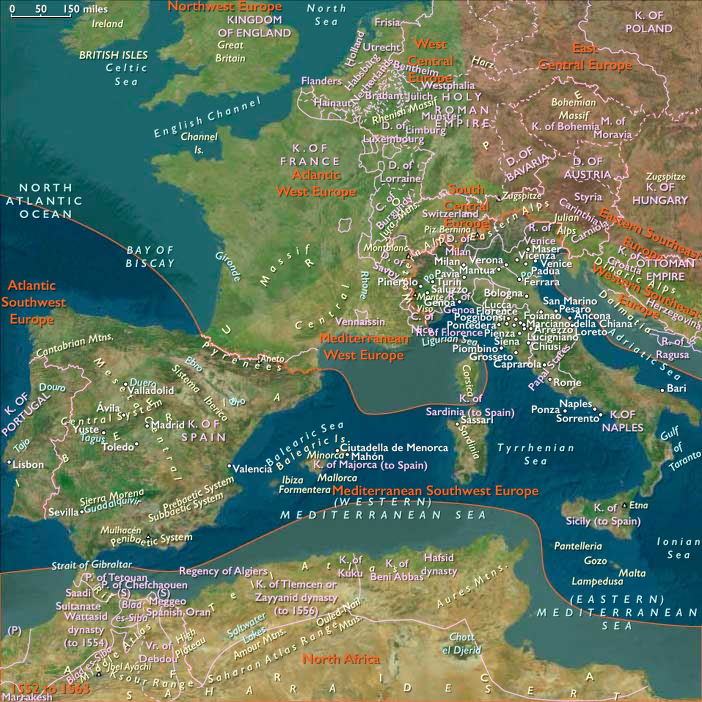
Southwest Europe
View →Subregions
