
Ferdinand and Isabella are the last of…
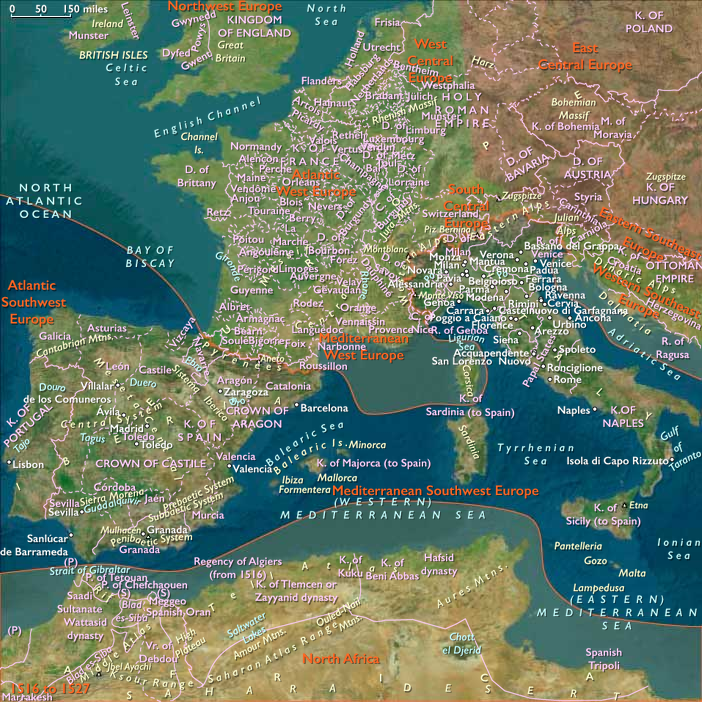
1516 CE to 1527 CE
When their sole male heir, John, who was to have inherited all his parents' crowns, died in 1497, the succession to the throne had passed to Juana, John's sister, but Juana had become the wife of Philip the Handsome, heir through his father, Emperor Maximilian I, to the Habsburg patrimony.
On Ferdinand's death in 1516, Charles of Ghent, the son of Juana and Philip, inherits Spain (which he rules as Charles I, r. 1516-56), its colonies, and Naples. (Juana, called Juana la Loca or Joanna the Mad, will live until 1555 but is judged incompetent to rule.)
When Maximilian I dies in 1519, Charles also inherits the Habsburg domains in Germany.
Shortly afterward he is selected Holy Roman emperor, a title that he holds as Charles V (r. 1519-56), to succeed his grandfather.
Charles, in only a few years, is able to bring together the world's most diverse empire since Rome.
Charles's closest attachment is to his birthplace, Flanders; he surrounds himself with Flemish advisers who are not appreciated in Spain.
His duties as both Holy Roman emperor and king of Spain, moreover, never allow him to tarry in one place.
As the years of his long reign pass, however, Charles moves closer to Spain and calls upon its manpower and colonial wealth to maintain the Habsburg empire.
People
Groups
Arab people
View →
Berber people (also called Amazigh people or Imazighen, "free men", singular Amazigh)
View →
Flemish people
View →
Flanders, County of
View →
Castillian people
View →
Aragón, Kingdom of
View →
Aragon, Crown of
View →
Valencia, Kingdom of
View →
Naples, Angevin Kingdom of
View →
Sicily, Aragonese Kingdom of
View →
Catalonia, Principality of
View →
Portugal, Avizan (Joannine) Kingdom of
View →
Portuguese Empire
View →
Puerto Rico (Spanish Colony)
View →
Santiago, Colony of (Spanish Jamaica)
View →
Canary Islands (Spanish colony)
View →
Cuba (Spanish Colony)
View →
Guatemala, (Spanish Colony)
View →
New Spain (Spanish colony)
View →
Topics
Subjects
Regions
Southwest Europe
View →Subregions
