Ippolito d'Este, born in Ferrara as the…
1503 CE
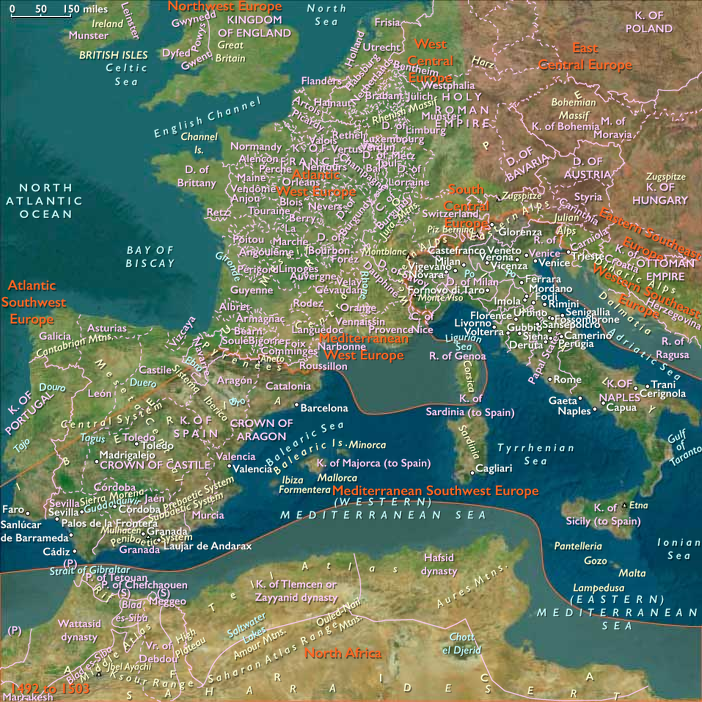
Ippolito d'Este, born in Ferrara as the son of Duke Ercole I d'Este and Eleanor of Naples, had immediately been educated for a career in the Church.
In 1485, at the age of six, he was already at the head of an abbacy, and two years later, thanks to his aunt Beatrix of Aragon, who had married King Matthias Corvinus of Hungary, he was named archbishop of Esztergom in Hungary.
The latter election had not been confirmed by Pope Innocent VIII until he was eighteen; in the meantime Ippolito had studied for seven years at the Hungarian court.
After Matthias' death, Ippolito had traveled frequently to Italy.
During one of these trips, he was created cardinal by Alexander VI, on September 20, 1493.
Three years later he returned to Italy to escape the plague that was striking Hungary and arrived in Rome with a following of two hundred and fifty people.
He had been appointed archbishop of Milan in 1497.
According to the tax reports of the Curia for the year 1500, he was the fifth richest member.
His influence had grown further when his brother Alfonso married Lucrezia Borgia, daughter of Alexander VI, who had granted him the title of archipresbyter of St. Peter's.
He remains in Rome until February 15, 1503, although his relationship with the pope will later deteriorate due to Ercole's philo-French maneuvers.
He is a famous patron of the arts.
Among his protegée are the poet Ludovico Ariosto and architect Biagio Rossetti.
Ariosto, after the death in 1500 of his father, a captain in the service of the Este dukes of Ferrara, had been compelled to forgo his literary occupations and take care of his family, whose affairs were in disarray.
Despite his family obligations, Ariosto has managed to write some comedies in prose as well as lyrical pieces.
Some of these had attracted the notice of Cardinal Ippolito d'Este, who takes the young poet under his patronage and appoints him one of the gentlemen of his household.
Locations
People
Groups
Topics
Regions
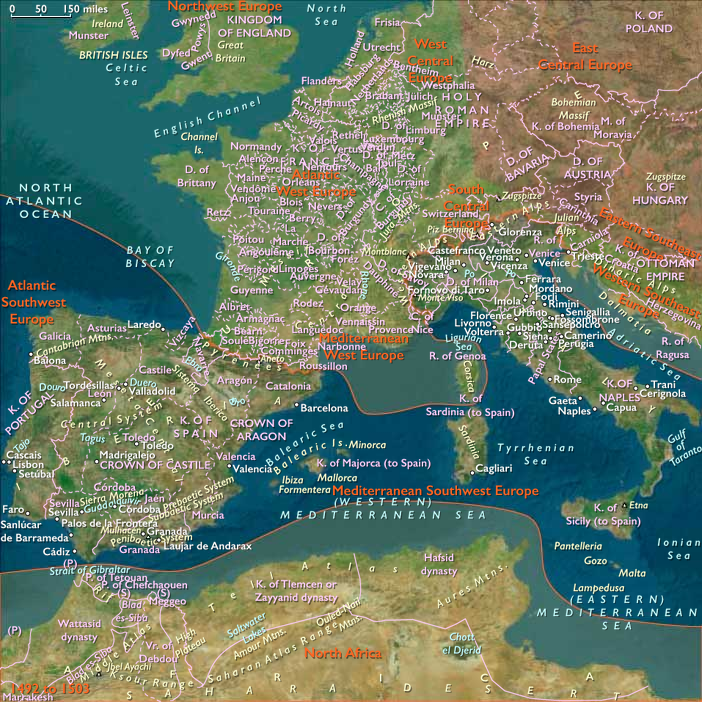
Southwest Europe
View →Subregions