Isabella I, aka “Isabella the Catholic,” queen…
1492 CE
Isabella I, aka “Isabella the Catholic,” queen of Castile and of Aragon, is described as a redhead.
She rules the two kingdoms jointly from 1479 with her husband, Ferdinand II of Aragon.
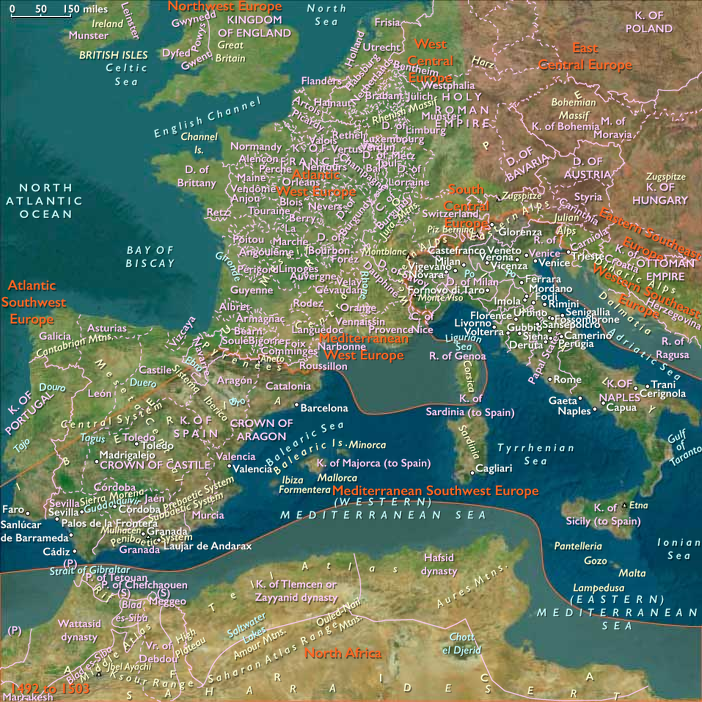
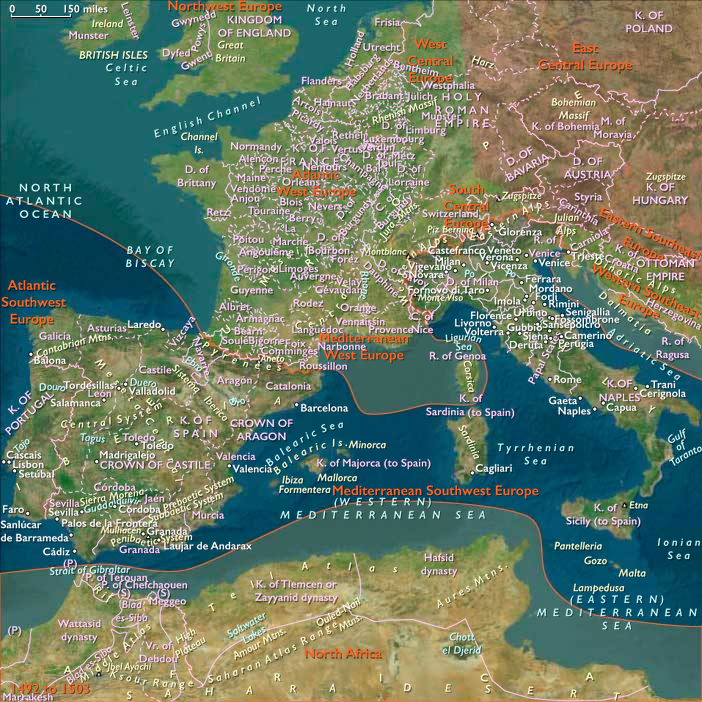
The popular queen has played an active part in the wars leading to the conquest of Granada, the last Moorish stronghold in Spain.
The Catholic Monarchs’ conquest of Granada in 1492 achieves the permanent union of Spain, a year that also the expulsion (or forced conversion) of Spain's Jewish communities sees the beginning of an overseas empire in the New World, discovered by Christopher Columbus, a fellow redhead, under Isabella's sponsorship.
The Catholic monarchs bless the Inquisition in its expulsion of all Jews from Spain.
Cardinal Francisco Jimenez de Cisneros becomes confessor to Isabella, whose deep religious convictions, which have made her a guiding spirit behind the founding of the Spanish Inquisition and the expulsion of the Jews, have also led her to support Cisneros in his efforts to reform the church.
Her husband Ferdinand, although lacking the religious fervor of his wife, nevertheless supports the Inquisition and the expulsion of the Jews for political reasons.
Music and the arts flourish in Spain, which by 1492 has achieved some degree of political unity under the rule of Ferdinand and Isabella.
Secular vocal music, which began as folkloric ballads that recounted heroic exploits, tragic events, and tales of love, now also appear in arrangements by court composers for three or four voices, or for solo voice with guitar or vihuela (a combination of lute and guitar).
The exuberant Spanish Gothic architectural sculpture of the Isabelline style, named for Isabella , graces both religious and secular buildings.
The Mudejars, Moors remaining in Spain after its gradual reconquest by the Christians, maintain the striking decorative tradition of brilliant geometrical ornamentation used to adorn mostly private, interiorized, architectural monuments.
As a patron of scholarship, Isabella does much to introduce humanism to Spain.
Locations
Groups
Topics
Commodities
Subjects
Regions
Southwest Europe
View →Subregions