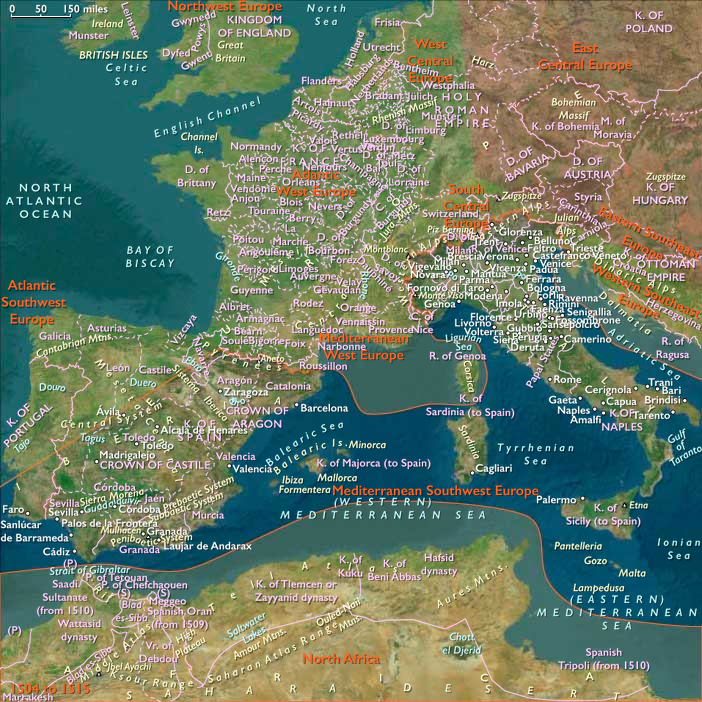
Isabella of Castile had received the title…
November 1504 CE
Isabella of Castile had received the title of Catholic Monarch by Pope Alexander VI, a pope of whose behavior and involvement in matters Isabella did not approve.
Along with the physical unification of Spain, Isabella and Ferdinand had embarked on a process of spiritual unification, trying to bring the country under one faith, Roman Catholicism.
As part of this process, the Inquisition has become institutionalized.
After a Muslim uprising in 1499, and further troubles thereafter, the Treaty of Granada had been broken in 1502, and Muslims had been ordered to either become Christians or to leave.
Isabella's confessor, Cisneros, who had been named Archbishop of Toledo, has been instrumental in a program of rehabilitation of the religious institutions of Spain, laying the groundwork for the later Counter-Reformation.
As Chancellor, he exerts more and more power.
Isabella and her husband have created an empire and in recent years have been consumed with administration and politics; they are concerned with the succession and have worked to link the Spanish crown to the other rulers in Europe.
By early 1497, all the pieces had seemed to be in place: John, Prince of Asturias, had married Archduchess Margaret of Austria, establishing the connection to the Habsburgs.
The eldest daughter, Isabella, had married Manuel I of Portugal, and Joanna had been married to another Habsburg prince, Philip of Burgundy.
However, Isabella's plans for her two eldest children did not work out.
John had died shortly after his marriage.
Isabella, Princess of Asturias, had died in childbirth and her son Miguel had died at the age of two.
Queen Isabella I's crowns will thus pass to her daughter Joanna and her son-in-law, Philip.
Isabella has, however, made successful dynastic matches for her three youngest daughters.
The death of Isabella, Princess of Asturias, created a necessity for Manuel I of Portugal to remarry: Isabella's third child, Maria, had become his next bride.
Isabella's youngest daughter, Catherine, had married England's Arthur, Prince of Wales, but his early death will result in her being married to his younger brother, Henry VIII of England.
Isabella, officially withdrawing from governmental affairs on September 14, 1504, dies the same year on November 26 in Medina del Campo, but it is said that she had truly been in decline since the death of her son Prince John in 1497.
Upon her death, her husband Ferdinand of Aragon claims the regency of Castile on behalf of their twenty-five-year-old second daughter Joanna, now incapacitated by insanity and known as Juana la Loca (Joanna the Mad).
Joanna’s husband Philip of Castile, son of Holy Roman Emperor Maximilian and Mary of Burgundy, opposes Ferdinand’s regency, as do a majority of the Castilian nobles.
People
Groups
Topics
Regions
Southwest Europe
View →Subregions