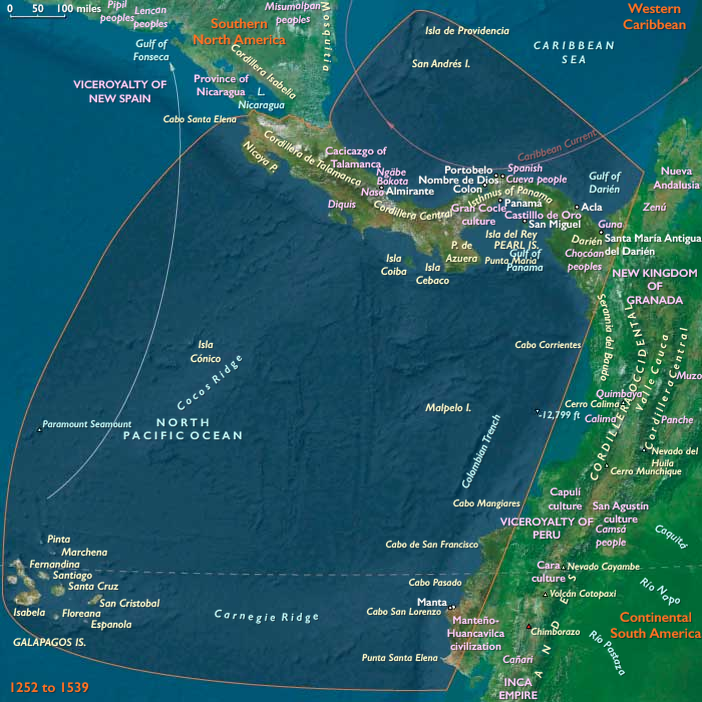
Isthmian America (1516–1527 CE): Pedrarias's Rule and…
1516 CE to 1527 CE
Isthmian America (1516–1527 CE): Pedrarias's Rule and the Founding of Panama
The new governor of Castilla del Oro, Pedro Arias Dávila—soon known by the epithet "Pedrarias the Cruel"—arrived with royal authorization to govern the fledgling colony. Almost immediately, Pedrarias accused his predecessor and rival, Vasco Núñez de Balboa, of treason. Balboa was swiftly arrested, brought before Pedrarias's tribunal, and executed by beheading in 1519.
Seeking a more hospitable environment than the unhealthy climate and resistant indigenous peoples of the Darién, Pedrarias relocated the colonial capital in 1519 to a small fishing village on the Pacific coast. The local inhabitants called this settlement Panamá, meaning "place of abundant fish." From this strategic location, the Spanish intended to control Pacific trade and further expeditions into South America.
Despite these ambitious goals, Pedrarias's governorship rapidly deteriorated into disaster. Hundreds of Spanish colonists succumbed to disease, hunger, and harsh conditions, despite often being dressed in unsuitable silk brocade clothing brought from Spain. Indigenous communities suffered profoundly under Pedrarias's regime. Thousands were enslaved, robbed, and massacred, and many more died from epidemics of European diseases—particularly smallpox and measles—against which they had no immunity. Those who survived often fled deep into remote forests or mountainous areas to avoid further violence and exploitation.
Pearl Islands: Exploitation and Enslavement
The Pearl Islands (Islas de las Perlas), an archipelago of over two hundred islands located about thirty miles off Panama’s Pacific coast, had been named by Vasco Núñez de Balboa in 1513 because of their rich pearl oyster beds. At the time of their European discovery, these islands were inhabited by indigenous peoples led by a cacique (chief) named Terarequí. Within two years of their discovery, relentless exploitation and violence from Spanish incursions devastated these communities.
According to historical accounts, shortly after Balboa’s initial discovery, another Spanish conquistador named Gaspar de Morales arrived. Morales became infamous for his ruthless cruelty, reportedly executing local chiefs brutally—including some reports (recorded by later chroniclers) that he fed twenty captured indigenous leaders to his war dogs as a deliberate act of terror. Another indigenous chief named Dites attempted to appease the Spanish by offering baskets filled with valuable pearls. However, rather than reducing Spanish demands, this display of wealth intensified their brutality, accelerating the near-total destruction of the native population.
With the indigenous labor force decimated, the Spanish settlers began importing enslaved Africans to harvest pearls from the islands' waters. The descendants of these African workers remain an integral part of the Pearl Islands' population today, particularly on the archipelago's largest island, Isla del Rey—which alone surpasses the combined area of all other Pearl Islands and ranks as Panama’s second-largest island after Coiba.
(Historical Note: Accounts of Gaspar de Morales’s brutal methods appear in early Spanish chronicles, such as those of Bartolomé de las Casas, who documented many atrocities committed against indigenous peoples. However, specific details of Morales’s acts, such as the feeding of chiefs to dogs, while widely cited, may have been exaggerated or symbolic portrayals meant to highlight the Spanish cruelty. Contemporary historians agree, though, on the catastrophic consequences of Spanish conquest on the Pearl Islands' indigenous inhabitants.)
Groups
Topics
Commodities
Subjects
Regions
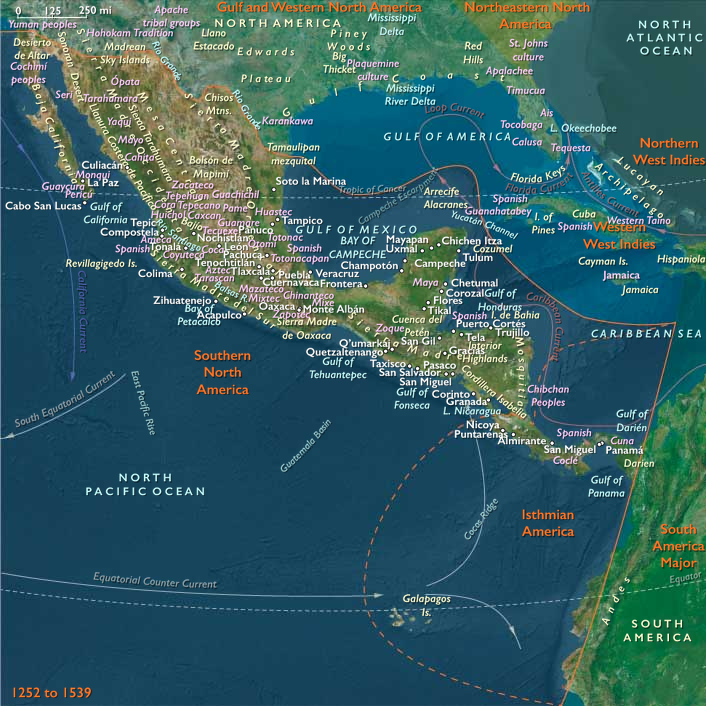
Middle America
View →Subregions