Southern North America (6,093–4,366 BCE): Middle Holocene…
6093 BCE to 4366 BCE
Southern North America (6,093–4,366 BCE): Middle Holocene — Gardens-in-the-Making, Coasts of Plenty, and Sacred Caves
Geographic & Environmental Context
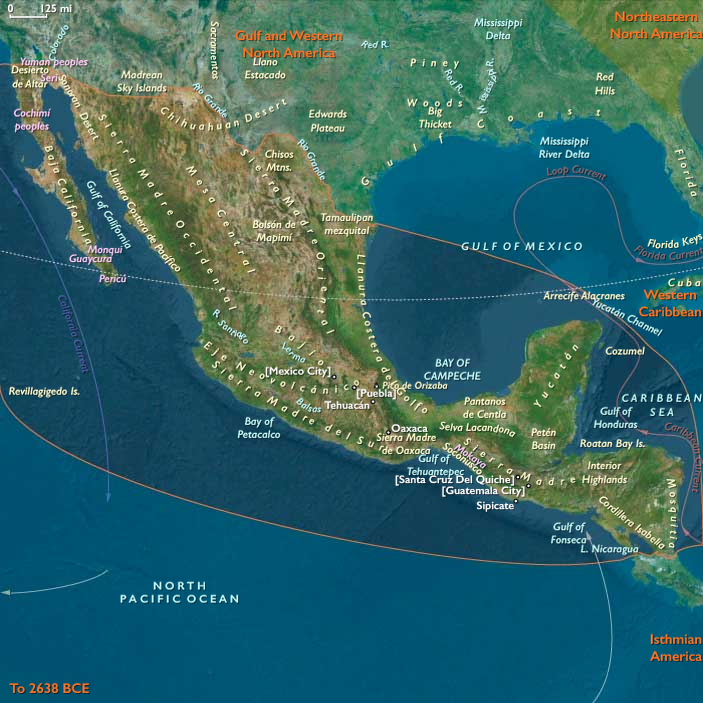
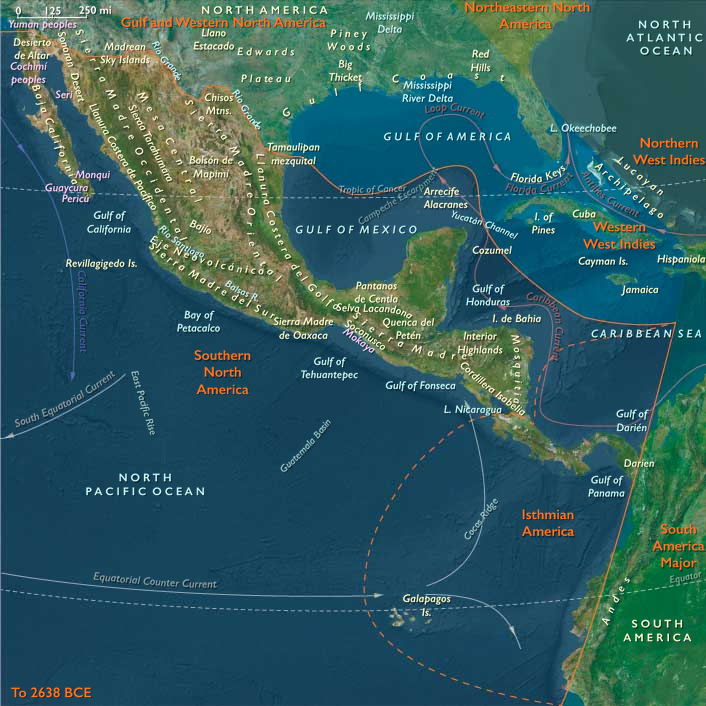
Southern North America spans Mexico and the northern Central American isthmus—Guatemala, Belize, Honduras, El Salvador, and Nicaragua—from the Pacific littoral and Soconusco coves across the Tehuantepec lowland, Basin of Mexico lake plains, Oaxaca and Motagua valleys, Maya lowlands and karst, and the Gulf–Caribbean mangrove shelves.
Hypsithermal warmth stabilized estuaries, lagoons, and spring-fed basins, while volcanic piedmonts shed fertile ash across alluvial fans. Karstic uplands held enduring aguadas and cave systems—reliable dry-season water and ritual spaces.
Climate & Environmental Shifts
The Middle Holocene optimum brought warmer, seasonally reliable rainfall with localized dry pulses in rain-shadows. Basin lakes (e.g., Basin of Mexico) maintained wide littoral marshes; Gulf and Caribbean mangrovesexpanded; Pacific upwelling kept nearshore fisheries productive. These predictable regimes favored semi-sedentary rounds and widening experimentation with plant tending.
Subsistence & Settlement
A forager–gardener mosaic took root:
-
Highlands (Oaxaca, Basin of Mexico, Transvolcanic corridors): shelters and open camps intensified seed and tuber processing (manos/metates) and the managed use of teosinte, squash/gourd, chile, amaranths, and tree crops (avocado). Lakeshore hamlets exploited waterfowl and reeds.
-
Pacific littoral (Soconusco–Guerrero–Tehuantepec): semi-permanent bayside villages combined shellfish, finfish, turtles, and slope gardens at springs/seeps.
-
Maya lowlands & karst margins (Belize–Petén): forest foodscapes (ramón/ojoche, palms) curated near camps; seasonal wetlands yielded fish and turtles; small clearings nurtured early root-crop/pepper plots.
-
Gulf/Caribbean lowlands: mangrove estuaries supplied mollusks and fish; levee ridges hosted dry-season base camps.
Across the subregion, settlement was semi-sedentary and nodal—returning to the same shores, caves, springs, and levees year after year.
Technology & Material Culture
Toolkits were light and effective: manos and metates, polished adzes, bifaces and microliths; nets, basketry, fish weirs, and watercraft (dugouts) for lagoon–river work. Atlatl and dart hunting persisted. Fired clay appeared mainly as hearth-lining and small objects; true pottery was rare to absent this early. Pigments, shell, seeds, and carved bone furnished ornament sets for feasting and burial.
Movement & Interaction Corridors
People stitched terrains with coast–valley–karst relays:
-
Tehuantepec and Motagua–Usumacinta–Grijalva river paths funneled stone, pigments, salt, dried fish, and seeds between slopes and coasts.
-
Pacific coves (Soconusco–Nicaragua) linked by short-hop canoeing and beach trails; Gulf lagoons formed parallel circuits.
-
Cave networks and springs anchored ritual and exchange rendezvous deep into uplands.
Cultural & Symbolic Expressions
Caves and springs served as cosmological thresholds. Offerings of pigments, shells, and carved bone accumulated in shelters; ancestor stones marked favored headlands and passes. Feasting middens—fish bones, shells, burned cobbles—encoded seasonal return and kin alliance. Early clearing shrines at garden margins linked tending to petitioning rain and fertility.
Environmental Adaptation & Resilience
Resilience came from portfolio livelihoods and place memory: gardens + marsh + reef + upland hunt. Repeated use of specific nodes allowed soil enrichment (ash, refuse) around camps; grove curation (palms, ramón, avocado) built food banks in place. Storage by drying/smoking and exchange obligations smoothed dry spells and storm seasons.
Long-Term Significance
By 4,366 BCE, Southern North America was a proto-horticultural heartland: semi-sedentary villages ringed by tended groves and plots, shore fisheries scaled to weirs and nets, and cave sanctuaries knitting landscape to lineage. The habits of garden-making, lacustrine scheduling, and coastal excha
Southern North America (6,093–4,366 BCE): Middle Holocene — Gardens-in-the-Making, Coasts of Plenty, and Sacred Caves
Geographic & Environmental Context
Southern North America spans Mexico and the northern Central American isthmus—Guatemala, Belize, Honduras, El Salvador, and Nicaragua—from the Pacific littoral and Soconusco coves across the Tehuantepec lowland, Basin of Mexico lake plains, Oaxaca and Motagua valleys, Maya lowlands and karst, and the Gulf–Caribbean mangrove shelves.
Hypsithermal warmth stabilized estuaries, lagoons, and spring-fed basins, while volcanic piedmonts shed fertile ash across alluvial fans. Karstic uplands held enduring aguadas and cave systems—reliable dry-season water and ritual spaces.
Climate & Environmental Shifts
The Middle Holocene optimum brought warmer, seasonally reliable rainfall with localized dry pulses in rain-shadows. Basin lakes (e.g., Basin of Mexico) maintained wide littoral marshes; Gulf and Caribbean mangrovesexpanded; Pacific upwelling kept nearshore fisheries productive. These predictable regimes favored semi-sedentary rounds and widening experimentation with plant tending.
Subsistence & Settlement
A forager–gardener mosaic took root:
-
Highlands (Oaxaca, Basin of Mexico, Transvolcanic corridors): shelters and open camps intensified seed and tuber processing (manos/metates) and the managed use of teosinte, squash/gourd, chile, amaranths, and tree crops (avocado). Lakeshore hamlets exploited waterfowl and reeds.
-
Pacific littoral (Soconusco–Guerrero–Tehuantepec): semi-permanent bayside villages combined shellfish, finfish, turtles, and slope gardens at springs/seeps.
-
Maya lowlands & karst margins (Belize–Petén): forest foodscapes (ramón/ojoche, palms) curated near camps; seasonal wetlands yielded fish and turtles; small clearings nurtured early root-crop/pepper plots.
-
Gulf/Caribbean lowlands: mangrove estuaries supplied mollusks and fish; levee ridges hosted dry-season base camps.
Across the subregion, settlement was semi-sedentary and nodal—returning to the same shores, caves, springs, and levees year after year.
Technology & Material Culture
Toolkits were light and effective: manos and metates, polished adzes, bifaces and microliths; nets, basketry, fish weirs, and watercraft (dugouts) for lagoon–river work. Atlatl and dart hunting persisted. Fired clay appeared mainly as hearth-lining and small objects; true pottery was rare to absent this early. Pigments, shell, seeds, and carved bone furnished ornament sets for feasting and burial.
Movement & Interaction Corridors
People stitched terrains with coast–valley–karst relays:
-
Tehuantepec and Motagua–Usumacinta–Grijalva river paths funneled stone, pigments, salt, dried fish, and seeds between slopes and coasts.
-
Pacific coves (Soconusco–Nicaragua) linked by short-hop canoeing and beach trails; Gulf lagoons formed parallel circuits.
-
Cave networks and springs anchored ritual and exchange rendezvous deep into uplands.
Cultural & Symbolic Expressions
Caves and springs served as cosmological thresholds. Offerings of pigments, shells, and carved bone accumulated in shelters; ancestor stones marked favored headlands and passes. Feasting middens—fish bones, shells, burned cobbles—encoded seasonal return and kin alliance. Early clearing shrines at garden margins linked tending to petitioning rain and fertility.
Environmental Adaptation & Resilience
Resilience came from portfolio livelihoods and place memory: gardens + marsh + reef + upland hunt. Repeated use of specific nodes allowed soil enrichment (ash, refuse) around camps; grove curation (palms, ramón, avocado) built food banks in place. Storage by drying/smoking and exchange obligations smoothed dry spells and storm seasons.
Long-Term Significance
By 4,366 BCE, Southern North America was a proto-horticultural heartland: semi-sedentary villages ringed by tended groves and plots, shore fisheries scaled to weirs and nets, and cave sanctuaries knitting landscape to lineage. The habits of garden-making, lacustrine scheduling, and coastal excha
Southern North America (6,093–4,366 BCE): Middle Holocene — Gardens-in-the-Making, Coasts of Plenty, and Sacred Caves
Geographic & Environmental Context
Southern North America spans Mexico and the northern Central American isthmus—Guatemala, Belize, Honduras, El Salvador, and Nicaragua—from the Pacific littoral and Soconusco coves across the Tehuantepec lowland, Basin of Mexico lake plains, Oaxaca and Motagua valleys, Maya lowlands and karst, and the Gulf–Caribbean mangrove shelves.
Hypsithermal warmth stabilized estuaries, lagoons, and spring-fed basins, while volcanic piedmonts shed fertile ash across alluvial fans. Karstic uplands held enduring aguadas and cave systems—reliable dry-season water and ritual spaces.
Climate & Environmental Shifts
The Middle Holocene optimum brought warmer, seasonally reliable rainfall with localized dry pulses in rain-shadows. Basin lakes (e.g., Basin of Mexico) maintained wide littoral marshes; Gulf and Caribbean mangrovesexpanded; Pacific upwelling kept nearshore fisheries productive. These predictable regimes favored semi-sedentary rounds and widening experimentation with plant tending.
Subsistence & Settlement
A forager–gardener mosaic took root:
-
Highlands (Oaxaca, Basin of Mexico, Transvolcanic corridors): shelters and open camps intensified seed and tuber processing (manos/metates) and the managed use of teosinte, squash/gourd, chile, amaranths, and tree crops (avocado). Lakeshore hamlets exploited waterfowl and reeds.
-
Pacific littoral (Soconusco–Guerrero–Tehuantepec): semi-permanent bayside villages combined shellfish, finfish, turtles, and slope gardens at springs/seeps.
-
Maya lowlands & karst margins (Belize–Petén): forest foodscapes (ramón/ojoche, palms) curated near camps; seasonal wetlands yielded fish and turtles; small clearings nurtured early root-crop/pepper plots.
-
Gulf/Caribbean lowlands: mangrove estuaries supplied mollusks and fish; levee ridges hosted dry-season base camps.
Across the subregion, settlement was semi-sedentary and nodal—returning to the same shores, caves, springs, and levees year after year.
Technology & Material Culture
Toolkits were light and effective: manos and metates, polished adzes, bifaces and microliths; nets, basketry, fish weirs, and watercraft (dugouts) for lagoon–river work. Atlatl and dart hunting persisted. Fired clay appeared mainly as hearth-lining and small objects; true pottery was rare to absent this early. Pigments, shell, seeds, and carved bone furnished ornament sets for feasting and burial.
Movement & Interaction Corridors
People stitched terrains with coast–valley–karst relays:
-
Tehuantepec and Motagua–Usumacinta–Grijalva river paths funneled stone, pigments, salt, dried fish, and seeds between slopes and coasts.
-
Pacific coves (Soconusco–Nicaragua) linked by short-hop canoeing and beach trails; Gulf lagoons formed parallel circuits.
-
Cave networks and springs anchored ritual and exchange rendezvous deep into uplands.
Cultural & Symbolic Expressions
Caves and springs served as cosmological thresholds. Offerings of pigments, shells, and carved bone accumulated in shelters; ancestor stones marked favored headlands and passes. Feasting middens—fish bones, shells, burned cobbles—encoded seasonal return and kin alliance. Early clearing shrines at garden margins linked tending to petitioning rain and fertility.
Environmental Adaptation & Resilience
Resilience came from portfolio livelihoods and place memory: gardens + marsh + reef + upland hunt. Repeated use of specific nodes allowed soil enrichment (ash, refuse) around camps; grove curation (palms, ramón, avocado) built food banks in place. Storage by drying/smoking and exchange obligations smoothed dry spells and storm seasons.
Long-Term Significance
By 4,366 BCE, Southern North America was a proto-horticultural heartland: semi-sedentary villages ringed by tended groves and plots, shore fisheries scaled to weirs and nets, and cave sanctuaries knitting landscape to lineage. The habits of garden-making, lacustrine scheduling, and coastal excha
Southern North America (6,093–4,366 BCE): Middle Holocene — Gardens-in-the-Making, Coasts of Plenty, and Sacred Caves
Geographic & Environmental Context
Southern North America spans Mexico and the northern Central American isthmus—Guatemala, Belize, Honduras, El Salvador, and Nicaragua—from the Pacific littoral and Soconusco coves across the Tehuantepec lowland, Basin of Mexico lake plains, Oaxaca and Motagua valleys, Maya lowlands and karst, and the Gulf–Caribbean mangrove shelves.
Hypsithermal warmth stabilized estuaries, lagoons, and spring-fed basins, while volcanic piedmonts shed fertile ash across alluvial fans. Karstic uplands held enduring aguadas and cave systems—reliable dry-season water and ritual spaces.
Climate & Environmental Shifts
The Middle Holocene optimum brought warmer, seasonally reliable rainfall with localized dry pulses in rain-shadows. Basin lakes (e.g., Basin of Mexico) maintained wide littoral marshes; Gulf and Caribbean mangrovesexpanded; Pacific upwelling kept nearshore fisheries productive. These predictable regimes favored semi-sedentary rounds and widening experimentation with plant tending.
Subsistence & Settlement
A forager–gardener mosaic took root:
-
Highlands (Oaxaca, Basin of Mexico, Transvolcanic corridors): shelters and open camps intensified seed and tuber processing (manos/metates) and the managed use of teosinte, squash/gourd, chile, amaranths, and tree crops (avocado). Lakeshore hamlets exploited waterfowl and reeds.
-
Pacific littoral (Soconusco–Guerrero–Tehuantepec): semi-permanent bayside villages combined shellfish, finfish, turtles, and slope gardens at springs/seeps.
-
Maya lowlands & karst margins (Belize–Petén): forest foodscapes (ramón/ojoche, palms) curated near camps; seasonal wetlands yielded fish and turtles; small clearings nurtured early root-crop/pepper plots.
-
Gulf/Caribbean lowlands: mangrove estuaries supplied mollusks and fish; levee ridges hosted dry-season base camps.
Across the subregion, settlement was semi-sedentary and nodal—returning to the same shores, caves, springs, and levees year after year.
Technology & Material Culture
Toolkits were light and effective: manos and metates, polished adzes, bifaces and microliths; nets, basketry, fish weirs, and watercraft (dugouts) for lagoon–river work. Atlatl and dart hunting persisted. Fired clay appeared mainly as hearth-lining and small objects; true pottery was rare to absent this early. Pigments, shell, seeds, and carved bone furnished ornament sets for feasting and burial.
Movement & Interaction Corridors
People stitched terrains with coast–valley–karst relays:
-
Tehuantepec and Motagua–Usumacinta–Grijalva river paths funneled stone, pigments, salt, dried fish, and seeds between slopes and coasts.
-
Pacific coves (Soconusco–Nicaragua) linked by short-hop canoeing and beach trails; Gulf lagoons formed parallel circuits.
-
Cave networks and springs anchored ritual and exchange rendezvous deep into uplands.
Cultural & Symbolic Expressions
Caves and springs served as cosmological thresholds. Offerings of pigments, shells, and carved bone accumulated in shelters; ancestor stones marked favored headlands and passes. Feasting middens—fish bones, shells, burned cobbles—encoded seasonal return and kin alliance. Early clearing shrines at garden margins linked tending to petitioning rain and fertility.
Environmental Adaptation & Resilience
Resilience came from portfolio livelihoods and place memory: gardens + marsh + reef + upland hunt. Repeated use of specific nodes allowed soil enrichment (ash, refuse) around camps; grove curation (palms, ramón, avocado) built food banks in place. Storage by drying/smoking and exchange obligations smoothed dry spells and storm seasons.
Long-Term Significance
By 4,366 BCE, Southern North America was a proto-horticultural heartland: semi-sedentary villages ringed by tended groves and plots, shore fisheries scaled to weirs and nets, and cave sanctuaries knitting landscape to lineage. The habits of garden-making, lacustrine scheduling, and coastal exchange established enduring relationships between people and place, laying the foundations for the village traditions, ritual landscapes, and agricultural systems that would shape later Mesoamerican civilization.Images

Southern North America in the Middle Holocene
Regions
Middle America
View →Subregions