Johannes Trithemius, abbot of Sponheim in Germany…
1510 CE
Johannes Trithemius, abbot of Sponheim in Germany chronicles the counts of Sponheim and accumulates a large collection of documents on the history of the area.
His Polygraphia, written in 1510, is the first printed work on cryptology.
He introduces for the first time the concept of a square table, or tableau, in which the normal alphabet is successively shifted a predetermined number of spaces.
Each alphabet line in turn is used to encipher successive letters.
For example, if the first letter were enciphered with the first alphabet, the second letter with the second alphabet, and so on, the word secret would be enciphered as SFEUIY. (Most authorities consider Trithemius to be the father of modern cryptography.)
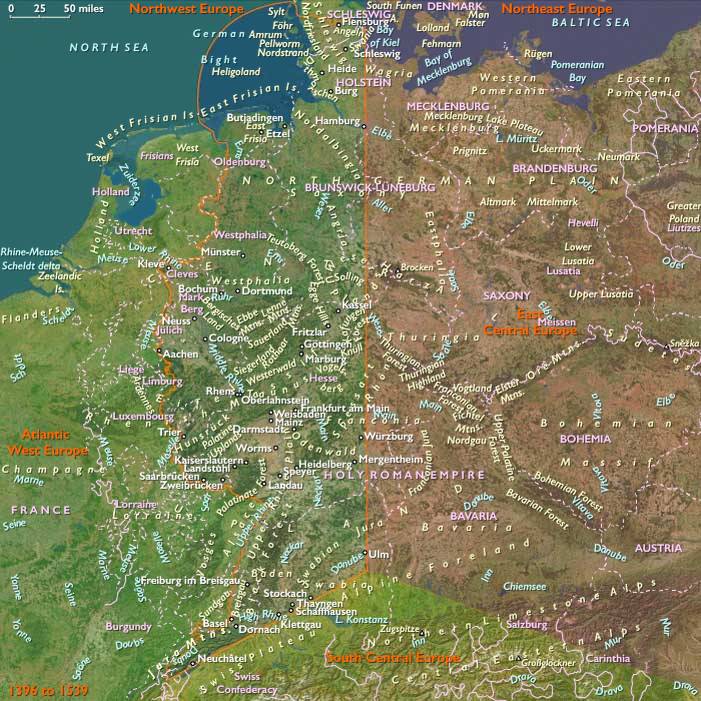
The byname Trithemius refers to his native town of Trittenheim on the Moselle River, at this time part of the Electorate of Trier.
Johannes was still an infant when his father Johann von Heidenburg died.
His stepfather, whom his mother Elisabeth married seven years later, was hostile to education and thus Johannes could only learn in secrecy and with many difficulties.
Learning Greek, Latin, and Hebrew, he escaped from his home when he was seventeen years old and wandered around looking for good teachers, traveling to Trier, Cologne, the Netherlands and Heidelberg.
He studied at the University of Heidelberg.
Traveling from university to his home town in 1482, he was surprised by a snowstorm and took refuge in the Benedictine abbey of Sponheim near Bad Kreuznach.
He decided to stay and in 1483 at the age of twenty-one was elected abbot.
He set out to transform the abbey from a neglected and undisciplined place into a center of learning.
In his time, the abbey library increased from around fifty items to more than two thousand.
He often served as featured speaker and chapter secretary at the Bursfelde Congregation's annual chapter from 1492 to 1503, the annual meeting of reform-minded abbots.
Trithemius also supervised the visitations of the congregation's abbeys.
Trithemius writes extensively as a historian, starting with a chronic of Sponheim and culminating in a two-volume work on the history of Hirsau Abbey.
His work is distinguished by mastery of the Latin language and eloquent phrasing, yet it is soon discovered that he has inserted several fictional passages into his works.
His work as a historian has been tainted ever since, the invented passages proved by several scholars.
His efforts do not in any event meet with praise, and his reputation as a magician does not further his acceptance.
Among his pupils are Heinrich Cornelius Agrippa and Paracelsus.
Increasing differences with the convent had led to his resignation in 1506, when he decided to take up the offer of the Bishop of Würzburg, Lorenz von Bibra to become the abbot of St. James's Abbey, the Schottenkloster in Würzburg.
He will remain here until the end of his life.
Trithemius is buried in this abbey's church, a tombstone by the famous Tilman Riemenschneider was erected in his honor.
The tombstone will be moved in 1825 to the Neumünster church, next to the cathedral.
Damaged in the firebombing of 1945, it will subsequently be restored by the workshop of Theodor Spiegel.
Locations
People
Regions
Central Europe
View →Subregions