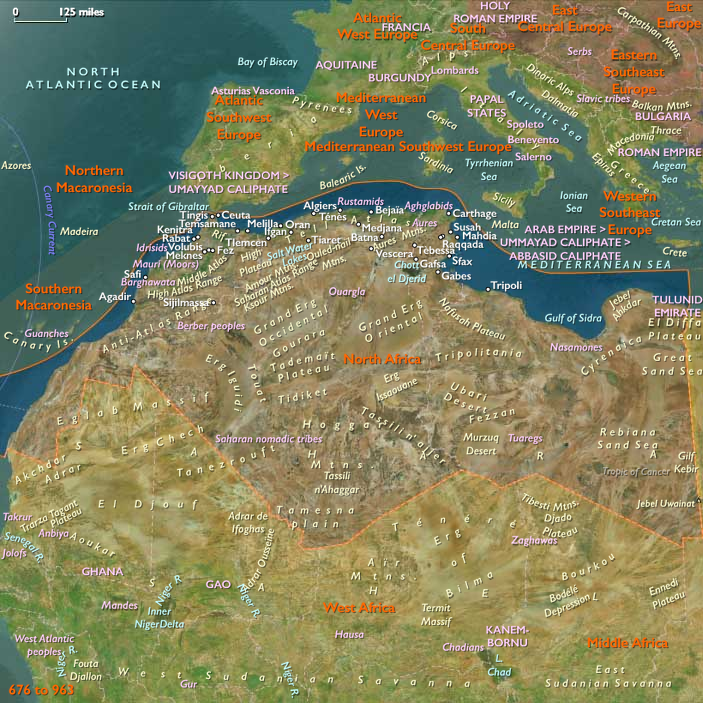
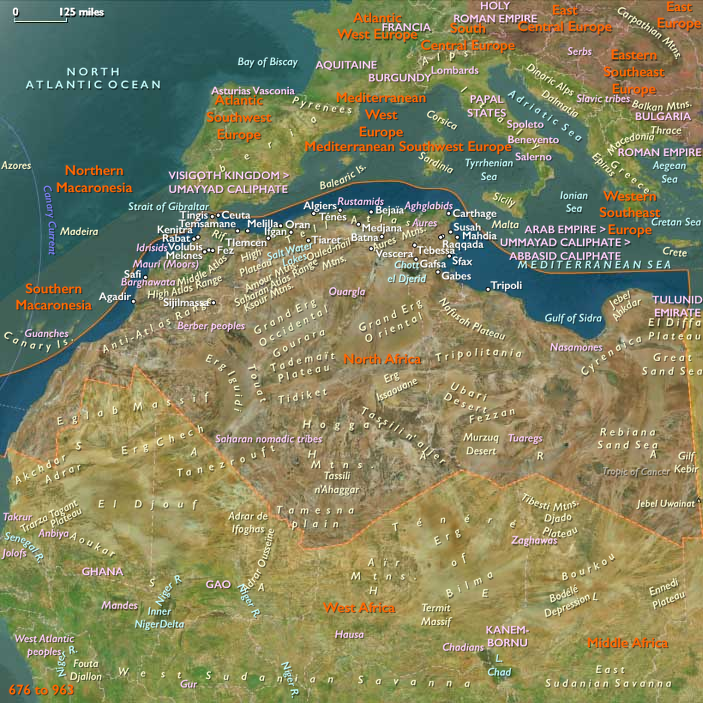
Julian provides the ships to carry Muslim …
Years: 711 - 711
April
Julian provides the ships to carry Muslim troops across to Europe in the summer of 711.
Julian also briefs Tariq, their general, who then leaves Julian behind among the merchants and crosses the Strait of Hercules with a force of some seventeen hundred men.
Locations
People
Groups
- Arab people
- Berber people (also called Amazigh people or Imazighen, "free men", singular Amazigh)
- Jews
- Goths (East Germanic tribe)
- Christianity, Arian
- Visigothic Kingdom of Spain
- Muslims, Sunni
- Umayyad Caliphate (Damascus)
- Roman Empire, Eastern: Heraclian dynasty
- Roman Empire, Eastern: Non-dynastic
Topics
- Migration Period
- Migration Period Pessimum
- Arab-Byzantine Wars
- Byzantine-Muslim War of 692-718
- Umayyad Conquest of Hispania
Commodoties
Subjects
Regions
Subregions
Related Events
Filter results
Showing 10 events out of 55788 total
Justinian's second reign is marked by a reconciliation with the papacy, cemented by the visit of Pope Constantine to Constantinople in 710-11.
The emperor is obsessed, however, with a desire for revenge against his opponents, and the resulting mass executions in turn have led to the alienation of many of his former supporters.
Bardanes is the son of the patrician Nicephorus, who was of Armenian extraction from an Armenian colony in Pergamon. (His original name, Vardan, may have been derived from that of his mother).
Relying on the support of the Monothelite party, he had made some pretensions to the throne on the outbreak of the first great rebellion against Emperor Justinian II; these had led to his relegation to Cephalonia by Tiberios Apsimarus, and subsequently to his banishment to Cherson by order of Justinian.
Here Bardanes, taking the name of Philippikos, has successfully incited the inhabitants to revolt with the help of the Khazars.
The successful rebels seize Constantinople, and Justinian flees.
Tervel gives the deposed emperor only three thousand soldiers who, after several skirmishes, are given safe conduct to Bulgaria by the new emperor and Justinian II, unable to rally substantial support in the provinces, is executed, together with his family, in December 711.
After resuming rule, Justininian had wreaked a vengeance so terrible that the fact of his second deposition and death is surprising only in it having been delayed for six years.
Philippikos takes the throne.
Umayyad interest in the the Indus valley occurred because of attacks from Sindh Raja Dahir on ships of Muslims and their imprisonment of Muslim men and women, according to Berzin.
They had earlier unsuccessfully sought to gain control of the route, via the Khyber Pass, from the Turki-Shahis of Gandhara, but by taking Sindh, Gandhara's southern neighbor, they would be able to open a second front against Gandhara; a feat they had, on occasion, attempted before.
According to Wink, Umayyad interest in the region was galvanized by the operation of the Meds and others.
Meds (a tribe of Scythians living in Sindh) had pirated upon Sassanid shipping in the past, from the mouth of the Tigris to the Sri Lankan coast, in their bawarij and now are able to prey on Arab shipping from their bases at Kutch, Debal and Kathiawar.
At the time, Sindh is the wild frontier region of al-Hind, inhabited mostly by semi-nomadic tribes whose activities disturb much of the Western Indian Ocean.
Muslim sources insist that it was these persistent activities along increasingly important Indian trade routes by Debal pirates and others which forced the Arabs to subjugate the area, in order to control the seaports and maritime routes of which Sindh was the nucleus, as well as, the overland passage.
During Hajjaj's governorship, the Mids of Debal in one of their raids had kidnapped Muslim women traveling from Sri Lanka to Arabia, thus providing a causus belli to the rising power of the Umayyad Caliphate that will enable them to gain a foothold in the Makran, Balochistan and Sindh regions.
Also cited as a reason for this campaign is the policy of providing refuge to Sassanids fleeing the Arab advance and to Arab rebels from the Umayyad consolidation of their rule.
All the above reasons have their own importance for a first attack on Sindh, but the immediate cause for the conquest of Sindh is the plunder of the gifts of Ceylon's ruler to Hajjaj and the attack on Arab ships that ware carrying the orphans and widows of Muslim soldiers who had died in Jihad against Africa.
These Arab had later been imprisoned by the Governor Deebal Partaab Raye.
A letter written by an escaped Arab girl from the Arab asks Hajjaj for help.
When Hajjaj asks Dahir forth release of prisoners and compensation, the latter refuses on the ground that he has no control over these.
Hajjaj sends his nephew Muhammad ibn Qasim to fight his way into the Indus Valley in 711.
Through conquest, the Umayyad Caliphate intends to protect its maritime interest, while also cutting off refuge for fleeing rebel chieftains as well as Sindhi military support to the Sassanid rump state; akin to those received at several prior major battles during the their conquest of Persia—such as those at Salasal and Qādisiyyah and the finally at the Battle of Rasil.
An actual push into the region had been out of favor, in accord with an Arab policy since the time of the Rashidun Caliph Umar bin Khattab, who upon receipt of reports of Sindh being an inhospitable and poor land, had stopped further expeditionary ventures into the region.
Hajjaj superintended this campaign from Kufa by maintaining close contact with Muhammad bin Qasim in the form of regular reports and then regularly issuing orders.
The army that departed from Shiraz in 710 CE under Muhammad bin Qasim is six thousand Syrian cavalry and detachments of mawali from Iraq.
The mawali are new non-Arab converts, usually allied with Hajjaj's political opponents and thus frequently forced to participate in the Jihads on the frontier—such as Kabul, Sindh and Transoxania.
At the borders of Sindh, Muhammad bu Qasim is joined by an advance guard and six thousand camel riders and later reinforcements from the governor of Makran transferred directly to Debal by sea along with five catapults ("manjaniks").
The army that eventually captures Sindh will later be swelled by the Jats and Mids as well as other irregulars that had heard of successes in Sindh.
When Muhammad bin Qasim passes through Makran while raising forces, he has to re-subdue the restive Umayyad towns of Fannazbur and Arman Belah (Lasbela).

Debal is the first town assaulted upon the orders of Al-Hajjaj, who exacts a bloody retribution on Debal by giving no quarter to its residents or priests and destroying its great temple.
From Debal, the Arab army then marches north taking towns such as Nerun and Sadusan (Sehwan) peacefully, often incorporating their military components; additionally, one-fifth of the booty, including slaves, is dispatched to Hajjaj and the Caliph.
The conquest of these towns is accomplished easily; however, Raja Dahir's armies being prepared on the other side of the Indus, are yet to be fought.
In preparation to meet them, Muhammad bin Qasim moves back to Nerun to resupply and receive reinforcements sent by Hajjaj.
Camped on the east bank of the Indus, Qasim sends emissaries and bargains with the river Jats and boatmen.
Upon securing the aid of Mokah Basayah, "the King of the island of Bet", Muhammad bin Qasim crosses over the river where he is joined by the forces of the Thakore of Bhatta and the western Jats.
At Ar-rur (Rohri), he is met by Dahir's forces and the eastern Jats in battle.
Dahir dies in the battle, his forces are defeated and a triumphant Muhammad bin Qasim takes control of Sindh.
In the wake of the battle, enemy soldiers are put to death—but not artisans, merchants or farmers—and Dahir and his chiefs, the "daughters of princes" and the usual fifth of the booty and slaves are sent on to Hajjaj.
Soon, the capitals of the other provinces, Brahmanabad, Alor (Aror) and Multan, are captured alongside other in-between towns with only light Muslim casualties.
Usually after a siege of a few weeks or months the Arabs gain a city through the intervention of heads of mercantile houses with whom subsequent treaties and agreements would be settled.
The general populace is encouraged to carry on with their trades and taxes and tributes settled.
With Sindh secured, Qasim sends expeditions to Surashtra, where his generals make peaceful treaty settlements with the Rashtrakuta.
Muhammad bin Qasim writes out letters to "kings of Hind" to surrender and accept Islam, and subsequently ten thousand cavalry are sent to Kannauj asking them to submit and pay tribute before his abrupt recall ends the campaign.
Aal-Hajjaj, later in 711, orders Qutayba to march against the Hephthalite kingdom of Zabulistan, whose ruler, titled Zunbil, has long remained an indomitable thorn in the Arabs' side and menaced their province of Sistan.
Repeated expeditions against him have failed, and a truce has been agreed in exchange for tribute.
In addition, the existence of a free Zabulite kingdom is a threat to the security of Muslim control over the Hephthalite principalities of Tokhristan, who might be encouraged to seek support from it.
Thus Qutayba leads a large army south, but the Zunbil readily offers his submission and the payment of tribute.
Satisfied with this easy success, and unwilling to hazard a campaign in the mountains of Zabulistan, Qutayba departs.
No garrisons are installed, and as soon as the Arab army has departed, the Zunbil ceases the payment of tribute.
Dagobert III: A Child King Under Pepin’s Rule
In 711, Dagobert III, the son of Childebert III, ascends to the throne at the age of twelve, becoming the nominal ruler of the three Frankish kingdoms—Neustria, Austrasia, and Burgundy. These realms had remained unified under the dominance of Pepin of Herstal, the Mayor of the Palace, since his decisive victory at Tertry in 687.
Despite holding the royal title, Dagobert III wields no real power. As with his predecessors, actual governance remains in the hands of Pepin of Herstal, who continues to rule as the de facto leader of Francia. The young king’s reign exemplifies the growing political irrelevance of the Merovingian monarchs, setting the stage for the eventual rise of the Carolingian dynasty.
Musa bin Nusayr, governor of the Muslim Arab city of Ceuta in northwestern Africa, responds in 711 to the request by the Witizan family to help them overthrow Roderick.
Seventeen hundred Umayyad Moorish troops led by Tariq ibn Ziyad land at Gibraltar on April 30, and begin their invasion of the Iberian Peninsula (Al-Andalus) and conquest of the Visigothic Kingdom.
(The name of the Spanish promontory later called Gibraltar derives from its Moorish designation, Jebel Tariq, or Mount Tariq, in honor of this conqueror of Spain.)
The Miknasa Berbers originated in southern Tunisia, but migrated westwards into central Morocco and western Algeria in pre-Islamic times.
The modern Moroccan city of Meknes bears witness to their presence.
After defeat by the Umayyad Arab Muslims, many of the Miknasa convert to Islam.
In 711, members of the tribe take part in the conquest of the Visigoth kingdom under Tariq ibn Ziyad.
Muslim Berber general Tariq ibn Ziyad, dispatched by Musa across the Straits of Gibraltar, defeats Roderic on July 19, 711 at Laguna de Janda, near the Guadalete River (Rio Barbate).
Roderic attempts escape, but is either killed or drowned.
According to the Mozarabic Chronicle, Mūsā crossed the Gaditanum fretum (strait of Cádiz) with a large force in 711 and remained in Hispania for fifteen months, but it is unclear from the sources if he came before or after the battle of Guadalete, which was fought by the forces of his subordinates.
During his time in the peninsula it is racked by civil war (intestino furore confligeratur, "internal frenzy", to the Mozarabic chronicler), cities are razed and many people slaughtered in the general destruction.
According to al-Maqqarī, Roderic was fighting the Basques when he was recalled to the south to deal with an invasion.
There is also the record of a attack on southern Iberia by Constantinople that was repulsed by Theudimer some years before the fall of the Visigothic kingdom.
This has led to theories that the Berber attacks may have been related to the East Roman, and perhaps the Arabs were originally useful allies in an imperial attempt to reconquer the lost province of Spania.
Tariq, following his decisive victory over Roderick's Visigoths, takes the Andalusian port cities of Algeciras, …
…Cartagena, …
Years: 711 - 711
April
Locations
People
Groups
- Arab people
- Berber people (also called Amazigh people or Imazighen, "free men", singular Amazigh)
- Jews
- Goths (East Germanic tribe)
- Christianity, Arian
- Visigothic Kingdom of Spain
- Muslims, Sunni
- Umayyad Caliphate (Damascus)
- Roman Empire, Eastern: Heraclian dynasty
- Roman Empire, Eastern: Non-dynastic
Topics
- Migration Period
- Migration Period Pessimum
- Arab-Byzantine Wars
- Byzantine-Muslim War of 692-718
- Umayyad Conquest of Hispania