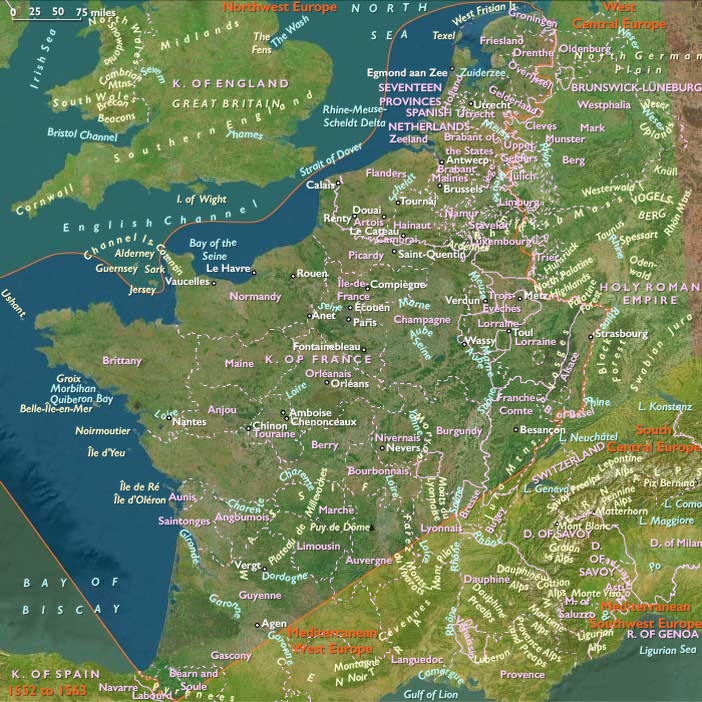
King Henry is a persecutor of the…
1552 CE
King Henry is a persecutor of the French Protestants, called Huguenots.
He has nonetheless allied himself with the German Lutheran princes.
Metz, a free city within the Holy Roman Empire from the twelfth century and the seat of a powerful bishop, has adopted Protestantism.
Holy Roman Emperor Charles IV had in 1354 and 1356 held diets here, at the latter of which was promulgated the famous statute known as the Golden Bull.
The town therefore feels that it occupies an almost independent position between France and Germany, and wants most of all to evade the obligation of imperial taxes and attendance at the diet.
The estrangement between it and the German States had daily became wider, and finally affairs have come to such a pass that in the religious and political troubles of 1552, Metz finds itself in the middle of the war between Charles V and the rebellious princes.
By an agreement of the German princes, Maurice of Saxony, William of Hesse, and John Albert of Mecklenburg, with Henry, ratified by the French king at Chambord, Metz is formally transferred to France, the gates of the city are opened, and Henry takes possession as vicarius sacri imperii et urbis protector.
The commander of the garrison, Francis, Duke of Guise (who had inherited the title from his father, Claude, in 1550), restores the old fortifications and adds new ones, and from October to December 1552 successfully resists the emperor's attacks.
Locations
People
Groups
Topics
Commodities
Subjects
Regions
West Europe
View →Subregions