North Europe (2637 – 910 BCE): Bronze…
2637 BCE to 910 BCE
North Europe (2637 – 910 BCE): Bronze and Early Iron — Amber Routes, Seaways, and Maritime Cosmologies
Regional Overview
From the Baltic forests to the Atlantic fjords, North Europe during the Bronze and Early Iron Ages was a world of sailors, herders, and metalworkers bound together by the sea.
Amber, bronze, and belief flowed along the great coastal arcs linking the Nordic Bronze Age of Scandinavia with the Atlantic megalithic traditions of the British Isles and northern France.
By 910 BCE, the northern world had become a networked maritime civilization that bridged the steppe and the Mediterranean.
Geography and Environment
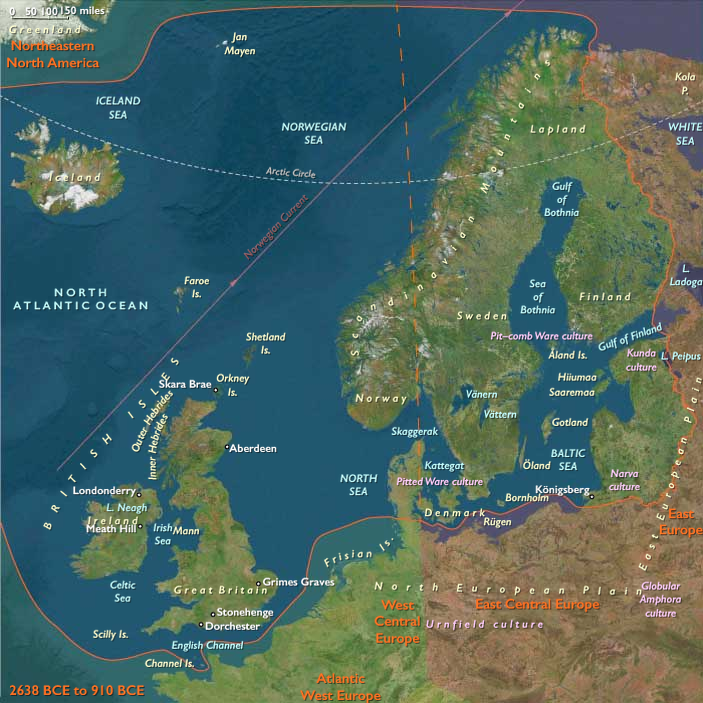
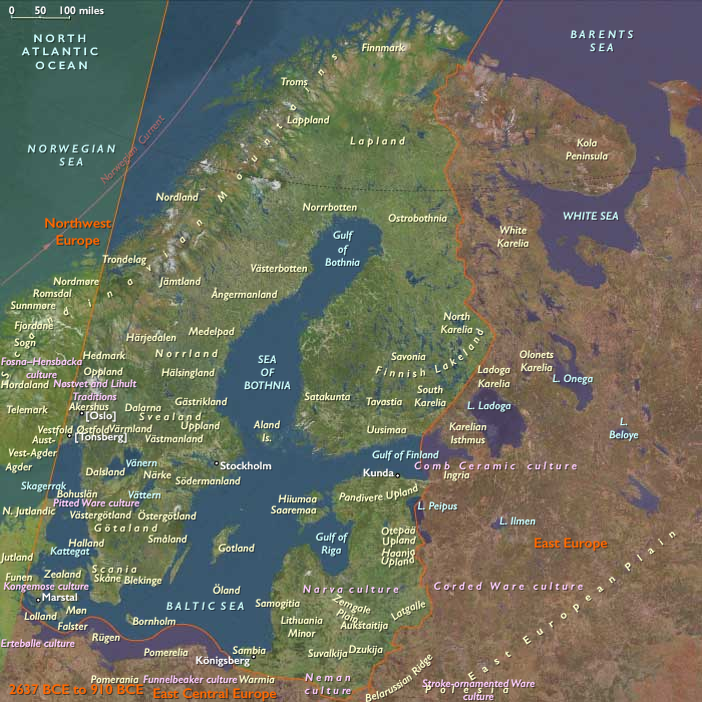
North Europe spanned the North and Baltic Seas, stretching from the fjordlands of Norway and Scotland to the Baltic plains of Poland, Lithuania, and Finland.
The region’s diverse physiography—fjords, islands, moraines, and inland lakes—fostered both isolation and connectivity.
-
The Baltic basin offered amber-rich shores and dense conifer forests.
-
The North Atlantic coast presented rugged cliffs, sheltered bays, and abundant fisheries.
-
River corridors such as the Vistula, Oder, Göta, and Thames tied interior farmlands to maritime exchange routes.
Climate and Environmental Shifts
The late Holocene brought gradual cooling after earlier warmth.
Moister summers in the second millennium BCE expanded pasture and encouraged cereal cultivation in southern Scandinavia and Denmark.
In the north, shorter growing seasons reinforced reliance on fishing, hunting, and reindeer or seal resources.
Sea levels stabilized, allowing permanent harbors and coastal villages to proliferate.
Societies and Political Developments
Baltic–Nordic Sphere (Northeast)
The Nordic Bronze Age (c. 1700–500 BCE) radiated outward from southern Scandinavia.
Chiefdoms of warrior–farmers controlled bronze imports and amber exports, projecting influence to the eastern Baltic.
Further north, Finno-Karelian forest peoples maintained hunting–fishing economies while exchanging furs and wax with agricultural neighbors.
Cairn burials, bronze hoards, and monumental rock art testify to hierarchical yet regionally distinct societies.
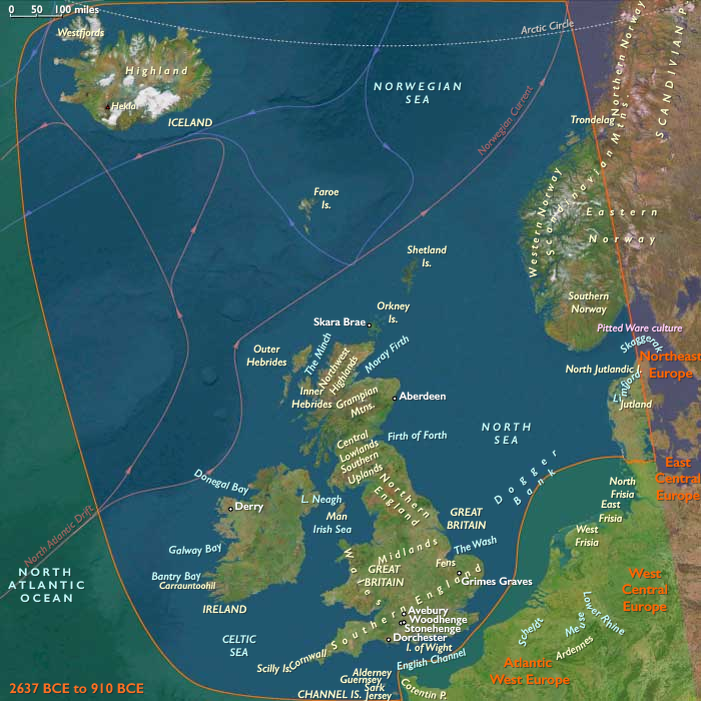
Atlantic–North Sea Sphere (Northwest)
Across the British Isles and coastal Scandinavia, farming hamlets evolved into organized chiefdoms.
The later phases of Stonehenge, the Orkney complex, and Scandinavian rock-carving fields (Bohuslän) embodied maritime ceremonialism.
By 1200 BCE, long-distance voyaging linked Ireland, Britain, Norway, and Denmark in an Atlantic Bronze Age trade of metal, salt, hides, and prestige goods.
Bronze swords and lunulae ornaments symbolized elite status, while barrow burials and cremations reflected widening social stratification.
Economy and Technology
Agriculture relied on barley, wheat, and flax; livestock included cattle, sheep, and pigs, supplemented by extensive fishing and sealing.
Bronze metallurgy flourished, producing elegant razors, axes, and spiral jewelry.
Late in the period, iron smelting appeared in the south Baltic zone.
Boat-building innovations—sewn-plank and clinker construction, flexible lashings, and decorated prows—enabled open-sea navigation.
Amber from the Baltic moved south through continental trade routes to Mycenaean and later Hallstatt markets.
Belief and Symbolism
North European religion centered on the sun, sea, and ancestors.
Rock carvings depicted solar disks, ships, and warriors, suggesting a shared maritime cosmology.
Wetland offerings—bronze weapons, ornaments, and even human sacrifices—expressed reverence for liminal water realms.
In the Atlantic archipelagos, monumental stone circles and cairns aligned with celestial events, integrating landscape and cosmos.
Movement and Interaction Corridors
-
Amber Route: from the Baltic coast to the Danube and Aegean.
-
North Sea arc: linking Jutland, Britain, and western Norway via coastal cabotage.
-
Baltic rivers: Vistula–Daugava–Neva systems carried furs, resin, and metals inland.
-
Trans-North Atlantic passages: seasonal voyages between Norway and the British Isles prefigured later Viking navigation.
These routes diffused metallurgy, iconography, and mythic motifs across the entire northern seaboard.
Environmental Adaptation and Resilience
Communities balanced cultivation, herding, and fishing to absorb climatic shocks.
Upland grazing and coastal fisheries provided redundancy; forest management ensured fuel and building timber.
Ship mobility allowed relocation and trade in lean years, while communal granaries and reciprocal alliances underpinned stability.
Regional Synthesis and Long-Term Significance
By 910 BCE, North Europe was an interconnected maritime realm—the Bronze North—where amber, metal, and myth traversed seas instead of roads.
Its Nordic Bronze Age art, Atlantic stone circles, and Baltic amber trade expressed a shared worldview of movement, water, and light.
The maritime skills, trade corridors, and cosmologies forged in this epoch would endure into the Iron Age, shaping the seafaring cultures that later bridged the North Atlantic and Baltic worlds.
Groups
Topics
Commodities
Subjects
Regions