Southwest Europe (6,093 – 4,366 BCE): Middle…
6093 BCE to 4366 BCE
Southwest Europe (6,093 – 4,366 BCE): Middle Holocene — Seafaring Farmers and the Weaving of Two Worlds
Geographic & Environmental Context
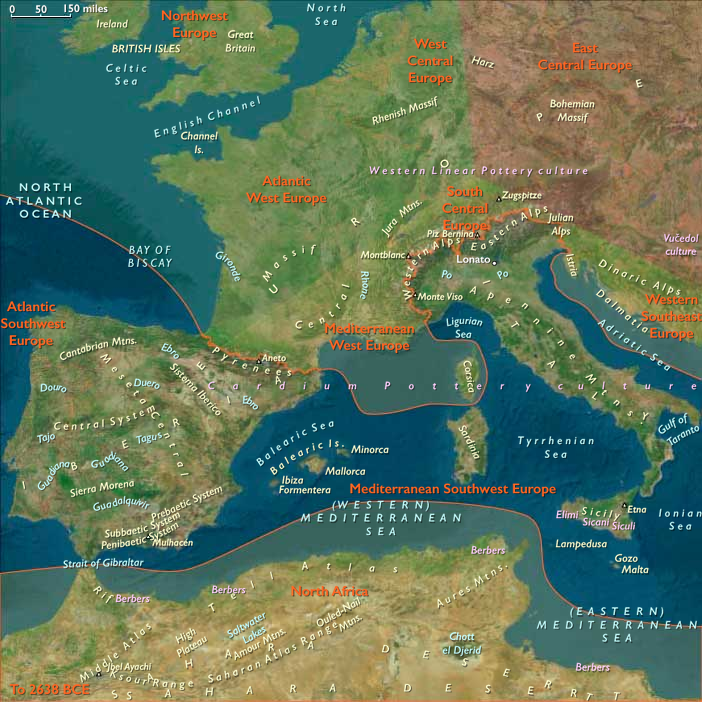
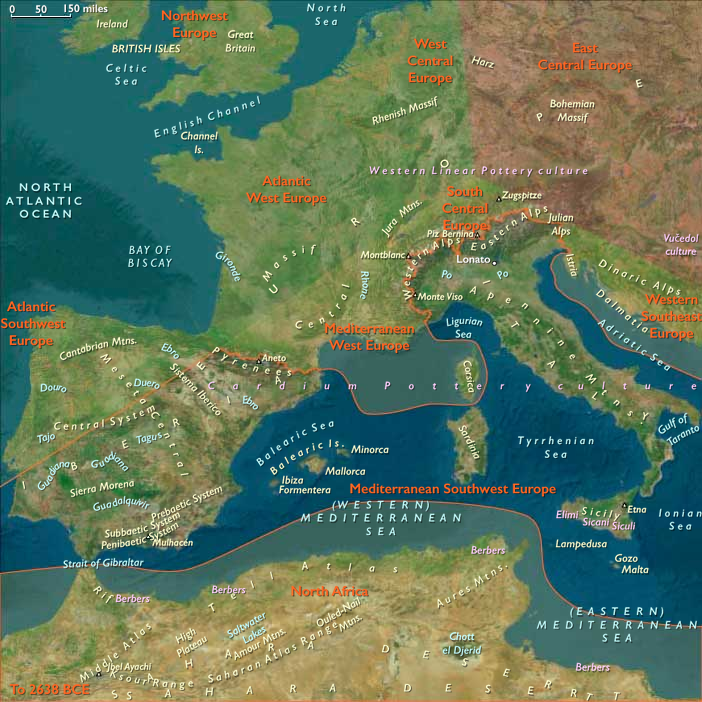
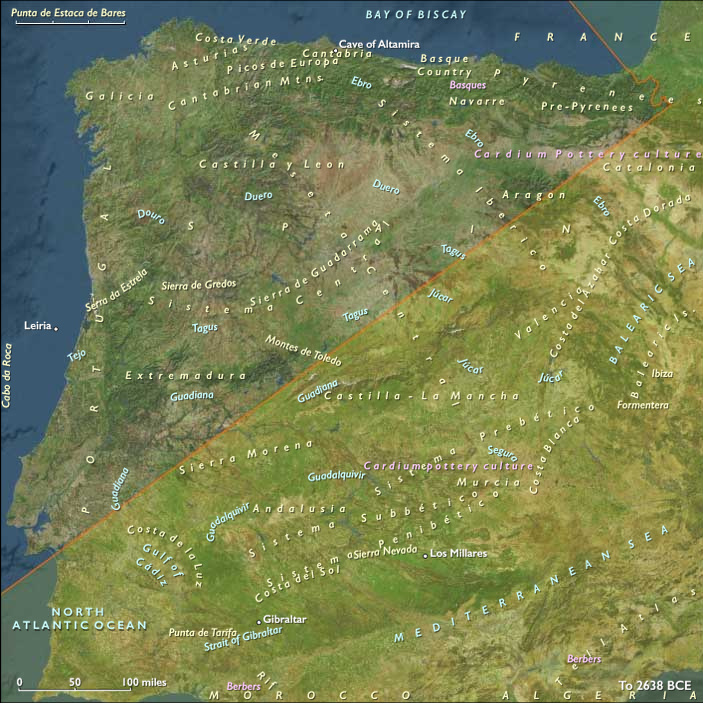
During the Middle Holocene, Southwest Europe—embracing the Iberian Peninsula, the Italian Peninsula, and the western Mediterranean islands—became the primary meeting ground of maritime Neolithic expansion and local forager adaptation.
Its landscapes encompassed an extraordinary range of environments:
-
The Guadalquivir and Ebro valleys of Iberia, rich in alluvium and framed by sierras;
-
The Apennine spine of Italy and the fertile Tiber and Po basins;
-
The uplands and coasts of Sardinia and Sicily, and the limestone terraces of Malta;
-
The Balearic coves and Venetian lagoon, where lagoonal fisheries and silts fostered settlement.
This was a world bound by water: the Mediterranean acted as highway and granary, ferrying people, crops, livestock, and ideas between Iberia, Italy, and the islands.
Across these zones, Cardial and Impressed Ware farmers established enduring colonies, while indigenous foragers persisted in riverine, coastal, and upland niches—together forming a mosaic of interaction rather than replacement.
Climate & Environmental Shifts
The Hypsithermal warm phase (7000–4000 BCE) brought a stable, productive climate across the region.
-
Regular rainfall maintained fertile soils in the Ebro, Tiber, and Po valleys, while seasonal dry periods favored grazing in Iberian and Apennine uplands.
-
Sea levels stabilized, converting former river mouths into lagoons and estuaries—prime zones for both fishing and farming.
-
Mediterranean oak forests and scrub mosaics provided fodder, timber, and game.
The result was an environment perfectly suited to the blending of agriculture, arboriculture, and coastal foraging—the ecological foundation of Neolithic resilience.
Subsistence & Settlement
Across Southwest Europe, new economies emerged that combined farming, herding, and aquatic resource use:
-
Cardial/Impressed Ware farmers introduced wheat, barley, lentils, and peas, together with sheep, goats, pigs, and cattle, colonizing fertile plains along the Catalan–Valencian coasts, southern France, and the Apennines.
-
Foragers in uplands and lagoons continued nut gathering, shellfish harvesting, and fishing, often trading with nearby farming villages.
-
Sardinia and Sicily hosted early mixed economies, where villages alternated between coastal horticulture and upland herding.
-
Malta saw its first Neolithic settlers (c. 5900–5200 BCE), who brought grain agriculture and caprine herding, laying foundations for its later temple culture.
-
In the Ebro and Po basins, tell-like settlements clustered along levees and flood margins, while small hamletsin karst valleys maintained continuous cultivation and trade.
The emerging pattern was one of regional hybridity—villages of farmers, herders, and fishers bound by mobility and exchange.
Technology & Material Culture
Innovation flourished in craft and seafaring:
-
Pottery with Cardial or Impressed decoration spread rapidly, symbolizing both cultural identity and wide maritime contact.
-
Polished stone axes cleared forests; flint blades, loom weights, and spindle whorls attest to skilled agriculture and textile production.
-
Obsidian from Sardinia (Monte Arci) and Lipari circulated across the Tyrrhenian and western Mediterranean, linking farmers from Provence to the Balearics.
-
Coastal dugout and plank canoes supported short-distance cabotage; inland, storage silos and pits regulated surplus and grain exchange.
Material culture thus expressed both practicality and connection—the shared toolkit of a maritime farming world.
Movement & Interaction Corridors
Southwest Europe was knitted together by coastal and inland trade arteries:
-
Maritime networks linked Iberia–Provence–Liguria–Italy–Sardinia–Sicily–Malta, distributing goods, crops, and people across the sea.
-
The Ebro–Rhône–Po corridor acted as the continental counterpart, carrying polished axes, ceramics, and ideas into the interior and northward toward the Danubian LBK frontier.
-
Island chains (Balearics, Tyrrhenians, Maltese group) served as waystations for navigation and exchange.
These networks transformed the western Mediterranean into an interlinked Neolithic sea, where goods, styles, and rituals circulated as freely as the winds that propelled early boats.
Cultural & Symbolic Expressions
Spiritual life deepened alongside sedentary stability:
-
Household shrines, figurines, and ritual hearths anchored worship within domestic and communal contexts.
-
Early megaliths appeared in southern Iberia, marking communal burials and territorial identity, precursors to the great dolmen traditions of the Atlantic façade.
-
On Malta, sacred enclosures and limestone platforms prefigured the monumental temples of the later fifth millennium.
-
Ancestor veneration pervaded ritual life: burials beneath houses, accompanied by pottery, ornaments, and tools, celebrated continuity between lineage and land.
-
Symbolic motifs—spirals, impressed circles, and maritime animals—reflected a worldview that united sea, fertility, and ancestry in a single cosmology.
Environmental Adaptation & Resilience
Adaptation relied on economic flexibility and landscape intelligence:
-
Mixed farming and herding diversified risk across microclimates.
-
Coastal foraging provided reliable fallback foods in lean agricultural years.
-
Storage pits and granaries buffered seasonal variation, while intercommunity trade redistributed surpluses.
-
Transhumance—moving herds between uplands and valleys—preserved pastures and stabilized food supplies.
-
Lagoon and estuary settlements combined access to arable land with fisheries, creating resilient ecological pairings.
This multi-resource strategy ensured survival through climatic fluctuation and sustained centuries of population continuity.
Long-Term Significance
By 4,366 BCE, Southwest Europe had become a fully integrated Neolithic world, defined by maritime mobility and cultural fusion.
Its coasts and river valleys formed the western frontier of the Mediterranean Neolithic, where seafaring colonists and local foragers blended lifeways into durable hybrid communities.
The region’s innovations—Cardial pottery, polished axes, megalithic ritual, and maritime exchange—set precedents that would shape later Chalcolithic and Bronze Age societies across Europe and North Africa.
Here, at the edge of the known world, the sea became the plow and the coastline a chain of gardens and sanctuaries—the living proof that agriculture and navigation could coexist, and that civilization itself could be both terrestrial and maritime in origin.
Commodities
Subjects
Regions