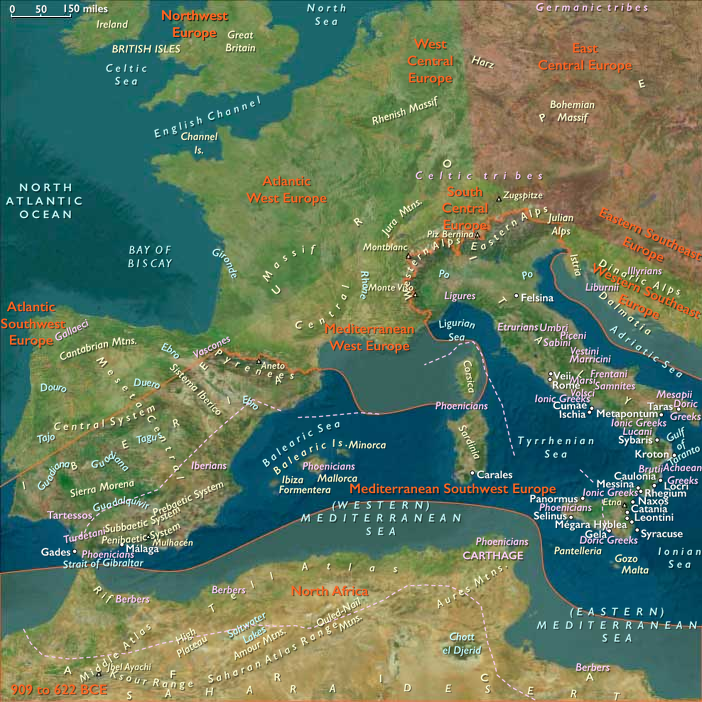
Mediterranean Southwest Europe (765–622 BCE): Greek Colonization,…
765 BCE to 622 BCE
Mediterranean Southwest Europe (765–622 BCE): Greek Colonization, Etruscan Urbanization, and the Organization of the Western Mediterranean
The age 765–622 BCE marks the second stage in the formation of an interconnected western Mediterranean. Across Italy, Sicily, Sardinia, Malta, the Balearic Islands, southern Portugal, southern, south-central, and eastern Spain, Andorra, and the central and eastern Spanish Pyrenees, long-established agricultural landscapes remained the foundation of society, while expanding Greek and Phoenician settlement, the emergence of Etruscan cities, and increasingly organized regional exchange transformed the political and economic geography of the subregion.
Expanding Agricultural Landscapes
Agriculture continued to dominate everyday life throughout Mediterranean Southwest Europe. Cereals remained the principal crop across the fertile plains of Sicily, southern Iberia, Campania, Apulia, and the Po Valley, while vineyards, olive groves, orchards, and vegetable cultivation expanded steadily along favorable hillsides and coastal districts. Mixed farming remained closely integrated with seasonal pastoralism, particularly within the Apennines, Sardinia, and the Spanish Pyrenean uplands, where transhumant livestock movement continued to shape regional economies.
Rather than replacing older farming systems, growing commercial opportunities encouraged communities to cultivate larger and more productive agricultural territories capable of supporting increasingly permanent settlements and expanding maritime exchange.
Greek Colonization and Maritime Integration
Beginning in the eighth century BCE, Greek settlers established enduring colonies along the coasts of southern Italy and eastern Sicily. Communities founded by settlers from Euboea, Corinth, Megara, Sparta, and other Greek regions rapidly became productive agricultural centers whose prosperity rested as much upon surrounding farmland as upon maritime commerce.
These colonies introduced new forms of urban organization, monumental sanctuaries, alphabetic literacy, coinless commercial accounting, and increasingly specialized craft production. Yet they did not exist in isolation. Greek settlements quickly became integrated into existing indigenous, Phoenician, and Italic exchange networks, creating one of the ancient Mediterranean's most dynamic zones of cultural interaction.
The sea increasingly functioned as a connective landscape rather than a boundary. Coastal shipping linked numerous modest ports and anchorages, while Sicily emerged as perhaps the most strategically important crossroads between the eastern and western Mediterranean.
Phoenician Expansion in the Western Basin
Phoenician communities strengthened their presence throughout southern Iberia, Sardinia, western Sicily, Malta, and the Balearic Islands, further expanding commercial relationships that connected agricultural production, mining, fisheries, and maritime trade. Rather than creating territorial empires, these settlements formed flexible networks of ports and coastal towns that exchanged metals, timber, textiles, ceramics, wine, olive oil, salt, and luxury goods across the Mediterranean.
Southern Iberia became particularly important as one of the Mediterranean's richest sources of silver and other metals. Indigenous communities increasingly participated in this expanding commercial system while maintaining their own political identities and agricultural traditions.
Etruscan Urbanization and Central Italy
During this age, the Villanovan communities of central Italy developed into increasingly sophisticated Etruscan city-states. Settlements became more formally organized, craft production became highly specialized, and long-distance commerce supported remarkable advances in metallurgy, ceramics, architecture, and religious life.
Etruscan cities coordinated surrounding agricultural territories, woodlands, mining districts, and river valleys, becoming some of the most prosperous urban societies in the western Mediterranean. Their influence extended well beyond central Italy through commercial exchange, artistic production, engineering knowledge, and diplomatic relationships with neighboring peoples.
Although politically independent, these cities collectively demonstrated an increasingly urban character that distinguished central Italy from earlier centuries.
Regional Communities and Mountain Frontiers
Beyond the major coastal centers, numerous indigenous societies continued to flourish within their own environmental settings. Nuragic Sardinia retained its mixed agricultural-pastoral economy centered upon long-established communities, while the peoples of Sicily maintained diverse cultural identities despite growing Greek and Phoenician influence.
Across southern and eastern Iberia, fortified settlements became increasingly prominent within productive agricultural valleys linked to mining and maritime commerce. Meanwhile, the central and eastern Spanish Pyrenees continued supporting pastoral communities whose seasonal livestock movements, woodland management, and control of mountain passes connected Mediterranean Iberia with southern Gaul. These upland societies participated selectively in expanding commercial networks while preserving distinct regional traditions.
The Lower Tiber and Emerging Rome
The settlements surrounding the lower Tiber continued developing within the broader landscape of central Italy. Their advantageous position at a river crossing between inland agricultural territories and the Tyrrhenian coast encouraged gradual commercial growth and increasing interaction with neighboring Latin, Sabine, and Etruscan communities.
Although later tradition associated this period with the foundation of Rome, the historical importance of the lower Tiber lay less in a single founding event than in the gradual consolidation of multiple communities occupying one of central Italy's most strategically favorable locations. During this age, Rome remained one regional center among many, participating in the same networks of agriculture, exchange, and cultural interaction that characterized much of the western Mediterranean.
Technology, Writing, and Cultural Exchange
Technological innovation accelerated throughout the region. Iron tools became increasingly widespread in agriculture, construction, and craft production, while improved metallurgy supported more sophisticated weapons, tools, and artistic objects. Alphabetic writing spread through Phoenician and Greek influence, gradually giving rise to local writing traditions among Etruscans and other Mediterranean peoples.
Architectural knowledge, religious practices, artistic styles, and systems of measurement circulated alongside merchants, artisans, and migrants. Rather than producing cultural uniformity, these exchanges created increasingly complex regional identities in which indigenous traditions coexisted with innovations arriving through expanding maritime networks.
Legacy of the Age
Between 765 and 622 BCE, Mediterranean Southwest Europe entered a new phase of historical development in which expanding networks of cities, colonies, and commercial centers began organizing the western Mediterranean into a more coherent regional system. Greek colonies transformed southern Italy and Sicily into major centers of agricultural production and maritime exchange, Phoenician settlements strengthened commercial integration across the western basin, and Etruscan cities emerged as powerful organizers of central Italy's productive landscapes.
Despite these developments, political authority remained widely distributed. Independent city-states, indigenous communities, pastoral societies, and maritime settlements continued to coexist across a landscape whose unity rested not upon empire but upon the growing interaction of agriculture, commerce, technology, and the Mediterranean Sea itself. By the close of the age, the environmental and institutional foundations of the western Mediterranean's classical civilizations had become firmly established, setting the stage for the intensifying regional competition and territorial consolidation of the following centuries.
Images

Mediterranean Southwest Europe in Archaic Antiquity II
Groups
Subjects
Regions
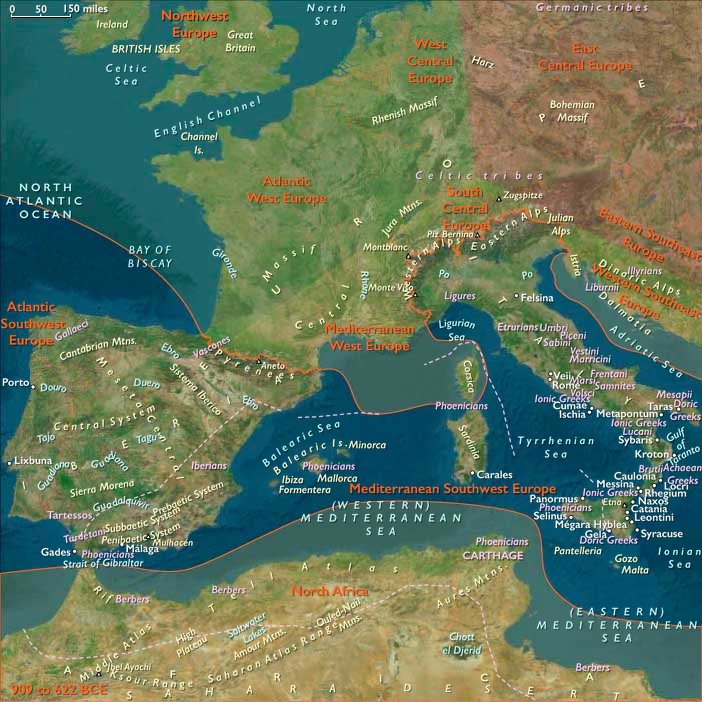
Southwest Europe
View →Subregions