
West Europe (1252–1395 CE): Papal Provence, Commercial …
Years: 1252 - 1395
West Europe (1252–1395 CE): Papal Provence, Commercial Flanders, and the Anglo-French Warlands
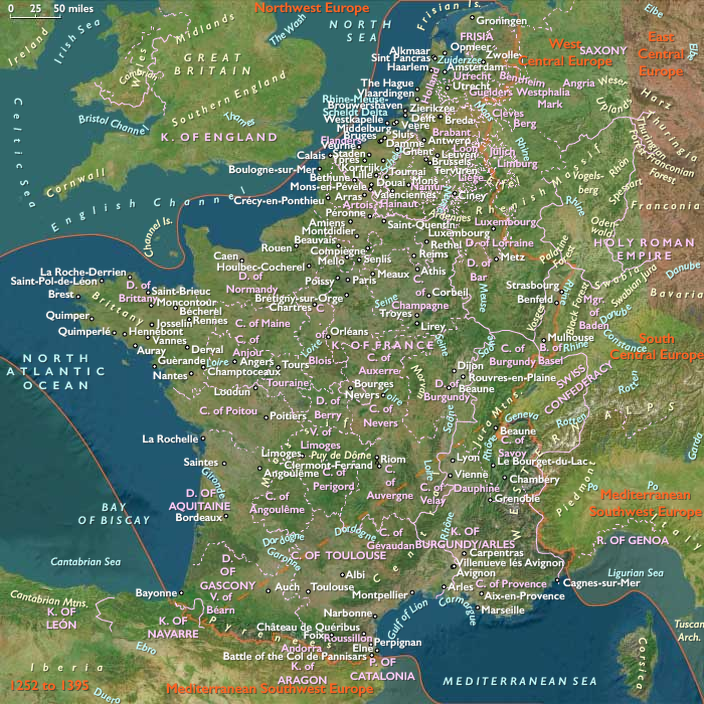
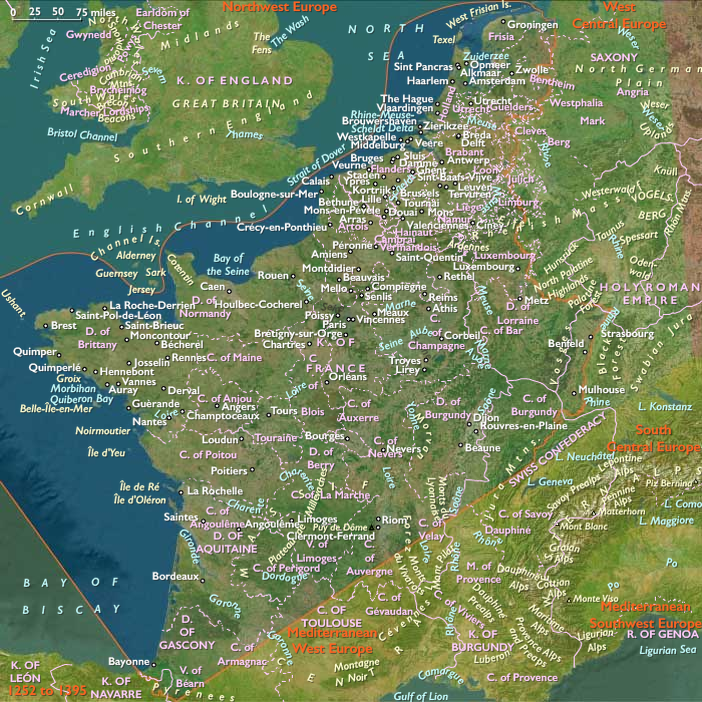
From the vineyards of the Rhône to the harbors of Bordeaux and the markets of Bruges, West Europe in the Lower Late Medieval Age combined papal finance, mercantile ingenuity, and dynastic rivalry. It was a region where the Mediterranean’s papal courts met the Atlantic’s trading republics, and where the long struggle between Capetians, Plantagenets, and Angevins reshaped the political map of France and the Low Countries.
In the south, the Avignon Papacy (1309–1377) transformed the Rhône Valley into the financial and spiritual capital of Latin Christendom. The popes, resident at Avignon, presided over a clerical bureaucracy rivaling any royal court, collecting tithes from across Europe and dispersing them through the counting houses of Lombard and Provençal bankers. The walls of the Papal Palace rose above the Rhône, its treasury vaults serving as Europe’s most secure depository of the age. Around it, Lyon, Arles, and Marseille became financial arteries: Lyon’s fairs and money markets linked Italian credit to northern merchants, while Marseille’s shipyards carried papal and Provençal goods across the Mediterranean.
The Angevin dynasty ruled Provence as counts and kings of Naples, blending French administration with Italian commercial culture. Their patronage fostered Gothic cathedrals and urban universities. Montpellier, Narbonne, and Toulouse revived from crusade-era devastation, cultivating a learned bourgeoisie of jurists, physicians, and notaries. To the west, Roussillon and Perpignan tied the Provençal plain to the Crown of Aragon, serving as gateways between Occitania and Catalonia. Along the coast, Monaco, seized by the Grimaldi family in 1297, became a fortified port wedged between Genoese power and Provençal trade. Offshore, Corsica remained under Genoese control but contested by Aragon, a strategic way-station on the western Mediterranean routes.
The climate’s cooling after 1300 shortened harvests, yet vineyards and olive groves endured. Even plague could not fully halt economic life: though the Black Death (1348–1352) devastated Marseille and Montpellier, Lyon recovered quickly, its inland fairs diversifying the regional economy. Avignon’s clergy endowed hospitals and confraternities, fostering both spiritual and social recovery. When the Great Schism (1378) divided papal allegiance between Avignon and Rome, Provençal towns found themselves on opposing sides of Christendom’s authority, but commerce and piety continued side by side—wine, wool, and grain flowing north, while alum, silks, and spices arrived from the Italian and Levantine markets.
Farther north, along the Atlantic rim, the legacy of the Angevin Empire and the rise of the Hundred Years’ War(1337–1453) defined the political landscape. The duchy of Aquitaine (Guyenne) remained England’s continental stronghold, its ports—Bordeaux, La Rochelle, an Bayonne—thriving on the wine trade. Every vintage of Bordeaux claret sailed up the Channel to England, enriching Gascon merchants and English customs alike. Salt from the marshes of Saintonge and Poitou filled barrels bound for London, while wool and cloth came south in return.
The northern plains and river basins of the Loire and Seine remained the Capetian and later Valois heartlands. Paris, though scarred by plague and intermittent warfare, retained its status as the intellectual and administrative center of France. Gothic art reached its high refinement in the Ile-de-France, while Chartres, Amiens, and Reims stood as architectural witnesses to enduring faith amid crisis.
To the north and east, the counties of Flanders, Artois, and Hainaut, together with the Low Countries, formed the engine of Western Europe’s urban economy. Cloth-making cities—Bruges, Ghent, and Ypres—wove English wool into the fabrics that dressed the courts of Europe. The Champagne fairs of an earlier era gave way to the great markets of Flanders and the credit systems of Italian bankers. Bruges became Europe’s first true commercial metropolis, where merchants from Venice, Genoa, Lübeck, and London exchanged goods, currency, and news. In the nearby Hanseatic towns of the North Sea, German traders joined the same networks that stretched south through Paris, Lyon, and Avignon to the Mediterranean.
Meanwhile, along the Rhône’s northern reaches, Lyon and the southern Jura served as continental pivots. Goods from the Swiss Confederation and Burgundy met Provençal wine, salt, and silk there before moving downriver to Marseille or across Alpine passes to Milan and Genoa. Despite wars and epidemics, this integration of riverine, overland, and maritime circuits made Western Europe’s economy remarkably resilient.
Religiously and artistically, the region mirrored its contrasts. The papal splendor of Avignon stood beside the mendicant austerity of Franciscan and Dominican houses in Toulouse and Narbonne. Across France’s northern cathedrals, devotion to the Virgin and plague saints deepened communal piety, while the Schism’s rival obediences multiplied rituals of allegiance. In Flanders, urban confraternities sponsored altarpieces and civic processions that expressed both faith and prosperity; in Provence, illuminated manuscripts and early vernacular poetry echoed the lingering troubadour tradition.
By 1395 CE, West Europe remained a tapestry of overlapping sovereignties but shared economies. Avignon symbolized papal grandeur and conflict; Lyon mediated between northern fairs and Mediterranean ports; Marseille and Montpellier linked Europe to the wider sea. Bordeaux and La Rochelle bound England to the continent through wine and salt, while Flanders and the Low Countries emerged as Europe’s richest manufacturing and banking zones.
Amid plague, schism, and war, the Rhône, Loire, and Seine valleys, together with the coasts of Aquitaine and Flanders, continued to pulse with life and exchange. From papal Provence to the Atlantic ports, Western Europe’s cities formed an unbroken chain of commerce and culture that united the Mediterranean and northern seas, laying the foundations for the mercantile revolutions of the coming age.

Mediterranean West Europe (with civilization) ©2024-25 Electric Prism, Inc. All rights reserved.
People
Groups
- Corsica, Medieval
- Toulouse, County of
- Aquitaine, (Angevin) Duchy of
- France, (Capetian) Kingdom of
- Pisa, (first) Republic of
- Savoy, County of
- Genoa, (Most Serene) Republic of
- Arles, Kingdom of
- Christians, Roman Catholic
- Provence, County of
- Aragón, Kingdom of
- England, (Plantagenet, Angevin) Kingdom of
- Aragon, Crown of
- Naples, Angevin Kingdom of
- Comtat Venaissin (Papal enclave)
- Monaco, Principality of
- Comtat Venaissin (Papal enclave)
- France, (Valois) Kingdom of
- Aquitaine, or Guyenne, (contested) Duchy of
Topics
- Little Ice Age, Warm Phase I
- Little Ice Age (LIA)
- Avignon Papacy
- Hundred Years' War
- Black Death, or Great Plague
- Tuchin revolt
Commodoties
- Glass
- Colorants
- Domestic animals
- Grains and produce
- Fibers
- Textiles
- Salt
- Beer, wine, and spirits
- Industrial chemicals
Subjects
- Commerce
- Architecture
- Watercraft
- Painting and Drawing
- Environment
- Public health
- Conflict
- Mayhem
- Faith
- Government
- Scholarship
- Custom and Law
- Catastrophe
Regions
Subregions

Years: 1252 - 1395
Mediterranean West Europe (with civilization) ©2024-25 Electric Prism, Inc. All rights reserved.
People
Groups
- Corsica, Medieval
- Toulouse, County of
- Aquitaine, (Angevin) Duchy of
- France, (Capetian) Kingdom of
- Pisa, (first) Republic of
- Savoy, County of
- Genoa, (Most Serene) Republic of
- Arles, Kingdom of
- Christians, Roman Catholic
- Provence, County of
- Aragón, Kingdom of
- England, (Plantagenet, Angevin) Kingdom of
- Aragon, Crown of
- Naples, Angevin Kingdom of
- Comtat Venaissin (Papal enclave)
- Monaco, Principality of
- Comtat Venaissin (Papal enclave)
- France, (Valois) Kingdom of
- Aquitaine, or Guyenne, (contested) Duchy of
Topics
- Little Ice Age, Warm Phase I
- Little Ice Age (LIA)
- Avignon Papacy
- Hundred Years' War
- Black Death, or Great Plague
- Tuchin revolt
Commodoties
- Glass
- Colorants
- Domestic animals
- Grains and produce
- Fibers
- Textiles
- Salt
- Beer, wine, and spirits
- Industrial chemicals
Subjects
- Commerce
- Architecture
- Watercraft
- Painting and Drawing
- Environment
- Public health
- Conflict
- Mayhem
- Faith
- Government
- Scholarship
- Custom and Law
- Catastrophe
Regions
Subregions