
Mediterranean West Europe (1341–1198 BCE): Continuity, Adaptation,…
1341 BCE to 1198 BCE
Mediterranean West Europe (1341–1198 BCE): Continuity, Adaptation, and Emerging Urnfield Influences
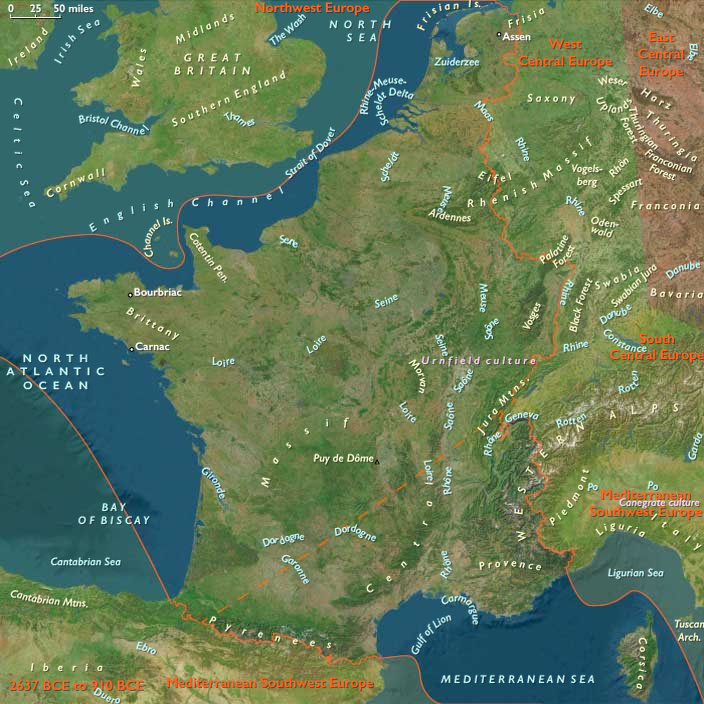
Between 1341 and 1198 BCE, Mediterranean West Europe—comprising southern France, Corsica, and Monaco—encountered significant challenges and transformations within the broader context of the Late Bronze Age collapse that profoundly impacted Mediterranean societies. Unlike the palace civilizations of the Eastern Mediterranean, however, this region demonstrated notable resilience and adaptability, maintaining cultural continuity even as important new social and ritual practices emerged.
Resilience and Continuity in Corsica's Torrean Civilization
In Corsica, the sophisticated Torrean civilization persisted through this turbulent era, albeit undergoing important adaptations. Sites such as Filitosa provide clear archaeological evidence of cultural continuity intertwined with significant transformations. Torrean communities repurposed and integrated earlier Neolithic megalithic stones into their new architectural projects, reflecting both practical considerations and evolving symbolic traditions.
The period was characterized by the proliferation of small fortified sites alongside the multiplication of distinctively shaped elliptic dwellings. These new village configurations, often established at the base of fortified settlements, indicate potential population growth, intensified settlement patterns, and evolving social structures, suggesting adaptive responses to external pressures and internal developments.
Emergence and Adaptation of Urnfield Burial Customs
This era also witnessed the initial introduction and gradual adaptation of Urnfield burial practices from Central Europe. Although collective burials remained prominent throughout the region, cremation rituals began to appear, notably materialized by the presence of distinctive biconical urns discovered within natural cave sites. These practices aligned with broader trends spreading across the northern Tyrrhenian region from the thirteenth and twelfth centuries BCE onward, marking the early penetration of Urnfield cultural influences.
Despite these new burial customs, local traditions continued to hold considerable influence, underscoring the complexity and selective integration of external cultural elements within Mediterranean West Europe's established social frameworks.
Stability Amid Broader Mediterranean Turmoil
Unlike contemporaneous Mediterranean societies to the east, Mediterranean West Europe largely avoided catastrophic collapse during this period. While significant adjustments in settlement patterns, defensive strategies, and ritual practices indicate substantial societal shifts, the overall resilience of local communities provided stability amid regional uncertainty. This era thus highlights the adaptability and robustness of Mediterranean West European societies in the face of widespread Mediterranean disruptions.
By 1198 BCE, the foundations had been laid for further integration of external cultural influences, notably those of the Urnfield culture, within resilient local structures—a synthesis that would continue to shape the region’s trajectory throughout subsequent centuries.
Groups
Subjects
Regions
West Europe
View →Subregions
