
Mithridates, having long presumed the Kingdom of…
73 BCE
Mithridates, having long presumed the Kingdom of Bithynia for himself, invades the country in 73 BCE, putting the small Roman garrison under pressure and isolating them from assistance.
Groups
Topics
Commodities
Subjects
Regions
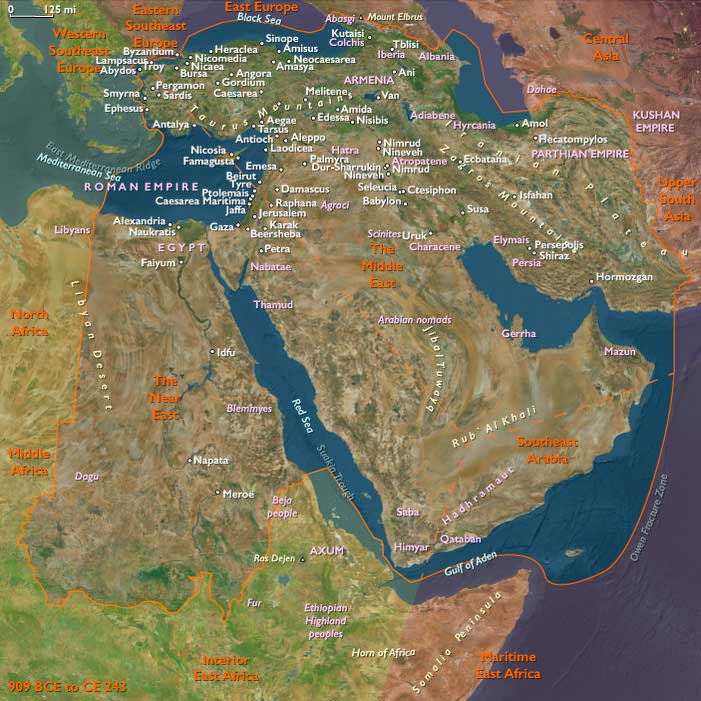
The Near and Middle East
View →Subregions
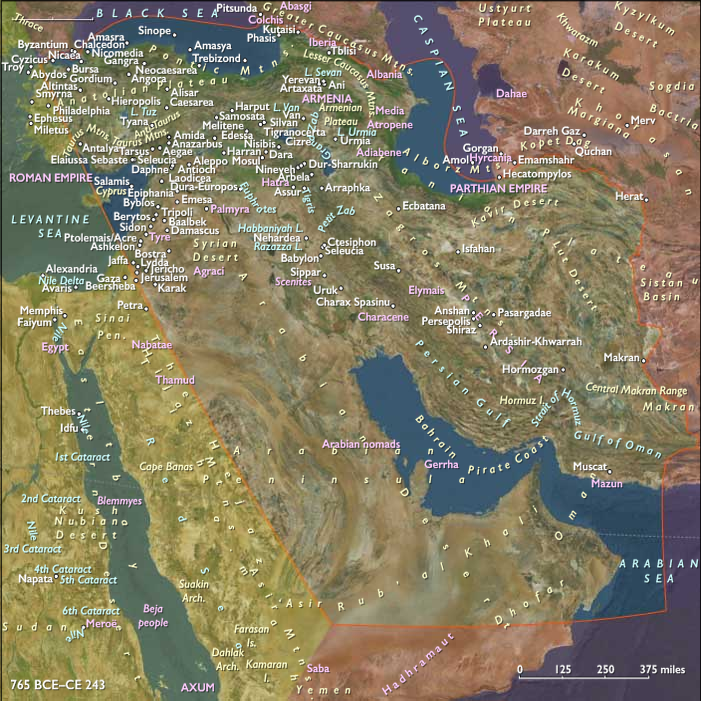
Middle East
View →Related Events
No active filters.
Showing 10 events out of 62710 total
Cotta, joined by Lucullus at Nicomedia in 73 BCE, is assigned the task of securing Lucullus' rear by taking the town of Heraclea, which Mithridates has reinforced with four thousand troops.
After reducing the Pontic coast, Cotta begins besieging Heraclea.
Deiotarus, tetrarch of the Tolistobogii (of western Galatia, now in western Turkey), drives the invading Pontic troops of Mithridates from Phrygia at the beginning of the Third Mithridatic War.
Mithridates, launching an attack at the same time as the revolt by Sertorius is sweeping through the Spanish provinces, is initially virtually unopposed.
The Senate responds by sending the consul Lucius Licinius Lucullus to Cilicia to deal with the Pontic threat.
The only other possible general for such an important command, Pompey, is in Gaul, marching to Hispania to help crush the revolt led by Sertorius.
Marcus Aurelius Cotta, having received Bithynia and Pontus as his proconsular command, had taken charge of a fleet to protect his province, having been dispatched to the east towards the end of his period as consul.
Lucullus, upon arrival in Cilicia and immediately sets forth to confront the Pontic army in Bithynia.
The original plan was that Cotta should tie down Mithridates' fleet, while Lucullus attacked by land.
Cotta had therefore been ordered to station his fleet at Chalcedon, while Lucullus marches through Phrygia with the intention of invading Pontus.
Lucullus has not advanced far when news comes through that Mithridates has made a rapid march westward, attacked Cotta, and forced him to flee behind the walls of Chalcedon.
Sixty-four Roman ships have been captured or burnt, and Cotta has lost three thousand men.
Here Cotta is forced to remain until Lucullus can to come to his rescue.
Lucullus harries the army of Mithridates and kills many of his soldiers, then turns to the sea and raises a fleet among the Greek cities of Asia.
With this fleet he defeats the enemy's fleet off Ilium and then off Lemnos.
Cotta, having made his way to Nicomedia, watches in frustration as Mithridates, learning that his fleet has been destroyed by Lucullus, escapes the city and sails down the Bosporus to the town of Heraclea Pontica.
Mithridates employs the cunning guerilla tactics he has polished in the first two wars to hold the Roman legions at bay, although Lucullus manages, with five legions, to drive Mithridates from Cyzicus in the winter of 74-73.
The existence of a pool of inexpensive labor in the form of enslaved people is an important factor in the economy through varying degrees throughout Roman history.
Slaves are acquired for the Roman workforce through a variety of means, including purchase from foreign merchants and the enslavement of foreign populations through military conquest.
With Rome's heavy involvement in wars of conquest in the second and first centuries BCE, tens if not hundreds of thousands of slaves at a time are imported into the Roman economy from various European and Mediterranean acquisitions.
While there is limited use for slaves as servants, craftsmen, and personal attendants, vast numbers of slaves work in mines and on the agricultural lands of Sicily and southern Italy.
For the most part, slaves are treated harshly and oppressively during the Roman republican period.
Under Republican law, a slave is not considered a person, but property.
Owners can abuse, injure or even kill their own slaves without legal consequence.
While there are many grades and types of slaves, the lowest—and most numerous—grades, who work in the fields and mines, are subject to a life of hard physical labor.
This high concentration and oppressive treatment of the slave population has led to rebellions.
In 135 BCE and 104 BCE, the First and Second Servile Wars, respectively, had erupted in Sicily, where small bands of rebels found tens of thousands of willing followers wishing to escape the oppressive life of a Roman slave.
While these were considered serious civil disturbances by the Roman Senate, taking years and direct military intervention to quell, they were never considered a serious threat to the Republic.
The Roman heartland of Italy had never seen a slave uprising, nor had slaves ever been seen as a potential threat to the city of Rome.
This all changes with the Third Servile War.
In the Roman Republic of the first century, gladiatorial games are one of the more popular forms of entertainment.
In order to supply gladiators for the contests, several training schools, or ludi, have been established throughout Italy.
In these schools, prisoners of war and condemned criminals—who are considered slaves—are taught the skills required to fight to the death in gladiatorial games.
In 73 BCE, a group of some two hundred gladiators in the Capuan school owned by Lentulus Batiatus plot an escape.
When their plot is betrayed, a force of about seventy men seizes kitchen implements, ("choppers and spits"), fight their way free from the school, and seize several wagons of gladiatorial weapons and armor.
Once free, the escaped gladiators choose leaders from their number, selecting two Gallic slaves—Crixus and Oenomaus—and Spartacus, who is said either to be a Thracian auxiliary from the Roman legions later condemned to slavery, or a captive taken by the legions.
There is some question as to Spartacus's nationality, however, as a Thraex (plural Thraces or Threses) is a type of gladiator in Rome, so the title "Thracian" may simply refer to the style of gladiatorial combat in which he had been trained.
These escaped slaves are able to defeat a small force of troops sent after them from Capua, and equip themselves with captured military equipment as well as their gladiatorial weapons.
Sources are somewhat contradictory on the order of events immediately following the escape, but they generally agree that this band of escaped gladiators plundered the region surrounding Capua, recruited many other slaves into their ranks, and eventually retired to a more defensible position on Mount Vesuvius.
The revolt and raid occurring in Campania—which is a vacation region of the rich and influential in Rome, and the location of many estates—quickly comes to the attention of Roman authorities.
They initially view the revolt as more a major crime wave than an armed rebellion.
Later this year, however, Rome dispatches a military force under praetorian authority to put down the rebellion.
A Roman praetor, Gaius Claudius Glaber, gathers a force of three thousand men, not as legions, but as a militia "picked up in haste and at random, for the Romans did not consider this a war yet, but a raid, something like an attack of robbery." (Appian, Civil Wars, 1:116.)
Glaber's forces besiege the slaves on Mount Vesuvius, blocking the only known way down the mountain.
With the slaves thus contained, Glaber is content to wait until starvation forces the slaves to surrender.
While the slaves lack military training, Spartacus' forces displays ingenuity in their use of available local materials, and in their use of clever, unorthodox tactics when facing the disciplined Roman armies.
In response to Glaber's siege, Spartacus' men make ropes and ladders from vines and trees growing on the slopes of Vesuvius and used them to rappel down the cliffs on the side of the mountain opposite Glaber's forces.
They move around the base of Vesuvius, outflank the army, and annihilated Glaber's men.
A second expedition, under the praetor Publius Varinius, is now dispatched against Spartacus.
For some reason, Varinius seems to have split his forces under the command of his subordinates Furius and Cossinius.
Plutarch mentions that Furius commanded some two thousand men, but neither the strength of the remaining forces, nor whether the expedition was composed of militia or legions, appears to be known.
These forces are also defeated by the army of escaped slaves: Cossinius is killed, Varinius is nearly captured, and the equipment of the armies is seized by the slaves.
With these successes, more and more slaves flocked to the Spartacan forces, as do "many of the herdsmen and shepherds of the region", swelling their ranks to some seventy thousand. (Plutarch, Crassus, 9:3; Appian, Civil War, 1:116)
Spartacus and Crixus by the end of 73 BCE are in command of a large group of armed men with a proven ability to withstand Roman armies.
What they intend to do with this force is somewhat difficult for modern readers to determine.
Since the Third Servile War is ultimately an unsuccessful rebellion, no firsthand account of the slaves' motives and goals exists, and historians writing about the war propose contradictory theories.
Sertorius, on the verge of successfully establishing an independent Roman republic in Hispania, is in league with the Cilician pirates, who have bases all across the Mediterranean, is negotiating with the formidable Mithridates VI of Pontus, and is in communication with the insurgent slaves in Italy.
His string of victories, however, had soon begun to inspire discontent in the Roman nobles and senators that make up the higher classes of his domain.
These people have grown jealous of Sertorius' power, and Perpenna, aspiring to take Sertorius' place, has encouraged that jealousy for his own ends.
They have taken to damaging Sertorius' measures for victory, or oppressing the local Iberian tribes in his name.
This has stirred discontent and revolt in the tribes, which has resulted in a cycle of oppression and revolt, with Sertorius none the wiser as to who is creating such mischief.
Perpenna now proceeds to invite Sertorius to a feast to celebrate a supposed victory.
While under most circumstances, any festivities to which Sertorius is invited are conducted with great propriety, this particular feast is vulgar, designed to offend the skillful general.
Disgusted, Sertorius changes his posture on the couch, intent on ignoring them all.
At this, Perpenna gives the signal to his minions, and they murder the unsuspecting Sertorius on the spot.
Gaius Aurelius Cotta, uncle to Julius Caesar through Caesar's mother, Aurelia Cotta, had in 92 BCE defended his uncle Publius Rutilius Rufus against the unjust accusation of extortion in Asia, and had been on intimate terms with the tribune Marcus Livius Drusus, who was murdered in 91 BCE, and in the same year was an unsuccessful candidate for the tribunate.
Shortly afterwards he was prosecuted under the lex Varia, the law proposed by Quintus Varius Severus which was directed against all who had in any way supported the Italians against Rome, and, in order to avoid condemnation, went into voluntary exile.
He did not return until 82 BCE, during the dictatorship of Sulla.
In 75, he was consul, and had excited the hostility of the optimates by carrying a law that abolished the Sullan disqualification of the tribunes from holding higher magistracies; another law, de judiciis privatis, of which nothing is known, was abrogated by his brother Lucius Cotta.
Cotta has obtained the province of Gaul, and had been granted a triumph for some victory of which we possess no details; but on the very day before its celebration an old wound broke out, and he was injured suddenly.
According to Cicero, Publius Sulpicius Rufus and Cotta were the best speakers of the young men of their time.
Physically incapable of rising to passionate heights of oratory, Cotta's successes were chiefly due to his searching investigation of facts; he kept strictly to the essentials of the case and avoided all irrelevant digressions.
His style was pure and simple.
He is introduced by Cicero as an interlocutor in the De Oratore and De Natura Deorum (iii.
), as a supporter of the principles of the New Academy.
The fragments of Sallust contain the substance of a speech delivered by Cotta in order to calm the popular anger at a deficient corn-supply.
The Romans, from 75, occupy Dobruja (Romanian: Dobrogea), a historical region lying between the lower Danube River and the Black Sea.
Tomis, (modern Constanta) a port city in southeastern Romania, on the Black Sea, settled by Greeks in the seventh century BCE, comes under Roman rule in 72.