
Near East (100–243 CE): Christianity, Roman Administration,…
100 CE to 243 CE
Near East (100–243 CE): Christianity, Roman Administration, and Jewish Resilience
Between 100 and 243 CE, the Near East is significantly shaped by the interplay of Roman administrative structures, the rise of Christianity, Jewish resilience, and ongoing cultural transformations.
Roman Administration and Cultural Integration
The Roman Empire exerts firm control over the Near East, bringing stability through a strong, centralized bureaucracy supported by military power sufficient to maintain internal order and protect against nomadic incursions. In Egypt, Rome continues Ptolemaic traditions, with the emperor ruling as successor to the Pharaohs, bearing the title "Pharaoh, Lord of the Two Lands". Roman authorities maintain traditional priestly rights but carefully oversee the native priesthood. The Romans complete significant architectural projects, notably the Temple of Isis on Philae Island, begun under the Ptolemies. Artistic innovations also flourish, exemplified by the painting of lifelike portraits on wood, notably originating in the Fayyum region, used to adorn coffins of mummies.
The administration is marked by exploitation; as absentee landlords, Roman rulers extract resources and taxes primarily for the empire’s benefit, leading to significant economic and social decline within Egypt. Nevertheless, the local Hellenized populations in urban areas maintain privileges over rural native Egyptians, reinforcing societal divisions.
Spread of Christianity and Religious Tensions
Christianity, originating in Judea, spreads rapidly across the empire, deeply influencing Egypt, where tradition attributes its arrival to Saint Mark in 37 CE. The early Egyptian Christians, known as Copts, experience severe Roman persecution beginning with Emperor Septimius Severus' edict of 202, which dissolves the influential Christian School of Alexandria and forbids conversions to Christianity. Despite persecution, the Christian faith takes firm root, with its influence expanding significantly throughout Egypt and the broader Near East.
Jewish Intellectual Life and Resistance
The Jewish community, despite ongoing persecution, continues vigorous scholarly activity, especially through the compilation of the Talmud, an immense commentary and analysis of Jewish law. This intellectual activity is epitomized by the development of both the Palestinian Talmud (100–425 CE) and the more authoritative Babylonian Talmud (completed around 500 CE), reflecting the intellectual maturity and resilience of Jewish scholarship.
Jewish resistance flares notably during the Bar-Kokhba Rebellion (132–135 CE), triggered by Emperor Hadrian’s repressive edicts aimed at cultural uniformity, including prohibitions on circumcision. After crushing the rebellion, Hadrian takes severe measures, renaming Jerusalem as Aelia Capitolina, banning Jewish presence in the city except once yearly to mourn at the Western Wall, now known as the Wailing Wall. Nevertheless, Jewish scholarship continues in Galilee, which emerges as the center of religious life under leaders such as Judah ha-Nasi, who oversees the final redaction of the Mishnah, foundational to both the Palestinian and Babylonian Talmuds.
Roman Expansion and Cultural Prosperity in Jordan
In 106 CE, Emperor Trajan annexes the Nabataean kingdom, organizing it into the Roman province of Arabia, with the ancient city of Petra initially serving as its capital. The Nabataeans prosper culturally and economically under Roman rule, becoming thoroughly Hellenized, and their region becomes an integral part of the empire through Roman road networks, commerce, and legal systems. Roman ruins scattered throughout present-day Jordan attest to the vibrant civic life fostered by this integration.
Kush, Meroë, and Rome’s Southern Strategy
To the south, the kingdom of Kush, particularly around Meroë, continues to interact with Rome, particularly through the Nobatae, a militarized group who establish themselves as protectors and rulers along the Nile's western bank. Rome strategically subsidizes the Nobatae to utilize Meroë as a buffer zone against nomadic incursions, notably from the Blemmyes, maintaining regional stability until nearly the fifth century.
Technological and Linguistic Developments
Technological innovation occurs with cast glass windows appearing around 100 CE in Alexandria, improving material culture despite limited transparency. Linguistic shifts accompany political changes; notably, in 212 CE, Egyptians are granted citizenship within the Roman Empire, prompting a gradual transition from Greek to Latin in higher administrative settings.
Legacy of the Age
This period witnesses the firm establishment and expansion of Christianity, the resilience and intellectual achievements of Jewish communities despite severe persecution, and a Roman administrative structure that significantly shapes the social and economic landscape. Artistic innovation, cultural integration, and linguistic evolution reflect a complex dynamic of continuity and change, laying enduring foundations for the region’s historical trajectory.
People
Groups
Topics
Regions
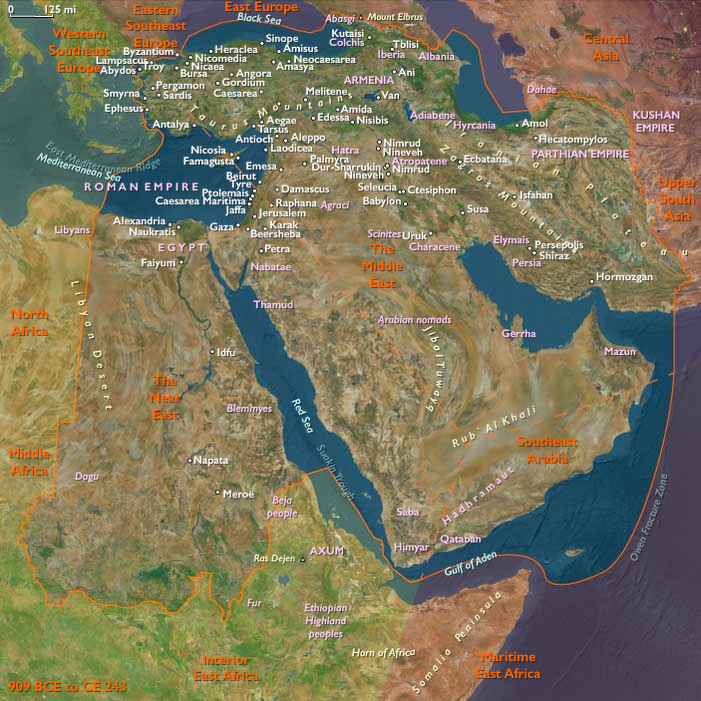
The Near and Middle East
View →Subregions
