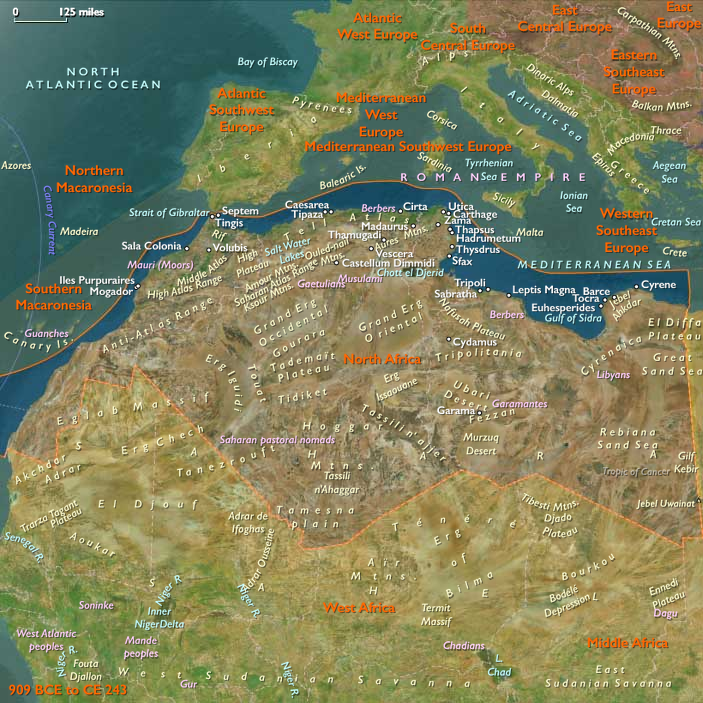
North Africa (537–526 BCE) Enhanced Trade Networks,…
537 BCE to 526 BCE
North Africa (537–526 BCE)
Enhanced Trade Networks, Diplomatic Complexity, and Cultural Integration
Carthaginian Maritime Power and Economic Expansion
Between 537 and 526 BCE, Carthage maintains and strengthens its maritime and economic dominance across the Western Mediterranean. Its advanced naval fleet and sophisticated harbor facilities sustain expansive trade networks connecting regions such as Iberia, Sicily, Sardinia, and the Balearic Islands. The city continues to strategically establish and fortify colonies, significantly enhancing its geopolitical reach and economic prosperity.
Under the leadership of Mago I, who ascends following the ousting of his predecessor for seeking royal power, Carthage's foreign policy undergoes a marked transformation. As related by Justin, a Latin historian of the Roman era, Carthage, previously a tentative colonizer, now asserts itself decisively, notably colonizing Ibiza and firmly establishing itself as the dominant Phoenician military power in the Western Mediterranean. Although Carthage remains economically dependent on Tyre, it increasingly acts with strategic independence.
Mago I significantly alters Carthaginian military strategy, abandoning the city’s purely citizen army and heavily relying on mercenaries due to the limited population base of Carthage. His son, Hasdrubal I, succeeds him in 530 BCE, continuing the Magonid dynasty’s leadership, under which Carthage establishes a commercial empire that dominates Western Mediterranean trade throughout the latter half of the sixth century BCE.
Strategic Diplomacy and Rising Rivalries
Diplomatic interactions between Carthage and Greek city-states, particularly Cyrene, grow increasingly intricate. The balance between peaceful coexistence and strategic competition becomes nuanced, as both powers maneuver for control over lucrative trade routes and regional influence. Cyrene, bolstered by continued economic prosperity and sustained immigration from the Hellenic world, remains a formidable economic and cultural counterpart to Carthaginian ambitions.
Berber Communities: Economic Integration and Cultural Continuity
Coastal Berber communities continue their robust economic integration with Carthaginian commerce, adopting advanced Phoenician agricultural techniques, maritime expertise, and artisanal innovations. This deepening economic interdependence enhances regional prosperity while allowing coastal Berber groups to retain distinctive cultural identities.
Inland Berber populations maintain substantial autonomy within traditional tribal frameworks and geographical isolation, indirectly benefiting from expanded coastal economic activities. They preserve distinct social structures and cultural practices while indirectly participating in regional economic growth.
Cultural Exchange and Syncretic Flourishing
This era sees further enrichment of cultural exchanges among Berber, Carthaginian, and Greek communities. Artistic and artisanal practices, particularly in pottery, textiles, and metalwork, reflect an increasingly dynamic and hybridized cultural landscape. Syncretic blending of indigenous Berber spiritual traditions with Phoenician and Greek religious practices continues to evolve, highlighting the ongoing cultural integration and complexity within the region.
Regional Stability and Prospects for Future Prosperity
By 526 BCE, North Africa enjoys sustained stability and prosperity, driven by Carthage's maritime economic supremacy under the assertive leadership of the Magonid dynasty and balanced by Cyrene’s thriving economy. Diplomatic interactions effectively manage emerging rivalries, maintaining regional peace. Rich cultural exchanges, economic integration, and strategic diplomacy during this period lay a strong foundation for the continued development and enduring influence of North Africa in the broader Mediterranean geopolitical context.
People
Groups
Regions
North Africa
View →Subregions