North Africa (57–46 BCE) Roman Influence, Economic…
57 BCE to 46 BCE
North Africa (57–46 BCE)
Roman Influence, Economic Vitality, and the Fate of Silphium
Roman Provincial Expansion and Economic Integration
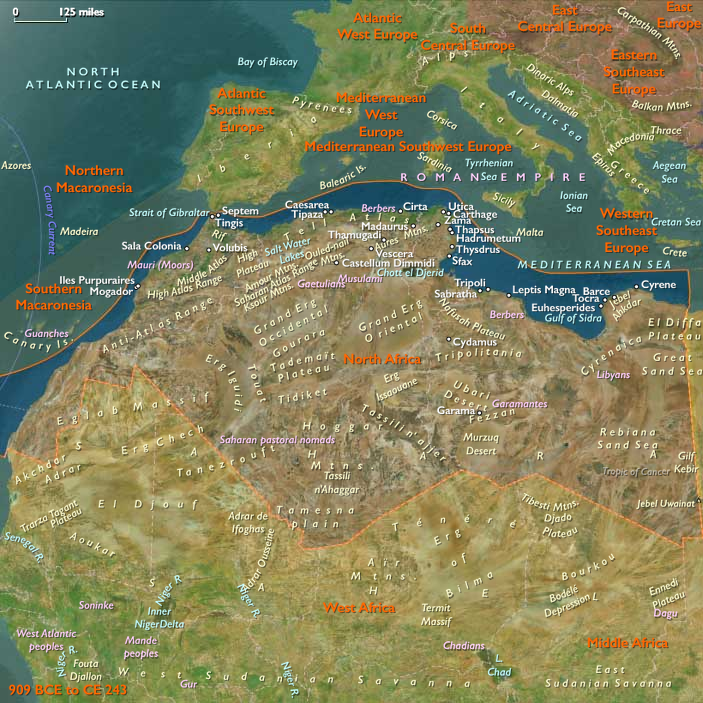
From 57 to 46 BCE, Roman influence in North Africa continues to expand through strategic administrative reforms, infrastructural investments, and economic integration. Key cities such as Utica, Leptis Magna, and Caesarea (Cherchell) thrive under Roman economic policies, further solidifying their roles as important Mediterranean trading hubs. Julius Caesar’s decisive campaign in North Africa (46 BCE) reinforces Roman dominance and facilitates further integration of the region into Roman administration.
Numidia: Economic Prosperity and Cultural Adaptation
Numidia benefits significantly from Roman investments in agriculture and trade, ensuring sustained economic growth. Numidian communities adapt culturally and politically, integrating traditional governance within the broader Roman administrative system, which promotes social cohesion and regional stability.
Mauretania: Rule of Bocchus II and Economic Flourishing
Mauretania, under the joint rule of Bocchus II and his brother Bogud, maintains its economic prosperity through trade in grain, olive oil, and luxury goods, supported by Roman infrastructural development. Caesarea remains a critical commercial center, enabling continued cultural exchanges and reinforcing Mauretania’s strategic significance within Roman North Africa.
Cyrenaica: Economic Peak and Silphium’s Decline
Cyrenaica remains economically strong, driven by trade in grain, wine, wool, and livestock. The Greek Pentapolis—Cyrene, Barce, Euhesperides, Teuchira, and Apollonia—continues functioning, though increasingly under Roman influence. Silphium, once dominant in Cyrenaica’s economy and prominently depicted on local coinage, nears extinction due to relentless overharvesting and an inability to cultivate the plant, marking a critical turning point in the region’s economic history.
Berber Communities: Economic Engagement and Cultural Resilience
Berber communities actively engage in regional commerce through coastal economic hubs such as Oea (Tripoli). Inland Berber tribes maintain their traditional governance structures and cultural practices, indirectly benefiting from prosperous coastal trade, ensuring continued economic integration and cultural resilience.
Garamantes: Persistent Saharan Trade Leaders
The Garamantes sustain their crucial role in trans-Saharan commerce, efficiently managing advanced agricultural practices and trade routes. Their strategic oversight facilitates robust economic exchanges between sub-Saharan Africa and Mediterranean markets, strengthening regional prosperity and cultural interaction.
Musulami, Gaetulians, Mauri (Moors), and Saharan Pastoral Nomads
The Musulami maintain agricultural and pastoral livelihoods, continuously interacting commercially and culturally with Roman and Numidian populations. The semi-nomadic Gaetulians persist as critical trade intermediaries between coastal and inland territories.
The Mauri (Moors) retain their regional influence through diplomatic and dynamic economic engagement, significantly contributing to stability and prosperity in western North Africa.
Saharan pastoral nomads continue their essential roles in facilitating trade, cultural exchanges, and information dissemination across diverse ecological and economic zones, reinforcing regional interconnectedness.
Cultural Syncretism and Regional Integration
Continued interactions among Berber, Roman, Greek, Garamantian, Musulami, Gaetulian, Mauri, and Saharan pastoral communities enrich regional traditions in arts, crafts, and religious practices. Religious syncretism remains vibrant, harmoniously blending indigenous Berber beliefs with Roman, Greek, Phoenician, and Saharan spiritual customs, significantly enhancing North Africa’s cultural diversity.
Foundations for Ongoing Stability and Prosperity
By 46 BCE, North Africa remains economically vibrant, culturally resilient, and regionally stable. Effective Roman provincial governance, thriving urban growth, robust Berber communities, enduring Saharan trade networks, and the prominence and subsequent decline of silphium collectively affirm North Africa’s strategic importance within the Mediterranean geopolitical context.
Groups
Commodities
Subjects
Regions
North Africa
View →Subregions