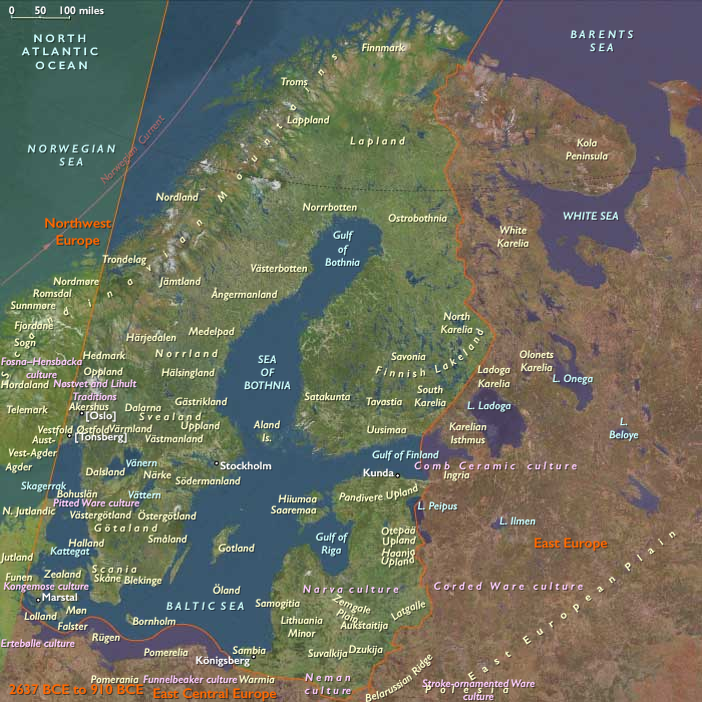
Northeast Europe (909 BCE – 819 CE):…
2637 BCE to 910 BCE
Northeast Europe (909 BCE – 819 CE): Bronze and Early Iron — Nordic Bronze Links, Lusatian Neighbors, and Forest-Zone Continuities
Geographic and Environmental Context
Northeast Europe includes Sweden, Finland, the Baltic States (Estonia, Latvia, Lithuania), eastern Denmark (including Copenhagen, Zealand, Bornholm), eastern Norway (including Oslo), and the Russian enclave of Kaliningrad.
Anchors: Baltic-coast amber zones; Lake Ladoga and Lake Onega; Estonian Narva–Daugava corridor; Uppland in Sweden; Oslofjord in Norway.
Climate and Environmental Shifts
Gradual cooling and wetter conditions set in during the late second millennium BCE, though lakes and river systems remained stable and productive. Forest expansion accompanied lower temperatures, encouraging both hunting and shifting agriculture.
Subsistence and Settlement
Baltic coastal peoples balanced foraging and farming economies. Seal hunting and river fishing persisted, while inland agro-pastoralism spread slowly northward.
In southern Scandinavia, the Nordic Bronze Age (c. 1700–500 BCE) flourished—marked by maritime trade, monumental burial cairns, and elaborate bronze weaponry.
Across the forest zone of Finland and Karelia, mobile hunting-fishing societies endured with little agricultural transformation, maintaining small semi-permanent lake settlements.
Technology and Material Culture
Bronze swords, axes, and ornaments circulated widely within the Baltic–Nordic sphere, signaling elite networks that connected Scandinavia, northern Germany, and the Baltic coast.
Iron metallurgy appeared only in the final centuries of this era.
Northern ceramic traditions shifted from Comb Ware to textile-impressed and simple pottery forms, reflecting both innovation and contact with Central European Urnfield and Lusatian cultures.
Movement and Interaction Corridors
-
Amber routes carried Baltic amber south to Mycenaean and Mediterranean markets.
-
Maritime lanes around Denmark and southern Sweden linked the North Sea with the eastern Baltic.
-
Riverine corridors (Daugava, Nemunas, Vistula) moved furs, wax, and honey inland toward steppe and central European zones.
-
Overland exchanges tied Lusatian and Nordic communities through the Oder–Vistula passage.
Cultural and Symbolic Expressions
Rock art in Bohuslän (Sweden) and Østfold (Norway) portrayed ships, sun wheels, ploughs, and warriors—visual records of a maritime cosmology that equated the voyage with life’s passage.
Coastal burial cairns and stone-ship settings reflected seafaring identity, while inland wetlands preserved wooden idols and offerings.
Ancestor veneration and solar cults dominated ritual life, uniting the landscape’s forests, lakes, and coasts into a shared spiritual geography.
Environmental Adaptation and Resilience
Mixed economies—hunting, fishing, small-scale farming, and stock-raising—buffered northern communities against short growing seasons.
Maritime mobility and exchange redistributed goods and food surpluses when local harvests failed.
Woodland management and multi-seasonal use of lake and forest resources sustained population stability through climatic fluctuations.
Legacy and Transition
By 819 CE, Northeast Europe had evolved into a mosaic of Finnic foragers, Baltic farmers, and Nordic maritime chiefdoms.
Its hillforts, amber routes, and rock-art traditions formed the cultural bridge between the Nordic Bronze Age and the early Viking Age worlds that followed—linking the Baltic forests to the greater European and Eurasian exchange systems of the first millennium CE.
Images

Northeast Europe in Early Antiquity
Groups
Topics
Commodities
Subjects
Regions
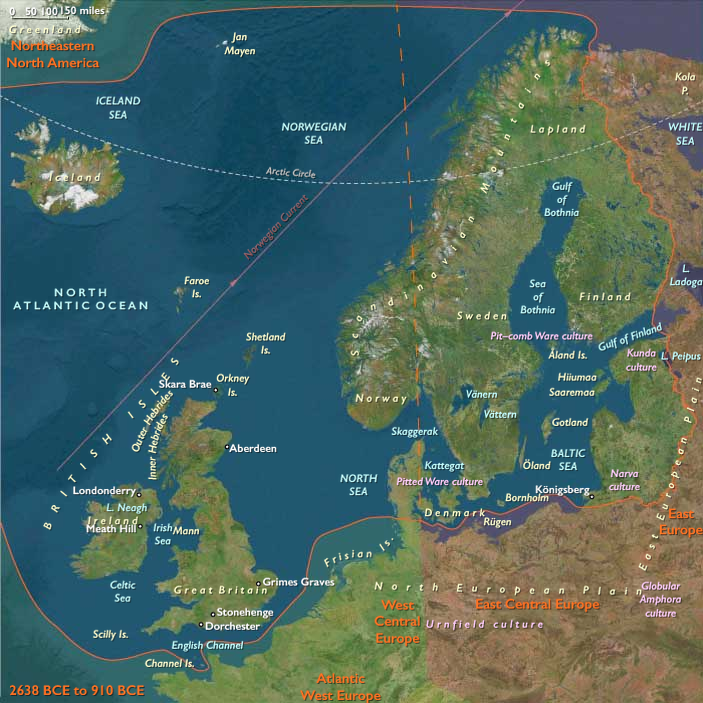
North Europe
View →Subregions