North Polynesia (1828–1971 CE): Colonial Transformation, American…
1828 CE to 1971 CE
North Polynesia (1828–1971 CE): Colonial Transformation, American Incorporation, and Indigenous Continuity
Geographic Parameters
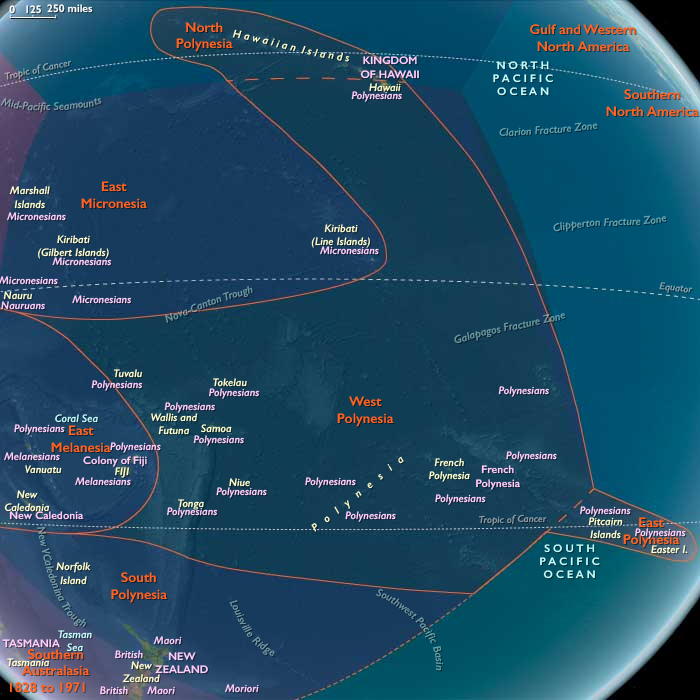
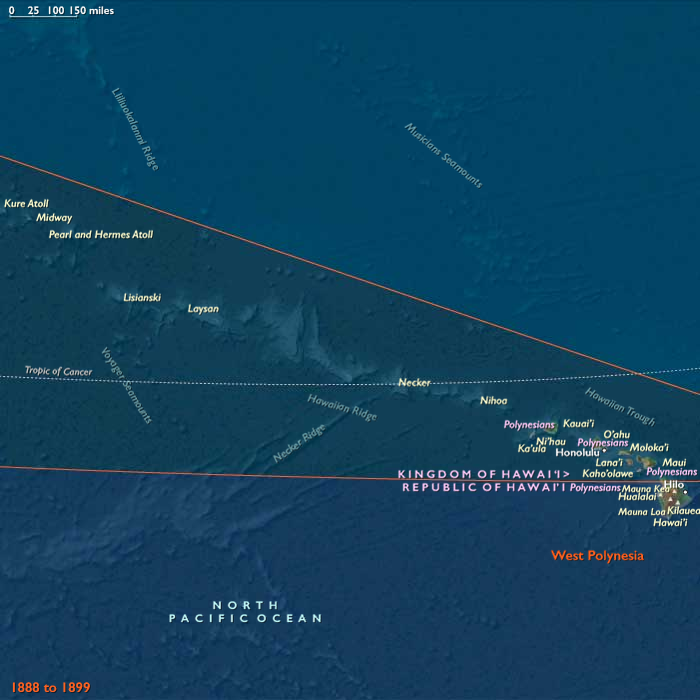
North Polynesia comprised Kauaʻi, Niʻihau, Oʻahu, Molokaʻi, Lānaʻi, Kahoʻolawe, Maui, and the Northwestern Hawaiian Islands extending through Nihoa, Mokumanamana, French Frigate Shoals, Laysan, Lisianski, Pearl and Hermes Atoll, Midway, and Kure. Hawaiʻi Island remained part of the adjoining West Polynesian subregion while participating fully in the political and economic history of the Hawaiian Kingdom and its successors.
The principal islands retained their enduring environmental contrasts. Windward volcanic mountains continued to sustain perennial streams and irrigated valleys, while leeward plains supported dryland agriculture, ranching, and later commercial plantations. Coral reefs, fishponds, beaches, estuaries, and sheltered harbors remained fundamental elements of island life despite increasing urban and industrial development.
Environmental Continuity
The environmental framework of North Polynesia remained recognizable throughout this period despite profound political and economic transformation. Native forests continued to occupy much of the mountain watersheds, supplying freshwater to valleys and coastal plains. Irrigated taro districts survived in favorable valleys, while reefs, wetlands, and fisheries continued to support both subsistence and commercial activity.
Commercial agriculture, urban expansion, military construction, and tourism altered selected districts, particularly on Oʻahu and parts of Maui and Kauaʻi. Nevertheless, these developments remained geographically concentrated. Much of the archipelago continued to consist of forests, agricultural valleys, grazing lands, rugged volcanic terrain, coral reefs, and sparsely settled coastlines.
Even at the end of the age, ecology remained visually dominant over modern infrastructure across most of the islands.
Transformation of Productive Landscapes
The defining historical development of this age was the layering of colonial and industrial systems onto long-established Hawaiian landscapes rather than their complete replacement.
Traditional loʻi kalo continued to operate in many valleys, although their extent declined where irrigation water was diverted to commercial agriculture or expanding towns. Fishponds likewise survived unevenly. Some remained productive under Hawaiian families or local communities, while others were abandoned, filled, or incorporated into new patterns of land use.
Beginning in the nineteenth century, sugar plantations expanded across suitable lowlands and leeward plains. Large irrigation works, mills, railways, roads, and processing facilities reorganized portions of Oʻahu, Maui, and Kauaʻi. Pineapple cultivation later became another important commercial crop.
Despite these changes, plantation agriculture never occupied the entire archipelago. Indigenous food production, ranching, fishing, orchards, household gardens, and uncultivated landscapes continued alongside export agriculture throughout the period.
Settlement and Urban Development
Settlement patterns diversified considerably. Rural Hawaiian communities remained centered upon valleys, coastal villages, fishing grounds, and agricultural districts, while plantation camps introduced new settlements occupied by immigrant laborers from across the Pacific and Asia.
Honolulu expanded from the capital of the Hawaiian Kingdom into the principal commercial, administrative, military, and transportation center of the archipelago. Smaller towns such as Lahaina, Wailuku, Līhuʻe, and Kāneʻohe also grew through combinations of agriculture, shipping, and local administration.
Urban development remained highly concentrated. Outside a limited number of expanding towns, dispersed rural settlements, agricultural landscapes, forests, and coastlines continued to define most of North Polynesia.
Economic Organization
The economy shifted from chiefly redistribution toward commercial agriculture integrated into global markets.
Sugar became the dominant export during the nineteenth century, followed later by pineapple. Plantations required extensive irrigation systems, transportation infrastructure, mills, warehouses, and shipping facilities. Commercial ranching expanded in suitable districts, while Honolulu developed into the principal port linking Hawaiʻi with the wider Pacific economy.
Labor migration fundamentally reshaped society. Workers from China, Japan, Portugal, Okinawa, Korea, the Philippines, Puerto Rico, and elsewhere contributed new agricultural skills, religious traditions, foods, languages, and cultural practices that gradually became part of modern Hawaiian society.
Traditional subsistence never disappeared. Fishing, taro cultivation, household gardens, fruit orchards, and reciprocal exchange remained important components of daily life, particularly in rural communities.
Transportation and Maritime Networks
Interisland canoe travel gradually yielded to sailing vessels and later steamships, while roads, railways, automobiles, and eventually commercial aviation transformed communication among the islands.
Honolulu emerged as one of the Pacific's principal maritime crossroads. Harbor improvements supported international commerce, whaling during the nineteenth century, naval operations, and eventually global tourism.
Although modern transportation increasingly connected North Polynesia with the outside world, interisland movement continued to reinforce long-standing relationships among Hawaiian communities.
The Northwestern Hawaiian Islands acquired new scientific, communications, and military significance during this period while remaining permanently uninhabited except for temporary personnel.
Institutions and Cultural Life
The nineteenth century witnessed major institutional transformation. The Hawaiian Kingdom developed constitutional government, legal codes, schools, and diplomatic relations while attempting to preserve Hawaiian sovereignty within an increasingly imperial Pacific.
Following the overthrow of the monarchy in 1893, annexation by the United States in 1898, territorial government, and eventual statehood in 1959, American political institutions became increasingly influential throughout the islands.
Christian churches, public schools, newspapers, courts, and modern government expanded across the archipelago. At the same time, Hawaiian language, genealogy, chant (oli), hula, navigation traditions, place knowledge, fishing customs, and family land relationships continued within many communities despite periods of official suppression or neglect.
The emergence of a multicultural island society enriched rather than erased Hawaiian cultural foundations.
Political Transformation
The principal political development of this age was the replacement of Indigenous sovereignty by colonial and later American administration.
The independent Hawaiian Kingdom entered the nineteenth century as an internationally recognized constitutional monarchy. Commercial pressures, foreign land ownership, and strategic interests increasingly weakened royal authority. The overthrow of Queen Liliʻuokalani in 1893 ended Hawaiian self-government, followed by annexation to the United States and administration as the Territory of Hawaiʻi.
Following the Second World War, Hawaiʻi entered the Union as the fiftieth state in 1959.
Political authority therefore shifted dramatically during this age, yet Indigenous identity and aspirations remained continuous despite changing governmental structures.
Military and Strategic Landscapes
Military development became increasingly important after annexation but remained geographically concentrated.
Pearl Harbor evolved into one of the world's largest naval installations, while airfields, barracks, ports, shipyards, coastal defenses, and communications facilities expanded primarily on Oʻahu. Midway became an important cable station and later a strategic naval and aviation base.
The Japanese attack on Pearl Harbor in 1941 and the Battle of Midway in 1942 transformed North Polynesia into a major theater of the Pacific War. During and after the war, military infrastructure expanded substantially but remained concentrated within specific districts rather than dominating the entire archipelago.
Most Hawaiian landscapes continued to function primarily as agricultural, residential, forested, or coastal environments.
Adaptation and Resilience
North Polynesian society demonstrated remarkable resilience during an era of unprecedented change. Indigenous communities adapted to commercial agriculture, immigration, urbanization, missionary activity, military expansion, and tourism while preserving many traditional relationships with land and sea.
Remaining loʻi, fishponds, coastal fisheries, family lands, and customary ecological knowledge continued to provide cultural continuity. New immigrant communities likewise adapted their own agricultural, culinary, religious, and artistic traditions to Hawaiian environments, producing one of the Pacific's most diverse societies.
During the twentieth century, renewed interest in Hawaiian language, hula, navigation, traditional agriculture, and Indigenous political identity signaled the beginning of a broader cultural renaissance that would become increasingly influential after 1971.
Legacy of the Age
Between 1828 and 1971 CE, North Polynesia underwent its greatest historical transformation. Independent Hawaiian governance gave way to plantation capitalism, colonial administration, American territorial government, global warfare, and eventual statehood. Commercial agriculture, immigration, military infrastructure, and tourism reshaped selected districts while integrating the archipelago into worldwide economic and political networks.
Yet these new systems never completely displaced the older Hawaiian landscape. Irrigated valleys, fishponds, reefs, forests, rural communities, and Indigenous cultural traditions persisted beneath successive layers of colonial and industrial development. Modern infrastructure remained concentrated within particular corridors, while the broader archipelago retained its ecological identity.
By 1971, North Polynesia had become a globally connected American state, but it also remained an enduring Hawaiian homeland whose Indigenous environmental knowledge, cultural traditions, and historical memory continued to shape its future.