Northeast Asia (1396–1539 CE): Ainu Maritime Networks,…
1396 CE to 1539 CE
Northeast Asia (1396–1539 CE): Ainu Maritime Networks, Amur Frontier Exchange, and the Northern Forest World
Geographic Parameters
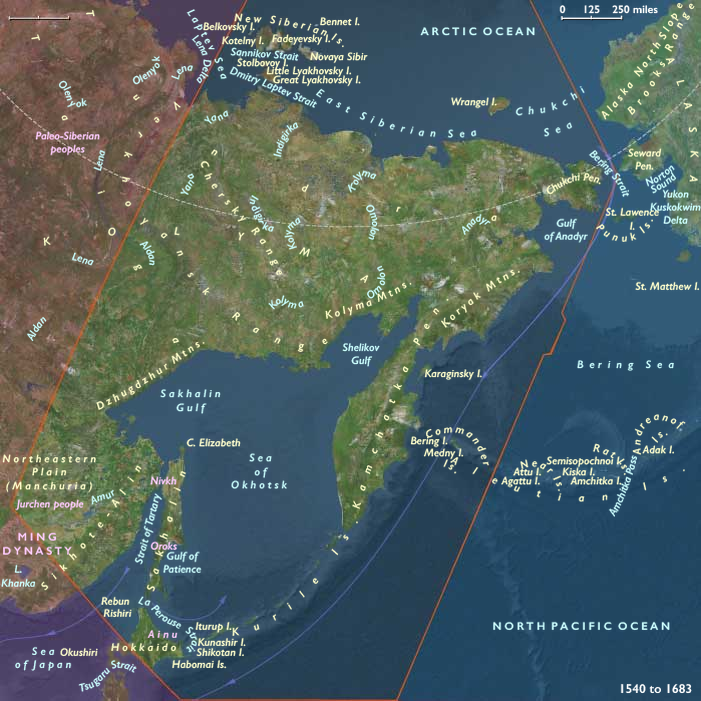
Northeast Asia encompasses eastern Siberia east of the Lena River basin to the Pacific Ocean, the Russian Far East north of southern Primorye, the Amur and lower Ussuri river systems, Sakhalin, Kamchatka, the Chukchi Peninsula, Wrangel Island, the Sea of Okhotsk littoral, the Kuril Islands, and Hokkaidō north of its southwestern peninsula. Across this immense northern landscape, taiga forests, Arctic tundra, volcanic mountain ranges, broad river valleys, and seasonally frozen seas continued to shape every aspect of human life. Rivers and coastal waters remained the principal corridors of communication and exchange.
Climate and Environmental Conditions
The transition into the early Little Ice Age brought gradually cooler conditions across much of the subregion. Longer winters, somewhat shorter growing seasons, and more persistent seasonal sea ice affected transportation and local productivity without fundamentally altering established ecological systems.
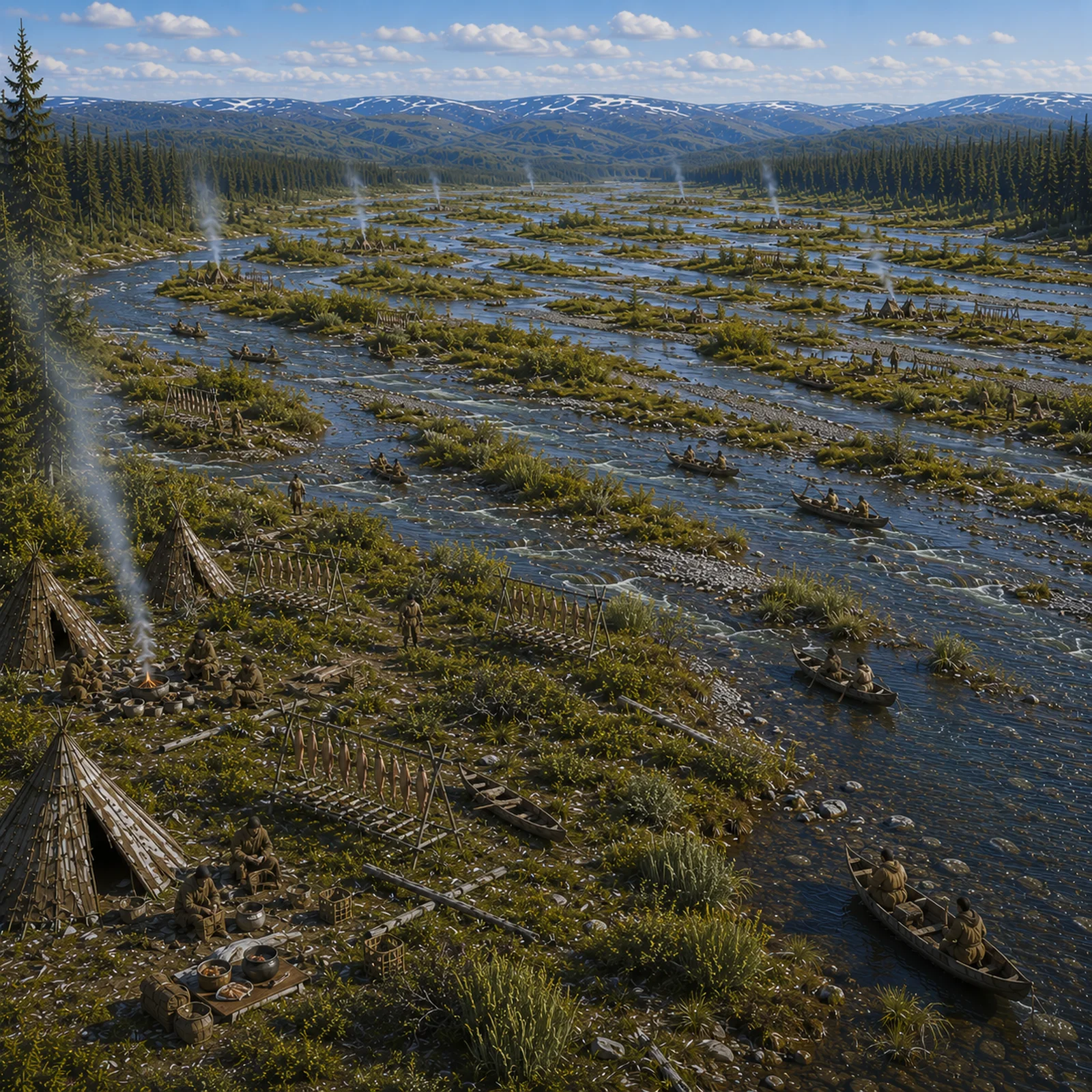
Salmon remained the dominant seasonal resource throughout the Amur basin, Sakhalin, Kamchatka, and Hokkaidō. Boreal forests continued to sustain abundant fur-bearing animals, while Arctic and Pacific coasts supported rich populations of seals, whales, walrus, seabirds, and marine fish. Communities adjusted to environmental variability through flexible seasonal movement rather than permanent changes in settlement.
Human Adaptation
Riverine, maritime, forest, and tundra societies continued to refine highly specialized ecological adaptations.
Along the Amur and lower Ussuri, the ancestors of later Nivkh, Ulch, Nanai, Udege, and related peoples maintained substantial fishing villages supported by salmon harvesting, hunting, trapping, gathering, and modest cultivation. Seasonal labor centered upon preserving fish for winter while exploiting surrounding forests and wetlands.
Evenki, Even, Yukaghir, and neighboring interior peoples maintained mobile annual rounds that combined hunting, trapping, fishing, and transport reindeer across the taiga. Seasonal camps shifted in response to animal migrations, weather, and river conditions.
Koryak, Itelmen, Chukchi, and Siberian Yupik communities continued to balance salmon fisheries, marine hunting, terrestrial game, and reindeer economies across Kamchatka and the northeastern coast.
On Hokkaidō, Ainu society became increasingly cohesive. Communities occupying major salmon rivers and productive coastlines strengthened regional exchange, ceremonial traditions, and territorial identities while preserving decentralized political organization rooted in kinship and reciprocal obligation.
Economic Organization
The principal historical development of the age was the steady expansion of commercial exchange between indigenous societies and neighboring states rather than the establishment of new imperial administration.
Trade along the Amur continued under the early Ming Dynasty, primarily through frontier markets and tributary relationships that exchanged furs, falcons, ginseng, fish products, and forest resources for iron, textiles, ceramics, and other manufactured goods. Imperial influence remained concentrated near the southern margins of the subregion, leaving most northern communities politically autonomous.
Across Hokkaidō, exchange with Wajin merchants became increasingly regular. Ainu communities exported dried salmon, herring, sea mammal products, eagle feathers, hawks, hides, and furs while importing iron tools, lacquerware, woven textiles, rice, sake, and metal vessels. Coastal exchange settlements assumed growing regional importance, although they remained integrated within indigenous social systems rather than becoming colonial enclaves.
Throughout the wider region, salmon, marine resources, trapping, and forest products continued to outweigh agriculture as the foundation of economic life.
Technology and Material Culture
Established northern technologies continued to evolve incrementally. Fish weirs, basket traps, nets, smokehouses, drying platforms, oil-rendering facilities, and elevated storage structures became increasingly refined through long experience.
Birch-bark canoes, plank boats, skin-covered vessels, skis, snowshoes, dog sleds, and reindeer transport remained the essential technologies of movement. Imported iron became more widely available through expanding trade, allowing improved woodworking tools, knives, spearheads, fishhooks, and household equipment while leaving indigenous technological traditions fundamentally intact.
Ainu wood carving, woven textiles, ceremonial implements, and decorated household objects reached increasingly sophisticated artistic forms during this period.
Movement and Interaction Corridors
The Amur River remained the dominant continental transportation corridor, linking interior forests, river settlements, and southern frontier markets.
The Sea of Okhotsk connected Sakhalin, Kamchatka, and the lower Amur through seasonal navigation, while winter ice continued to provide temporary overland routes between coastal communities.
The Kuril Islands and northern Hokkaidō formed an increasingly active maritime network supporting fishing, trade, and communication. Crossings of the Tsugaru Strait became more frequent as commercial relations between Ainu communities and northern Honshū expanded.
Despite growing exchange, the overwhelming majority of movement continued to follow ecological rather than political geography.
Institutions and Political Authority
Local governance remained rooted in extended families, clan relationships, respected elders, ritual specialists, and leaders capable of organizing communal labor and exchange.
The Ming government maintained frontier diplomacy and tributary relations along portions of the Amur but exercised only limited direct administration beyond its southern frontier.
On Hokkaidō, influential trading households acquired greater prominence as intermediaries between Ainu communities and Wajin merchants, yet authority continued to depend primarily upon consensus, kinship, generosity, and ceremonial leadership rather than centralized political institutions.
Across the broader subregion, indigenous institutions remained considerably stronger than external governmental structures.
Belief and Cultural Life
Animistic and shamanic traditions continued to organize relationships between people and the northern environment.
Salmon, bears, whales, seals, rivers, forests, mountains, and weather remained understood as spiritually powerful beings requiring reciprocal respect through seasonal ceremonies and offerings.
Among the Ainu, rituals honoring kamuy, including the increasingly elaborate bear-sending ceremony (iomante), assumed growing cultural importance. Amur societies maintained ceremonies celebrating salmon runs and river spirits, while northern coastal peoples preserved ceremonial traditions associated with marine mammals and successful sea hunting.
Imported religious influences remained limited and generally complemented rather than displaced established northern cosmologies.
Adaptation and Resilience
Communities continued to demonstrate remarkable resilience through diversified subsistence and flexible seasonal scheduling. Fishing, hunting, trapping, gathering, limited cultivation, and reindeer transport remained mutually supportive rather than specialized pursuits.
Food preservation, seasonal migration, cooperative labor, and extensive kinship networks buffered climatic fluctuations and periodic shortages. Expanding trade increased access to iron and manufactured goods without creating dependence upon external political authority.
Even under cooler climatic conditions, the ecological foundations of northern society remained stable and productive.
Legacy of the Age
Between 1396 and 1539 CE, Northeast Asia experienced expanding commercial interaction while preserving the ecological balance that had long defined the region. Ming frontier exchange strengthened connections along the southern Amur, and maritime commerce between Ainu communities and Wajin merchants became increasingly regular across the Tsugaru Strait. Yet neither development fundamentally altered the organization of northern life.
Salmon rivers, boreal forests, Arctic coasts, and seasonal mobility continued to govern settlement, economy, and belief more powerfully than distant states. By 1539, Northeast Asia remained an indigenous river-and-sea world whose expanding commercial relationships foreshadowed the much more direct imperial competition that would begin during the following age.
Images
Northeast Asia in the Late Medieval (Upper) age
Groups
Commodities
Regions
Northeastern Eurasia
View →Subregions