Northeast Asia (1540–1683 CE): Russian Expansion, Amur…
1540 CE to 1683 CE
Northeast Asia (1540–1683 CE): Russian Expansion, Amur Frontiers, and the Northern Pacific
Geographic Parameters
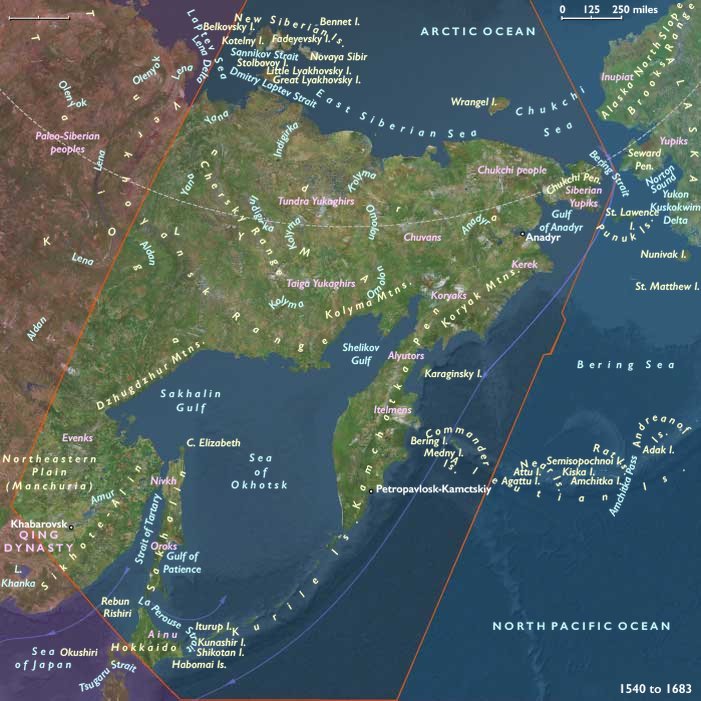
Northeast Asia encompasses eastern Siberia east of the Lena River basin to the Pacific Ocean, the Russian Far East north of southern Primorye, the Amur and lower Ussuri river systems, Sakhalin, Kamchatka, the Chukchi Peninsula, Wrangel Island, the Sea of Okhotsk littoral, the Kuril Islands, and Hokkaidō north of its southwestern peninsula. Taiga forests, Arctic tundra, volcanic mountain chains, broad river valleys, and seasonally frozen seas continued to dominate the physical landscape. Rivers remained the principal transportation corridors, while the Sea of Okhotsk and northern Pacific coast linked scattered maritime communities.
Climate and Environmental Conditions
The Little Ice Age brought generally cooler temperatures, longer winters, and more persistent seasonal sea ice across much of the region. Although these conditions shortened growing seasons in southern districts, they also strengthened winter travel over frozen rivers and coastal waters. Salmon continued to dominate the river systems of the Amur, Kamchatka, and Hokkaidō, while boreal forests, marine ecosystems, and tundra remained exceptionally productive for hunting, trapping, and fishing.
Human Adaptation
Throughout the subregion, indigenous communities continued to organize their lives around complementary seasonal resource systems.
Along the Amur basin, the ancestors of later Nanai, Nivkh, Ulch, Udege, and related peoples maintained substantial fishing villages supported by salmon harvesting, sturgeon fisheries, hunting, trapping, forest gathering, and limited cultivation. Seasonal preservation of fish remained the foundation of food security.
Evenki, Even, Yukaghir, and neighboring peoples continued highly mobile annual cycles of hunting, trapping, fishing, and reindeer transport across the interior taiga.
Koryak, Itelmen, Chukchi, and Siberian Yupik communities maintained maritime economies centered upon whales, walrus, seals, salmon, and terrestrial game, adapting flexibly to changing sea-ice conditions.
Across Hokkaidō, Ainu communities continued to strengthen regional exchange networks while maintaining riverine and coastal settlements centered upon salmon, deer, bears, marine resources, and modest horticulture.
Economic Organization
The principal historical development of the age was the arrival of sustained Russian expansion into northeastern Siberia, introducing a new continental system of exploration, tribute, and commerce.
Beginning in the late sixteenth century and accelerating throughout the seventeenth, Russian expeditions crossed Siberia along its great river systems, establishing wintering stations, fortified settlements, and trading posts. Fur tribute (yasak) became the principal mechanism through which many interior communities entered Russian commercial networks. Sable, fox, ermine, and other valuable pelts flowed westward in exchange for iron goods, firearms, metal tools, textiles, beads, and manufactured products.
Along the Amur frontier, Ming authority gave way during the seventeenth century to the expanding Qing Dynasty, while indigenous communities continued to mediate trade between forest, river, and frontier markets.
Across Hokkaidō, commerce with Wajin merchants expanded steadily. Ainu exports of dried salmon, herring, kelp, marine products, eagle feathers, hawks, hides, and furs increased, while imported iron, lacquerware, textiles, rice, sake, and metal vessels became increasingly familiar within coastal communities.
Despite these expanding commercial systems, fisheries, hunting, trapping, and seasonal harvesting remained the dominant productive foundation throughout most of the subregion.
Technology and Material Culture
Traditional northern technologies remained highly effective and widely employed. Fish weirs, nets, basket traps, smokehouses, drying racks, oil-rendering facilities, elevated granaries, birch-bark canoes, plank boats, skin-covered vessels, skis, snowshoes, sledges, and reindeer transport continued to support everyday life.
Imported iron became increasingly common through both Russian and Japanese trade, improving woodworking tools, knives, axes, fishhooks, spearheads, cooking vessels, and household equipment. Firearms appeared in portions of the interior and along major exchange routes but supplemented rather than displaced established hunting technologies.
Wood carving, woven textiles, carved ritual objects, decorated clothing, and bone and antler craftsmanship remained important expressions of regional identity.
Movement and Interaction Corridors
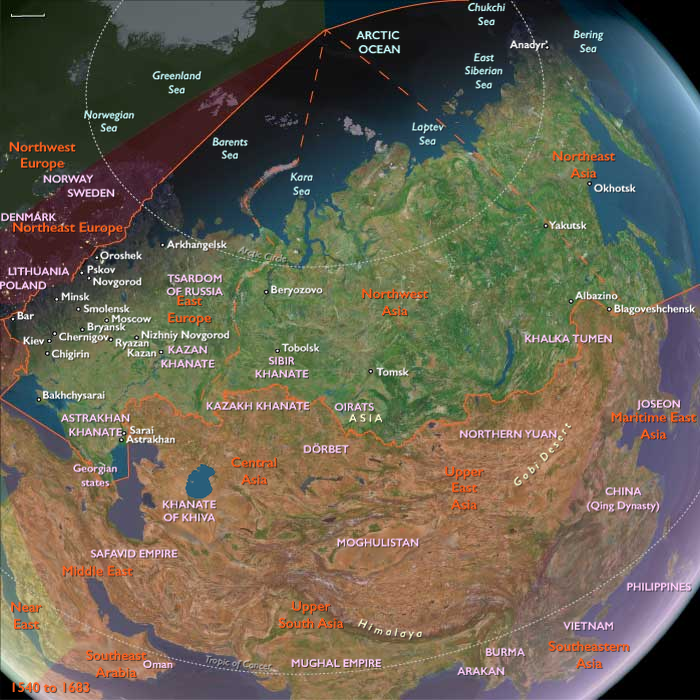
The great Siberian river systems became increasingly important not only for indigenous movement but also for Russian exploration and expansion eastward toward the Pacific.
The Amur River continued to unite interior forests with southern frontier markets, while the Sea of Okhotsk connected Sakhalin, Kamchatka, and coastal settlements through seasonal navigation.
The Kuril chain and northern Hokkaidō supported growing maritime exchange among Ainu communities and with northern Honshū. Winter ice continued to create temporary transportation routes linking otherwise isolated settlements across bays, estuaries, and frozen rivers.
By the late seventeenth century, Northeast Asia had become connected simultaneously to East Asian commercial systems and the expanding Russian world.
Institutions and Political Authority
Indigenous governance remained rooted in kinship, respected elders, ritual specialists, and local leaders responsible for organizing seasonal labor and maintaining access to fisheries, hunting territories, and exchange relationships.
The principal institutional transformation came through expanding Russian administration across Siberia. Forts, tribute collection, diplomatic missions, and Orthodox missionaries gradually appeared along the major river corridors, although direct governmental control remained highly uneven across this immense territory.
Along the Amur, Qing authority increasingly replaced Ming institutions, culminating in frontier negotiations with Russia that led to the Treaty of Nerchinsk (1689), immediately following the close of this age. Hokkaidō likewise experienced increasing influence from the Matsumae domain through expanding commercial regulation, although indigenous communities retained substantial internal autonomy.
Belief and Cultural Life
Animistic and shamanic traditions continued to provide the principal religious framework throughout the region. Rivers, forests, salmon, bears, whales, mountains, and weather remained active spiritual participants in daily life.
Ainu iomante ceremonies, Amur salmon rituals, northern whale observances, and reindeer ceremonies reinforced reciprocal relationships between communities and the natural world. Russian Orthodox Christianity appeared in scattered frontier settlements, while Buddhist and Confucian influences remained largely confined to southern administrative centers.
For most indigenous societies, traditional cosmologies remained the dominant cultural framework.
Adaptation and Resilience
Communities continued to rely upon diversified seasonal economies that balanced fisheries, hunting, trapping, gathering, limited cultivation, and reindeer transport. Extensive food preservation, flexible mobility, and strong kinship networks continued to buffer climatic variability and changing political conditions.
Rather than replacing indigenous systems, expanding Russian, Qing, and Japanese commercial networks were largely incorporated into existing ecological strategies. Northern societies selectively adopted imported technologies while preserving the environmental knowledge that had sustained them for centuries.
Legacy of the Age
Between 1540 and 1683, Northeast Asia entered a fundamentally new historical phase as Russian expansion reached the Pacific and established the first durable western imperial presence in the region. Simultaneously, Qing authority emerged along the southern Amur frontier, while Matsumae commercial influence deepened around Hokkaidō. These developments introduced new systems of tribute, diplomacy, and long-distance commerce that increasingly connected Northeast Asia to the wider Eurasian world.
Yet the region remained overwhelmingly defined by its enduring ecological structure. Salmon rivers, taiga forests, Arctic tundra, volcanic coasts, and seasonally frozen seas continued to shape settlement, economy, and culture more profoundly than expanding imperial frontiers. By 1683, Northeast Asia stood at the threshold of an age in which empires would increasingly compete for control of its resources and strategic corridors, while indigenous societies continued to anchor the northern landscape through resilient ecological adaptation.
Images

Northeast Asia in the Early Modern age
Groups
Commodities
Subjects
Regions
Northeastern Eurasia
View →Subregions